
26th Sunday: Self-giving, self-emptying love
Let the same mind be in you that was in Christ Jesus (Phil 6:14).
Two Sundays ago, when we celebrated the Feast of the Exaltation of the Holy Cross, you may remember that our second reading was essentially the same text we have just heard from St. Paul’s Epistle to the Philippians. We return to it for our consideration and prayer today so that we might further deepen our understanding of the mind and Heart of Christ; revealed as they are in this canticle that summarizes for us the Mystery of the Cross, the Mystery of Faith: “Christ Jesus … emptied himself. … He humbled himself and became obedient to the point of death—death on a cross” (Phil 2:6-11).
The hymn successfully evokes all the phases of our Lord’s existence, from His pre-existence as the eternal Word of God, to His Incarnation, Passion and, lastly, His glorification and exaltation as Lord. When we gaze upon the Crucified Lord we see before us the most concise and comprehensive statement about the Word made flesh. Jesus emptied himself. The term that is given to this self-emptying is kenosis, a Greek word that expresses the self-abasement of the eternal Word of God in the Redemptive Incarnation. In the kenosis, our Lord’s glory as the eternal Son of the Father is withheld, hidden. In the Holy Sacrifice of the Mass this kenosis is re-presented for us sacramentally, and both His divinity and humanity are both hidden; veiled in the sacramental signs of bread and wine. We who receive the Holy Eucharist are taken up in this oblation, this self-emptying; and this dynamic becomes the animating principle of our life in Christ. We too empty ourselves in imitation of our Saviour; and so we give ourselves in love in a variety of ways, mindful that self-giving, sacrificial love is the means to our fulfillment for we are created in the image and likeness of God whose Trinitarian life is self-surrender and love. In becoming Man and in dying for our salvation, Jesus our Lord reveals to us the true nature of God who wills to share His life with us. The Mass is the means by which this transformative union with God is most effectively brought about. Our self-offering in union with the offering of our Lord is the fullest expression of our participation in the Holy Sacrifice of the Mass.
In the Proverbs of Solomon is written: “If you sit down to eat at the table of a ruler, observe carefully what is set before you; then stretch out your hand, knowing that you must provide the same kind of meal yourself” (Prov 23:1). St. Augustine asks: “What is this ruler’s table if not the one at which we receive the Body and Blood of Him who laid down His life for us? What does it mean to sit at this table if not to approach it with humility? What does it mean to observe carefully what is set before you if not to meditate devoutly on so great a gift? What does it mean to stretch out one’s hand, knowing that one must provide the same kind of meal oneself, if not what I have just said: as Christ laid down his life for us, so we in our turn ought to lay down our lives for our brothers?” (from a treatise on John by St. Augustine; The Liturgy of the Hours, Vol. II, p.449-450). A life centred on the Eucharistic Sacrifice of Christ our Lord is a participation in this Mystery of God’s self-giving and self-emptying love. When we approach this Mystery with humility and devotion, with longing and generosity, our lives become Eucharistic and we reflect the goodness of God. Devotion to the Blessed Sacrament is essential to Christian life. The Saints whom we venerate and imitate were men and women who made this Eucharistic love of God real and tangible through their participation in our Lord’s kenotic Mystery.
This past week we celebrated the memorial (September 23) of St. Pio of Pietralcina or Padre Pio as he is more commonly known. Padre Pio bore the stigmata or wounds of Christ for over fifty years. These wounds never became infected but they bled. They conformed this priest to the Passion of our Lord in a manner that was altogether unique, mystical. Yet in every other way Padre Pio was conformed to the Mystery of our Lord’s Sacrifice as you and I are. In this sense, his life was very ordinary; so much so, that when he died in 1968, Pope Paul VI said of him: “Look at what fame he had, what a worldwide following gathered around him! But why? Perhaps because he was a philosopher? Because he was wise? Because he had resources at his disposal? It was because he said Mass humbly, heard confessions from dawn to dusk and was—it is not easy to say it—one who bore the wounds of our Lord. He was a man of prayer and of suffering.” This priest was at once both absolutely extraordinary and very ordinary in the fulfillment of his duties. Why was he raised up by God in our times? Was it perhaps because the years that have followed his death have been so confusing and difficult for the Church? Is it possible that our Lord gave him to us so that we might have a guide, a model of what it means to live the Mystery of Christ? The truth is that each and every one us is like Padre Pio both in his exceptionalism and his ordinariness. “Each one of us is the result of a thought of God. Each of us is willed, each of us is loved, each of us is necessary” (Pope benedict XVI). Herein lays our uniqueness. And each one of us is called to make our own the words of the Apostle as they specifically refer to us: “I have been crucified with Christ; it is no longer I who live, but Christ who lives in me; and the life I now live in the flesh I live by faith in the Son of God, who loved me and gave himself for me” (Gal 2:20). Padre Pio was given to us as prophet for an age that has become destructively addicted to pleasure and pain killers. The year of his death, 1968, is considered by many to have been a revolutionary year, a time of almost universal social upheaval. Indeed, in two generations our culture has modified itself in radically unexpected ways. Could it be that Padre Pio was a gift from God for our times and a witness to the enduring value and purpose of a life of sacrifice and devotion? The truth of Christ remains the same. “Jesus Christ is the same yesterday and today and forever” (Heb 13:8).
The Church has suffered much confusion in the years following Padre Pio’s death. In 1972, on the Feast of Sts. Peter and Paul, Pope Paul VI delivered a sermon that startled the world. Describing the chaos then consuming the Church, he said, “From some fissure the smoke of Satan has entered the temple of God.” A close collaborator of the pope, his Master of Ceremonies has said that the Holy Father spoke of the smoke of Satan because he maintained that those priests who turned Holy Mass into dry straw in the name of creativity, in reality were possessed of the vainglory and the pride of the Evil One. So, the smoke of Satan was nothing other than the mentality which wanted to distort the traditional and liturgical canons of the Eucharistic ceremony. Padre Pio however, said Mass humbly. This is why the faithful flocked to assist at his Masses. This is how we must also both celebrate and assist at Holy Mass; with humility, with love and devotion. The stigmata that he bore were an outward sign of the love with which our Lord has loved us. Padre Pio responded to Love Crucified with a crucified love, literally. His devotion and the love that he inspired enabled him to establish a hospital known as the House for the Relief of Suffering. This is the kenosis of Christ our Saviour at work in the life of His disciples; self-emptying that results in fruitful self-giving. Our self-emptying in our own, specific state in life is the means by which we unite our life to the redeeming Life of our Lord, and the means by which we are fulfilled. What we do here sacramentally enables and empowers us to relieve the sufferings of others. Let us foster in ourselves and in others a deep love of the Mass and the Most Blessed Sacrament for “the gift of love enables us to become in reality what we celebrate as mystery in the sacrifice” (Fulgentius of Ruspe, Liturgy of the Hours, Vol. IV, p. 379).

Saint Kateri , Canada’s Protectress
This was the title given to Saint Kateri Tekakwitha, by Pope Benedict XVI, when he canonized her on October 28th, 2012, along with six others, in Saint Peter’ Square (she had been beatified by Pope John Paul II back in 1980). With Saint Joseph as our protector, along with the Canadian martyrs, we seem to[…]Continue reading→

Remembering Father Alphonse de Valk
(Today marks the sixth anniversary of the death of Father Alphonse de Valk, C.S.B., a faithful, courageous and indefatigable Basilian priest, pro-life-and-family apostle, and the founder of Catholic Insight magazine. Here is what we wrote those on his entering into eternity five years ago, as we continue to remember him in our prayers and thoughts)[…]Continue reading→

My Name is Bernadette
April 16th is a propitious day, for besides the anniversary of Father de Valk’s death, who founded Catholic Insight in its print form decades ago, and the commemoration of the ‘two Benedicts’, mentioned in accompanying posts, today we also recall Saint Bernadette Soubirous, the young visionary to whom the Virgin Mary appeared numerous times at[…]Continue reading→

Canonizing Sister Faustina and Divine Mercy
HOMILY OF THE HOLY FATHER MASS IN ST PETER’S SQUARE FOR THE CANONIZATION OF SR MARY FAUSTINA KOWALSKA Sunday, 30 April 2000 1. “Confitemini Domino quoniam bonus, quoniam in saeculum misericordia eius”; “Give thanks to the Lord for he is good; his steadfast love endures for ever” (Ps 118: 1). So the Church sings on the Octave of[…]Continue reading→

Divine Mercy Sunday – An Echo of Every Mass
Reach out your hand and put it in my side. Do not doubt but believe’… ‘My Lord and my God!’ (Jn. 20:18)). Today is Divine Mercy Sunday, and as we celebrate the end of the Easter Octave, we contemplate the wounded side of our Saviour, the Church’s source of life. On Good Friday in the[…]Continue reading→

First Holy Communion: Sermon from May 16, 1943
Here is a sermon from the good old days by +Rev. Msgr. Vincent Nicholas Foy (August 14, 1915 – March 13, 2017), from 1943. Readers may recall that Pope Saint Pius X, by the decree Quam Singulari in 1910, lowered the customary age of reception of Holy Communion – after the rigours of the plague[…]Continue reading→

In the Glorious Light of Easter, Alleluia!
Set your minds on things that are above, not on things that are on earth, for you have died, and your life is hidden with Christ in God. When Christ who is your life is revealed, then you also will be revealed with him in glory (Col. 3:3-4). The Resurrection of Our Lord and Saviour[…]Continue reading→

An Ancient Homily for Holy Saturday
The time between Good Friday and Easter Sunday is one of waiting, in silence, as the world wonders – anticipates – what will happen, after the death of Christ. We re-live this time each year in the anamnesis of our liturgy, and in turn look forward to the glorious re-creation of all things at the[…]Continue reading→

Europe’s Long Descent
(As we meditate on this day on Christ’s burial, and His descent into hell, it is fitting to ponder here with contributor Peter Marcus how the world seems to be heading there as well. The difference is that, although God cannot ‘redeem’ hell, nor those therein, He can and did redeem the world. There is[…]Continue reading→
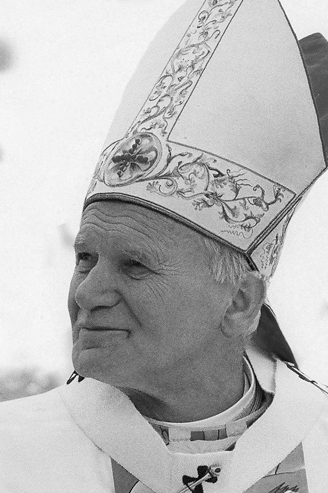
Pope Saint John Paul II’s First Good Friday Homily
ADDRESS OF HIS HOLINESS JOHN PAUL II AT THE CONCLUSION OF THE STATIONS OF THE CROSS AT THE COLOSSEUM Good Friday, 13 April 1979 When we make the Way of the Cross from one station to the next, in spirit we are always at the spot wherethis journey had its “historical” place: where it[…]Continue reading→