
On seeing Christ
From the beginning Our Blessed Lord has been found only by two classes; those who know and those who do not know— but never by those who think they know. – Archbishop Fulton J. Sheen
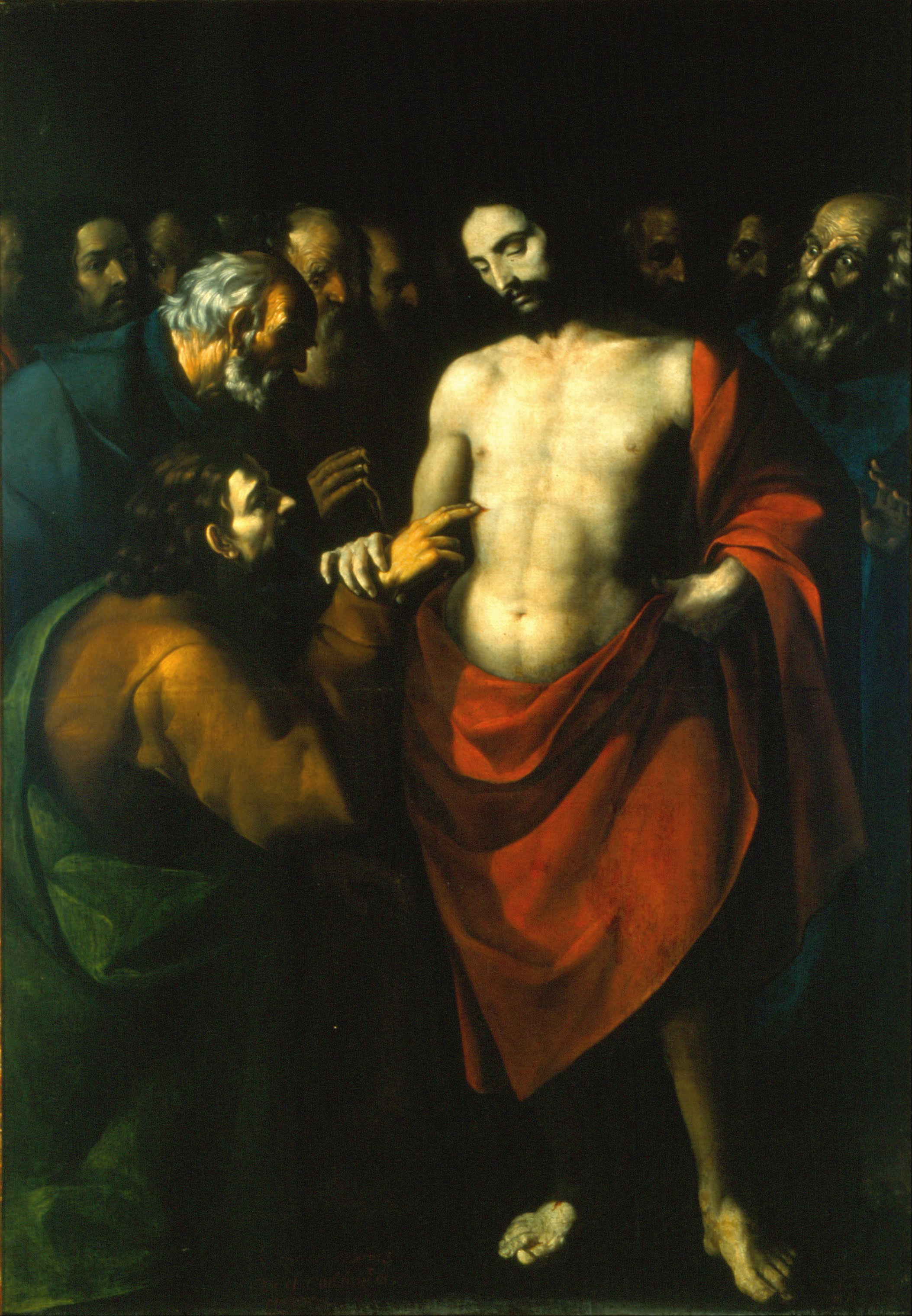
When Thomas was shown the wounds of Christ, he believed. He is popularly called Doubting Thomas because he refused to accept the first pope’s word that Christ had risen. Doubting what he was told, he insisted on being “shown the holes in his hands where the nails were driven, and the hole in his side where the lance had pierced.”
Of course, there were good reasons not to believe the first pope, a man who had denied Our Lord three times in public, going so far as to swear that he did not know who Jesus was. While not denying Peter’s authority, Thomas did doubt his credibility. Thomas insisted on seeing Christ’s body.
It is kind of hard on the memory of Thomas that he is singled out in this way, for when Mary Magdalene told the rest of the apostles that she had seen the risen Lord, they did not believe her. When Our Lord finally did appear to these eleven apostles, He chastised them for their unbelief (Mark 16:14). Thomas was just acting in the same careful, skeptical manner as the others were, including the pope himself. But neither Thomas nor the apostles were professional skeptics. They were just very cautious thinkers, careful men who needed to be shown evidence that Christ was alive.
This gospel account tells us about the nature of conversion. We might try and tell people about what we see, but often their conversion can only be brought about by Christ coming and revealing Himself to them. He does this in many ways, and everyone reading this can think about how this has happened in his or her own life. Christ’s body can be seen by any who will take the trouble to go to church and look up at the Elevation. We might not be able to put our fingers into the nail holes, but we certainly see Christ on the altar. Some people think that if only Christ was visible again in the flesh, people would convert. Not so. He tried that 2000 years ago and the response at the time was mixed, muted even, among some people. Many of the common people tended to accept Christ, but often the intellectuals and rulers of the time preferred to argue around the issue with questions such as “What is truth?” and “Is it not better that one should die for the people?” and “Tell me, are you a king?”
Such atheism comes from people being too clever by half, the kind of men who never have to face the real world. I personally think there is a link between men and women having calloused hands and their being Christians—the experience of reality leads to belief.
These professional skeptics are still with us. What do they have to offer us instead of our Faith? Nothing. They would rob us of our religion by their skepticism only to replace it with the prospect of a life wrecked by selfishness—the Selfish Gene. They still ask foolish questions such as “What is marriage?” and “Is it not better that a child’s innocence should die for the good of the school board?” and “Tell me, do you like our flag?”
The first Vatican Council defined as Catholic Doctrine that, unaided by grace, man can reason to the knowledge that God exists. Man can, but it appears that some men cannot. In fact, some modern philosophers cannot reason at all. I once built a house for a philosopher whose specialty was Hegel. I got a worried phone call: all his windows were broken or painted shut, and he could not open any of them. At his house, I showed him with as much gravitas as I could manage how to unhook the latch and open the windows.
That some glory boy media hounds cannot reason to God is their problem, not ours. Normal men and women can, even children can, and do quite successfully. In my opinion, that is why Christ came to Bethlehem and revealed Himself to the shepherds. It was partly to humble the wise, or rather those who often claim to be wise and who are actually very stupid.
But I do not need to fall back on reason alone, for I see Christ on the altar each time I go to Mass.
By Sebastián López de Arteaga (1610 – 1652) (Spanish) (Painter, Details of artist on Google Art Project) [Public domain or Public domain], via Wikimedia Commons.

Saint Kateri , Canada’s Protectress
This was the title given to Saint Kateri Tekakwitha, by Pope Benedict XVI, when he canonized her on October 28th, 2012, along with six others, in Saint Peter’ Square (she had been beatified by Pope John Paul II back in 1980). With Saint Joseph as our protector, along with the Canadian martyrs, we seem to[…]Continue reading→

Remembering Father Alphonse de Valk
(Today marks the sixth anniversary of the death of Father Alphonse de Valk, C.S.B., a faithful, courageous and indefatigable Basilian priest, pro-life-and-family apostle, and the founder of Catholic Insight magazine. Here is what we wrote those on his entering into eternity five years ago, as we continue to remember him in our prayers and thoughts)[…]Continue reading→

My Name is Bernadette
April 16th is a propitious day, for besides the anniversary of Father de Valk’s death, who founded Catholic Insight in its print form decades ago, and the commemoration of the ‘two Benedicts’, mentioned in accompanying posts, today we also recall Saint Bernadette Soubirous, the young visionary to whom the Virgin Mary appeared numerous times at[…]Continue reading→

Canonizing Sister Faustina and Divine Mercy
HOMILY OF THE HOLY FATHER MASS IN ST PETER’S SQUARE FOR THE CANONIZATION OF SR MARY FAUSTINA KOWALSKA Sunday, 30 April 2000 1. “Confitemini Domino quoniam bonus, quoniam in saeculum misericordia eius”; “Give thanks to the Lord for he is good; his steadfast love endures for ever” (Ps 118: 1). So the Church sings on the Octave of[…]Continue reading→

Divine Mercy Sunday – An Echo of Every Mass
Reach out your hand and put it in my side. Do not doubt but believe’… ‘My Lord and my God!’ (Jn. 20:18)). Today is Divine Mercy Sunday, and as we celebrate the end of the Easter Octave, we contemplate the wounded side of our Saviour, the Church’s source of life. On Good Friday in the[…]Continue reading→
First Holy Communion: Sermon from May 16, 1943
Here is a sermon from the good old days by +Rev. Msgr. Vincent Nicholas Foy (August 14, 1915 – March 13, 2017), from 1943. Readers may recall that Pope Saint Pius X, by the decree Quam Singulari in 1910, lowered the customary age of reception of Holy Communion – after the rigours of the plague[…]Continue reading→
In the Glorious Light of Easter, Alleluia!
Set your minds on things that are above, not on things that are on earth, for you have died, and your life is hidden with Christ in God. When Christ who is your life is revealed, then you also will be revealed with him in glory (Col. 3:3-4). The Resurrection of Our Lord and Saviour[…]Continue reading→
An Ancient Homily for Holy Saturday
The time between Good Friday and Easter Sunday is one of waiting, in silence, as the world wonders – anticipates – what will happen, after the death of Christ. We re-live this time each year in the anamnesis of our liturgy, and in turn look forward to the glorious re-creation of all things at the[…]Continue reading→
Europe’s Long Descent
(As we meditate on this day on Christ’s burial, and His descent into hell, it is fitting to ponder here with contributor Peter Marcus how the world seems to be heading there as well. The difference is that, although God cannot ‘redeem’ hell, nor those therein, He can and did redeem the world. There is[…]Continue reading→
Pope Saint John Paul II’s First Good Friday Homily
ADDRESS OF HIS HOLINESS JOHN PAUL II AT THE CONCLUSION OF THE STATIONS OF THE CROSS AT THE COLOSSEUM Good Friday, 13 April 1979 When we make the Way of the Cross from one station to the next, in spirit we are always at the spot wherethis journey had its “historical” place: where it[…]Continue reading→