
Women in combat
Have you noticed there are an alarming number of combative females on television? I am not talking about women who are angry at everything but rather women who play “tough-guy” characters. The men are the calm writers or the slackers who need protection—while the women get their butts kicked by the bad guys, run headfirst into burning buildings, and call their female supervisors “sir.” The trend has been growing since before Uma Thurman “Killed Bill,” but it is alarming to me that our society is normalizing (and glorifying) women in physically dangerous roles. I once asked my husband if it bothered him to watch a woman get walloped by a man, or to watch two women swinging punches at each other. He thought for a minute and said, “Yes, but I tell myself they’re fighting the bad guy and that makes me feel better about it.”
Not me. I wince. Every. Single. Time. There is something about watching a woman in a violent fist fight that grates against everything I hold as good, true, and beautiful. Something in it just is not right. But I am not exactly sure what that is.
There is hot debate that has been raging for some years now: whether or not women should be accepted into physically dangerous, violent careers like military combat forces—and it is increasingly being won by the “pro” side. In the name of equality women have been battling to be treated as men and our society is responding. And if we women are the same as men, then what excuse do we have but to actually start doing what men have always traditionally done? Now that we open doors for ourselves and have ceased ascribing to the “evil patriarchy” for our self-worth, we must take on careers like wrestling, boxing, firefighting, and hard-core military combat careers. Now that we are “equal” we are obligated to fight hard, just like men. Right?
I’m not so sure. First of all I think that the word “equality” in this sense is a misnomer. Fulton Sheen in his book Love, Marriage, and Children wrote the following:
The catchword became “equality,” which meant roughly: “Anything you can do I can do better.” Equality meant uniformity, or exactly the same amount of everything for everybody. It was forgotten that there are two kinds of equality: mathematical and proportional equality. For example, a mother does not give the same clothes, same food, same spending money to a son of two that she gives to a sixteen-year-old girl; but as a good mother, she gives proportional equality, according to age, needs, and physical and spiritual differences. … What women wanted was to do man’s work in man’s way, which is quite different from doing the same work as man in a woman’s way.
Men and women are equal in dignity and value as human persons—but about as different as a two-year-old son is from a sixteen-year-old daughter. We not only do not do the same jobs in exactly the same way, we should not. Why would we? Men have one set of gifts. Women have another. Although I am certain that some women enjoy bodybuilding and super strength training and could best a good number of opponents, man or woman, anytime they felt like it, I am not convinced that generally speaking women are the best candidates for hard-core, physically demanding careers—especially where the military is concerned.
A local radio station plays a commercial where the announcer states: “At —FM we believe that you are only limited by your imagination. And your time. And your ability. And your money.” He goes off to list a few more things by which we’re all limited and I laugh every time I hear it. We (both men and women) like to think that we are limitless in our abilities—that we can do anything we think of moment we think of it. It is even what we tell our kids, but I think the concept is stupid. Dreams are great. But if I am four-foot-one and clumsy I will find it extremely difficult to be a ballet dancer. Sure I could do everything in my power to achieve the goal of being a ballet dancer but it is very likely I will never be as good as those who are tall and graceful. Or if math just does not make sense to me no matter how hard I work at it, I might have to kiss my lifelong ambition of being a world-renown statistician goodbye. Even if I achieve an acceptable level of understanding, it is still very likely that I will not ever come close to obtaining the mathematical ability of those who find math a breeze. That’s life.
This is how I see women in combat positions. Our bodies and spirits were not made for that type of thing and no matter how much we would like to, we cannot force our genetic makeup to change. For one thing, men generally have more skeletal muscle mass than women, which typically makes them physically stronger. On a good day, could the strongest woman in any given group best the strongest man? Maybe. But highly doubtful. No matter how much weight and strength training they undergo, women cannot make themselves grow more muscle mass to equal that of the average man. In addition, many women experience extreme muscle weakness in the days leading up to menstruation—some say they lose up to half their physical strength. Women cannot force their bodies to be as consistently strong as men, which is decidedly not an asset when human lives are on the line.
But even beyond certain physical differences between men and women, combative careers require women to expunge from themselves that which many would consider their greatest asset: their emotions and relational sensibilities. Military women must cut ties with their children for months on end while deployed. And it is not hard to see why those in combat must keep all emotions in check. Horrible things are done and experienced in times of war—and men are able to compartmentalize the horrors a little bit better than women. Of course I am generalizing. I imagine there will be an exceptional person to disprove every rule, but generally speaking, this is true.
So what now? Should all women be pigeonholed into a small list of “feminine” occupations like they have been in the past: careers like nanny, tea-pourer, or dressmaker? I don’t think so. Just because I believe women are not suited towards mortal combat does not mean think they should sit in parlours and drink tea all day. Rather I think all women must identify their gifts and strengths, and give what they have got, not what they have not got. I may be atrocious at math, but perhaps I am talented in the courtroom. I may be four-foot-one and clumsy while dancing but I am a whiz with a knife in the kitchen. Most women are not suited to military combat and wrestling in the same way that most men are not suited to synchronized swimming or professional housecleaning. Does that make either any less of a person–because they have talents in one area over another? No. Emphatically no. Yet the current thought is that because women generally are not suited to combat, that they are somehow “less than,” “inferior,” or “weak.”
What a silly notion. But I understand why it is a pervading thought. In her book The Privilege of Being a Woman, Alice von Hildebrand said:
The hierarchy of values being upset [at the Fall], male accomplishments became overvalued. Physical strength became glorified and weakness was looked down upon as proof of inferiority. … Hand in hand with the overestimation of strength and virility goes an overestimation of accomplishments, feats, performances, success. In our society to be a “self-made man” calls for awe. A Bill Gates, an Oprah Winfrey, or even a Bill Clinton inspires people with a totally illegitimate feeling of admiration.
We have come to believe, since the Fall, that only certain gifts and talents are valued: strength, virility, prowess, being “self-made” or powerful—the noticeably shining “virtues” of our modern world. Those who cannot acquire those “virtues” or have different or opposite abilities are substandard, lesser human beings. What about humility, charity, loyalty, compassion, and obedience? These are real virtues that our world cannot stand. To the untrained eye, humility and grace look shabby and dull next to dazzling novelty and pride.
Yet choosing to do something that may be well beyond the limits of our physical, mental, or psychological strength, merely because we believe that doing so is the only way to be valued, is a suicide of sorts. We put to death an important part of our very selves (i.e. our femininity) in order to meet the requirements of “the job” and in the process utterly discount our value and worth as a woman—as ourselves. Perhaps this is why I find it so jarring to see women being physically violent on TV: I instinctively feel that they are setting aside something truly authentic for something counterfeit. Or perhaps it is simply because I know that the average women would not stand a chance in a fight against the average man. It is not a fair fight, no matter how much some would try to convince you otherwise.
So why does it matter that women are accepted as “tough guys,” able to best any man, woman, or child that walks through the door? I honestly don’t know because women, within themselves, ARE tough. They are fierce—just not in the way society thinks they should be, that is, in the way that men are fierce. While they may not break your neck with their bare hands, threaten their loved ones and you will wish you had never been born. Women are highly intuitive: they will be able to ascertain important facts about situations that many would not figure out in a million years. Most women have the ability to multi-task, doing eighteen things with one hand while pouring a glass of wine and sending five emails with the other. They have a deep wellspring of strength and a supernatural ability to sacrifice themselves that puts many a man to shame. And best of all, women are able to shelter, nourish, and grow new life within themselves: a gift that is a privilege and an honour to possess. All of this is not to brag, but to enlighten.
And just as the physical strength of every man (and every one of their other abilities) is needed in the world, the gifts of all women are also needed wherever there are people—whether it be a courtroom, the military, a household, or a kitchen. We might have been historically referred to as the weaker sex, but I think that also is a misnomer. Men and women are both weak and strong, in their own unique ways. So what if women are physically weaker than men. Maybe men are spiritually weaker than women. Why is that bad? Men and women need not only each other’s strengths but also each other’s weaknesses. Weaknesses help to spur us on to be better individuals—we realize we are not “there” yet. They can motivate us to support one another and help us to be humble and honest in admitting our needs. They keep us vulnerable (in a good way) and can increase intimacy between friends and lovers alike (if we allow them) as long as both parties understand the importance of both strengths and weaknesses, and treats the other accordingly.
In the end, what matters is not that I benched 200 pounds or was able to do seventy-five squats, but that I used my abilities to their fullest to help myself and others to gain heaven. Is there anything more fulfilling than doing just that: using your expertise to change lives, or allowing others to share their expertise with you? Like a doctor saving a life by clearing a windpipe or a violinist bringing her audience to tears, there is nothing better than doing what we are meant to do, when we are meant to do it. It is thrilling and satisfying, an adventure from beginning to end. St. Josemaria Escriva said:
To fulfill [her] mission, a woman has to develop her own personality and not let herself be carried away by a naive desire to imitate, which, as a rule, would tend to put her in an inferior position and leave her unique qualities unfulfilled. If she is a mature person, with a character and mind of her own, she will indeed accomplish the mission to which she feels called, whatever it may be. Her life and work will be really constructive, fruitful, and full of meaning, whether she spends the day dedicated to her husband and children or whether, having given up the idea of marriage for a noble reason, she has given herself fully to other tasks. Each woman in her own sphere of life, if she is faithful to her divine and human vocation can and, in fact, does achieve the fullness of her feminine personality. Let us remember that Mary, Mother of God and Mother of men, is not only a model but also a proof of the transcendental value of an apparently unimportant life.
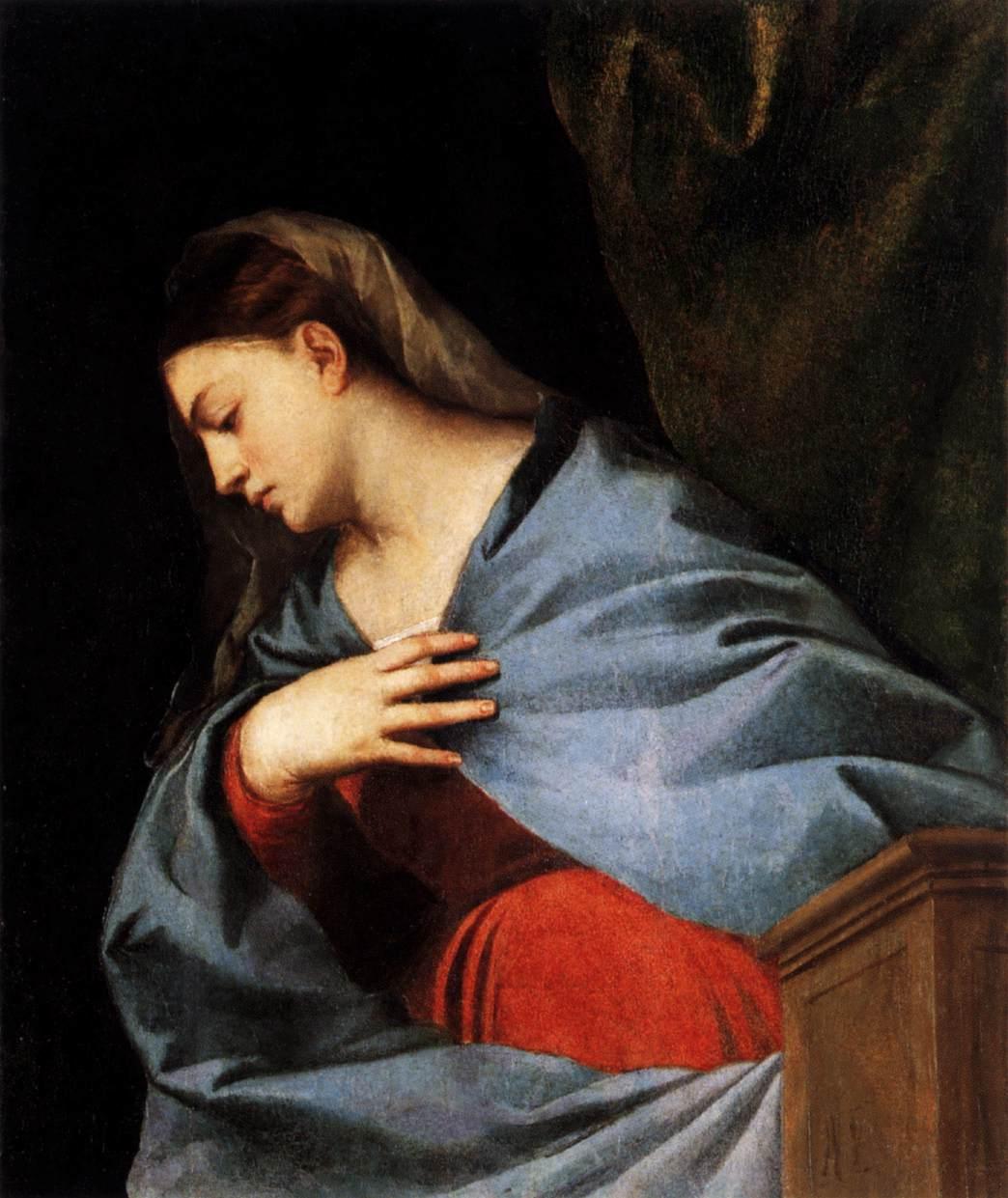
Photo credit: Titian [Public domain], via Wikimedia Commons

Saint Kateri , Canada’s Protectress
This was the title given to Saint Kateri Tekakwitha, by Pope Benedict XVI, when he canonized her on October 28th, 2012, along with six others, in Saint Peter’ Square (she had been beatified by Pope John Paul II back in 1980). With Saint Joseph as our protector, along with the Canadian martyrs, we seem to[…]Continue reading→

Remembering Father Alphonse de Valk
(Today marks the sixth anniversary of the death of Father Alphonse de Valk, C.S.B., a faithful, courageous and indefatigable Basilian priest, pro-life-and-family apostle, and the founder of Catholic Insight magazine. Here is what we wrote those on his entering into eternity five years ago, as we continue to remember him in our prayers and thoughts)[…]Continue reading→

My Name is Bernadette
April 16th is a propitious day, for besides the anniversary of Father de Valk’s death, who founded Catholic Insight in its print form decades ago, and the commemoration of the ‘two Benedicts’, mentioned in accompanying posts, today we also recall Saint Bernadette Soubirous, the young visionary to whom the Virgin Mary appeared numerous times at[…]Continue reading→

Canonizing Sister Faustina and Divine Mercy
HOMILY OF THE HOLY FATHER MASS IN ST PETER’S SQUARE FOR THE CANONIZATION OF SR MARY FAUSTINA KOWALSKA Sunday, 30 April 2000 1. “Confitemini Domino quoniam bonus, quoniam in saeculum misericordia eius”; “Give thanks to the Lord for he is good; his steadfast love endures for ever” (Ps 118: 1). So the Church sings on the Octave of[…]Continue reading→

Divine Mercy Sunday – An Echo of Every Mass
Reach out your hand and put it in my side. Do not doubt but believe’… ‘My Lord and my God!’ (Jn. 20:18)). Today is Divine Mercy Sunday, and as we celebrate the end of the Easter Octave, we contemplate the wounded side of our Saviour, the Church’s source of life. On Good Friday in the[…]Continue reading→

First Holy Communion: Sermon from May 16, 1943
Here is a sermon from the good old days by +Rev. Msgr. Vincent Nicholas Foy (August 14, 1915 – March 13, 2017), from 1943. Readers may recall that Pope Saint Pius X, by the decree Quam Singulari in 1910, lowered the customary age of reception of Holy Communion – after the rigours of the plague[…]Continue reading→

In the Glorious Light of Easter, Alleluia!
Set your minds on things that are above, not on things that are on earth, for you have died, and your life is hidden with Christ in God. When Christ who is your life is revealed, then you also will be revealed with him in glory (Col. 3:3-4). The Resurrection of Our Lord and Saviour[…]Continue reading→

An Ancient Homily for Holy Saturday
The time between Good Friday and Easter Sunday is one of waiting, in silence, as the world wonders – anticipates – what will happen, after the death of Christ. We re-live this time each year in the anamnesis of our liturgy, and in turn look forward to the glorious re-creation of all things at the[…]Continue reading→

Europe’s Long Descent
(As we meditate on this day on Christ’s burial, and His descent into hell, it is fitting to ponder here with contributor Peter Marcus how the world seems to be heading there as well. The difference is that, although God cannot ‘redeem’ hell, nor those therein, He can and did redeem the world. There is[…]Continue reading→
Pope Saint John Paul II’s First Good Friday Homily
ADDRESS OF HIS HOLINESS JOHN PAUL II AT THE CONCLUSION OF THE STATIONS OF THE CROSS AT THE COLOSSEUM Good Friday, 13 April 1979 When we make the Way of the Cross from one station to the next, in spirit we are always at the spot wherethis journey had its “historical” place: where it[…]Continue reading→