
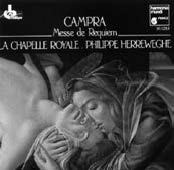
Andre Campra: Messa da Requiem
Andre Campra: Messa da Requiem
Featuring Philippe Herreweghe (Conductor)
Harmoia Mundi, 1992
Campra wrote this masterpiece around 1699, before he abandoned his duties as maître de musique at the cathedral Notre Dame for the stage. It was considered the greatest Messe De Requiem along with Jean Gilles’ (1668-1705) work in the eighteenth century and used at all state or ceremonial funerals in France. This Mass is the most recorded in our own generation of all this priest-composer’s work. This re-release (originally recorded in 1987) is sublime and transcendental with his handling of the twenty-two member choir (many of whom were soli, including the Canadian soprano Isabelle Desrochiers). One becomes lost in time through the grave character of the work, taken at a pace that respects an Office of the Dead. Unfortunately many modern conductors treat liturgical musical works in a secular way, equating fast tempi with energy, dropping sixteenth notes along the way in an effort to sound au courant, powerful, and capable of retaining the interest of the listener. Our fast-paced life has only accelerated in the last hundred years along with the pitch used by musical instruments. Campra’s Mass is at the pitch that was popular in his own day: A=392, well below our A=440 and the recent and up to A=512. At A=392 pitch the voice doesn’t have to strain and the high French tenor voice called haute-contre doesn’t sound feminine at all, like many of the counter tenors of our time. For hautecontre is not really a counter tenor at all.
The soli (two soprani, tenor, haute-contre, bass) all have solos that describe the Latin text in an emotional or dramatic fashion but it is the entire choir that creates much of the magnificence of this work, as it moves in waves ever higher as the piece progresses. The choral parts lift the soul of the listener to peace and calm after sorrow, yearning, loss, fear, and the shock of death. Campra brilliantly paints the transition of all the stages of reaction, self-identification, reflection on mortality, and the emotional quotients.
This CD is universally regarded as one of the great classics of French Baroque discography and this writer considers it one of the greatest liturgical recordings of the twentieth century. It follows the standard rite with a Requiem aeternam, Kyrie, Graduel, Offertoire, Sanctus, Agnus Dei, Post-Communion. Although it is only 43:25 in length, its over-powering beauty and grace are a heartfelt cry and prayer for the departed soul to the Almighty God, for forgiveness and deliverance. Truly this realization is a penitential plea that pierces the heavenly realms with its divine sounds.
© Paul-James Dwyer 2014

Saint Kateri , Canada’s Protectress
This was the title given to Saint Kateri Tekakwitha, by Pope Benedict XVI, when he canonized her on October 28th, 2012, along with six others, in Saint Peter’ Square (she had been beatified by Pope John Paul II back in 1980). With Saint Joseph as our protector, along with the Canadian martyrs, we seem to[…]Continue reading→

Remembering Father Alphonse de Valk
(Today marks the sixth anniversary of the death of Father Alphonse de Valk, C.S.B., a faithful, courageous and indefatigable Basilian priest, pro-life-and-family apostle, and the founder of Catholic Insight magazine. Here is what we wrote those on his entering into eternity five years ago, as we continue to remember him in our prayers and thoughts)[…]Continue reading→

My Name is Bernadette
April 16th is a propitious day, for besides the anniversary of Father de Valk’s death, who founded Catholic Insight in its print form decades ago, and the commemoration of the ‘two Benedicts’, mentioned in accompanying posts, today we also recall Saint Bernadette Soubirous, the young visionary to whom the Virgin Mary appeared numerous times at[…]Continue reading→

Canonizing Sister Faustina and Divine Mercy
HOMILY OF THE HOLY FATHER MASS IN ST PETER’S SQUARE FOR THE CANONIZATION OF SR MARY FAUSTINA KOWALSKA Sunday, 30 April 2000 1. “Confitemini Domino quoniam bonus, quoniam in saeculum misericordia eius”; “Give thanks to the Lord for he is good; his steadfast love endures for ever” (Ps 118: 1). So the Church sings on the Octave of[…]Continue reading→

Divine Mercy Sunday – An Echo of Every Mass
Reach out your hand and put it in my side. Do not doubt but believe’… ‘My Lord and my God!’ (Jn. 20:18)). Today is Divine Mercy Sunday, and as we celebrate the end of the Easter Octave, we contemplate the wounded side of our Saviour, the Church’s source of life. On Good Friday in the[…]Continue reading→

First Holy Communion: Sermon from May 16, 1943
Here is a sermon from the good old days by +Rev. Msgr. Vincent Nicholas Foy (August 14, 1915 – March 13, 2017), from 1943. Readers may recall that Pope Saint Pius X, by the decree Quam Singulari in 1910, lowered the customary age of reception of Holy Communion – after the rigours of the plague[…]Continue reading→
In the Glorious Light of Easter, Alleluia!
Set your minds on things that are above, not on things that are on earth, for you have died, and your life is hidden with Christ in God. When Christ who is your life is revealed, then you also will be revealed with him in glory (Col. 3:3-4). The Resurrection of Our Lord and Saviour[…]Continue reading→
An Ancient Homily for Holy Saturday
The time between Good Friday and Easter Sunday is one of waiting, in silence, as the world wonders – anticipates – what will happen, after the death of Christ. We re-live this time each year in the anamnesis of our liturgy, and in turn look forward to the glorious re-creation of all things at the[…]Continue reading→
Europe’s Long Descent
(As we meditate on this day on Christ’s burial, and His descent into hell, it is fitting to ponder here with contributor Peter Marcus how the world seems to be heading there as well. The difference is that, although God cannot ‘redeem’ hell, nor those therein, He can and did redeem the world. There is[…]Continue reading→
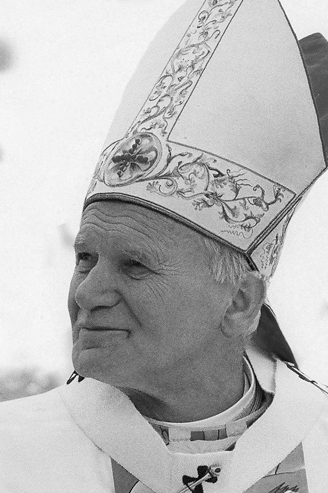
Pope Saint John Paul II’s First Good Friday Homily
ADDRESS OF HIS HOLINESS JOHN PAUL II AT THE CONCLUSION OF THE STATIONS OF THE CROSS AT THE COLOSSEUM Good Friday, 13 April 1979 When we make the Way of the Cross from one station to the next, in spirit we are always at the spot wherethis journey had its “historical” place: where it[…]Continue reading→