
Cutting a Christmas Tree
“Father Christmas throws out with the same gigantic gesture the prig who can only sneer at the Christmas pudding and the snob who can only snarl at the Christmas waits.” – G. K. Chesterton, Illustrated London News, 22 December 1923
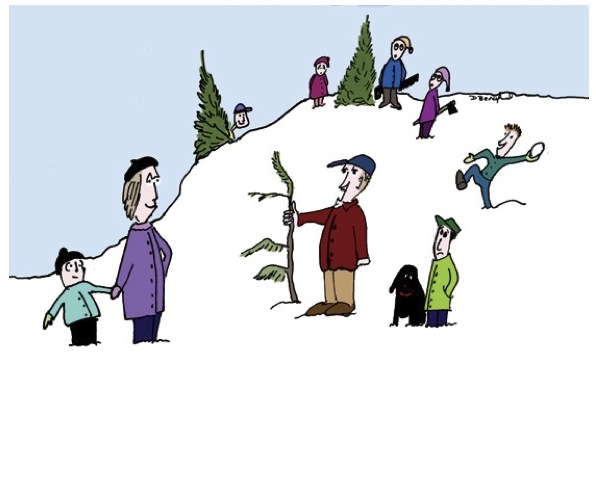
Every year we cut a Christmas tree. First, the children go looking for some suitable candidates and then we review the choices during a hike to pick the best one. My criteria are simple. I insist that we cut a spruce that is either being crowded out by another tree or is growing crooked against a fence. The trees I choose are flat on one side with some dead branches and a twisted trunk. We place the bad side against the wall, leaving the full side to face into the living room. By a careful arrangement of ornaments, the crooked trunks and dead branches can be more or less hidden.
Theresa and the children seem to have a hard time grasping these ideas. The trees they inevitably choose are full and bushy, growing away from any obstructions, with straight trunks and thick branches. It is nice, of course, to have a perfect tree, but my stinginess makes it hard for me to cut a sound tree when we can cut down one that is dying anyway. By cutting down a healthy tree I think that we impede the restoration of the woods, removing vigorous trees that will produce vigorous seeds and add more tall, straight trees to the landscape.
Landscapes naturally return to woods: deserts, mountain tops, and the arctic are the only exceptions I know of. There is a popular myth that woods grow because people plant trees, reinforced by timber company advertisements showing young men and women planting small saplings about a foot tall, evidence of their responsible stewardship. Of course, these trees are being planted as future timber and are species that have economic value. That is fine, but the fact remains that if a patch of land is left alone it always turns back into a forest. The question when one is presented with a barren patch of ground is not—who cut down the forest, but—what is stopping the forest from returning? Usually the culprit is overgrazing by cattle or, in the case of cities, recently spread asphalt to create a parking lot. But even paved parking lots will become forests in time.
We always kill a turkey each Christmas. It is amazing how fast my fingers go numb when plucking a turkey outside in the wind and snow. But it is nothing that scotch and hot water cannot undo. I de-bone our turkey by cutting along the spine and filleting the bird as if it were a fish. It takes about an hour or so. We stuff the de-boned bird with sausage and bread dressing and tie it up with cotton string for cooking. You can tell when the bird is done using a meat thermometer. A turkey done this way seems to go further and every slice is perfect! The meat is tender, and leftovers are not dry on the second of the twelve days of feasting. It is odd that some folks stop their Christmas parties after just one day to return to the gloomy winter grindstone, broken by a brief flurry on New Year’s Eve. These people could learn something about feasting from we Catholics.
When the children were little, I used to cut the Christmas tree. We would bring toboggans and sleds and set an open fire in the woods to cook hot chocolate and coffee for a winter picnic, getting the water from the snow and drinking from tin cups. Sitting in the snow beside an open fire, it was fun to watch the snow on overhanging branches melt and drip on everything. Now that the children are older they go out with Swede saws and hatchets and cut the tree themselves on Christmas Eve.
My memory must be playing tricks on me these days, because the past few years I have found that the trees always look better in the house than in the field. This year’s tree, which I thought had been rather sparse and scrawny when I picked it out, appears to be quite full and lush in our house.
“Are you sure you cut down the right Christmas tree?” I asked my children.
“Yes,” the chorus replied.
“I think the children’s tree is wonderful,” my wife Theresa said. “Isn’t it nice that they are old enough to do this for us?”
And it is.

Saint Kateri , Canada’s Protectress
This was the title given to Saint Kateri Tekakwitha, by Pope Benedict XVI, when he canonized her on October 28th, 2012, along with six others, in Saint Peter’ Square (she had been beatified by Pope John Paul II back in 1980). With Saint Joseph as our protector, along with the Canadian martyrs, we seem to[…]Continue reading→

Remembering Father Alphonse de Valk
(Today marks the sixth anniversary of the death of Father Alphonse de Valk, C.S.B., a faithful, courageous and indefatigable Basilian priest, pro-life-and-family apostle, and the founder of Catholic Insight magazine. Here is what we wrote those on his entering into eternity five years ago, as we continue to remember him in our prayers and thoughts)[…]Continue reading→

My Name is Bernadette
April 16th is a propitious day, for besides the anniversary of Father de Valk’s death, who founded Catholic Insight in its print form decades ago, and the commemoration of the ‘two Benedicts’, mentioned in accompanying posts, today we also recall Saint Bernadette Soubirous, the young visionary to whom the Virgin Mary appeared numerous times at[…]Continue reading→

Canonizing Sister Faustina and Divine Mercy
HOMILY OF THE HOLY FATHER MASS IN ST PETER’S SQUARE FOR THE CANONIZATION OF SR MARY FAUSTINA KOWALSKA Sunday, 30 April 2000 1. “Confitemini Domino quoniam bonus, quoniam in saeculum misericordia eius”; “Give thanks to the Lord for he is good; his steadfast love endures for ever” (Ps 118: 1). So the Church sings on the Octave of[…]Continue reading→

Divine Mercy Sunday – An Echo of Every Mass
Reach out your hand and put it in my side. Do not doubt but believe’… ‘My Lord and my God!’ (Jn. 20:18)). Today is Divine Mercy Sunday, and as we celebrate the end of the Easter Octave, we contemplate the wounded side of our Saviour, the Church’s source of life. On Good Friday in the[…]Continue reading→

First Holy Communion: Sermon from May 16, 1943
Here is a sermon from the good old days by +Rev. Msgr. Vincent Nicholas Foy (August 14, 1915 – March 13, 2017), from 1943. Readers may recall that Pope Saint Pius X, by the decree Quam Singulari in 1910, lowered the customary age of reception of Holy Communion – after the rigours of the plague[…]Continue reading→

In the Glorious Light of Easter, Alleluia!
Set your minds on things that are above, not on things that are on earth, for you have died, and your life is hidden with Christ in God. When Christ who is your life is revealed, then you also will be revealed with him in glory (Col. 3:3-4). The Resurrection of Our Lord and Saviour[…]Continue reading→

An Ancient Homily for Holy Saturday
The time between Good Friday and Easter Sunday is one of waiting, in silence, as the world wonders – anticipates – what will happen, after the death of Christ. We re-live this time each year in the anamnesis of our liturgy, and in turn look forward to the glorious re-creation of all things at the[…]Continue reading→

Europe’s Long Descent
(As we meditate on this day on Christ’s burial, and His descent into hell, it is fitting to ponder here with contributor Peter Marcus how the world seems to be heading there as well. The difference is that, although God cannot ‘redeem’ hell, nor those therein, He can and did redeem the world. There is[…]Continue reading→
Pope Saint John Paul II’s First Good Friday Homily
ADDRESS OF HIS HOLINESS JOHN PAUL II AT THE CONCLUSION OF THE STATIONS OF THE CROSS AT THE COLOSSEUM Good Friday, 13 April 1979 When we make the Way of the Cross from one station to the next, in spirit we are always at the spot wherethis journey had its “historical” place: where it[…]Continue reading→