
The problem of modesty
Sometimes I have scruples about the things I write, worrying whether words will be misconstrued or pert opinions come across as doctrine. There haven’t been any major problems yet, thank the Lord, which might be because I generally stick to issues on which most can agree, leaving the really contentious ones for those much better educated than I.
But there is one pseudo-contentious issue that I find myself delving into more and more: modesty. As much as I’d like it to be a cut-and-dried issue, it simply isn’t. Modesty, especially within the realm of clothing, is an area shrouded in shades of grey. This bothers me, because I like black and white. I like the rules to be neatly laid out before me with everyone following them in an unswervingly straight line. But that’s not the reality—and I know this because I work with young people who are asked to stick to a fairly specific dress code. It is an area rife with personal judgment calls, body types, colours, fabrics, sizes, shapes—the list goes on and on. Aside from the very, very basics, what’s good for one is totally inappropriate for another.
Can it be any other way? Short of giving specific measurements, how do you go about providing guidance? When we are talking about modesty in dress there are two definite goalposts: Fundamentalist Muslim on one side and Most Definitely Naked on the other, and worlds in between. How does anyone navigate this chasm, with blessed little to concretely go on?
Recently I read a book by Colleen Hammond called Dressing with Dignity. It was a shocker for me because it was the first time I’d heard a Catholic talk about exact measurements in relation to modest attire. Hammond gives a rundown of instructions regarding women’s modesty issued to every parish in 1928 by the Cardinal Vicar of Rome:
“A dress cannot be called decent which is cut deeper than two fingers’ breadth under the pit of the throat, which does not cover the arms at least to the elbows, and scarcely reaches a bit beyond the knees.”
It was all a little irritating for me; I had to admit that a good portion of my wardrobe might not measure up to the “modesty guidelines.” I mean, elbows? Immodest? Really? Yet the more I pondered the more I (begrudgingly) admitted that it was strangely comforting to at least have something to use as a jumping-off point. I know that these guidelines aren’t completely outdated because most churches in Europe have similar regulations. Generally, people (and that’s men and women) are barred from entering if they are wearing tank tops, shorts, strapless tops, or miniskirts (for the ladies) and I can’t say I’d be sad to see that happen in North American churches, where you can come to church wearing something closer to the Most Definitely Naked side with nary a word said. It makes for an uncomfortable and distracting Mass, for both sexes, when there’s a gentleman with shiny, tight pants or a lady with a short skirt and legs-for-days in front of you. And it’s not just uncomfortable. There’s an element of temptation that weaves its subtle-yet-deadly way into it too—especially for those struggling with sexual sin. Jesus tells us that we should be more willing to cut off our hands or pluck out our eyes rather than consent to sin—yet how much more difficult is it to avoid committing sin when the very objects of our affection are standing in front of us, alluringly beautiful and only half dressed?
Do you know what’s attractive? Legs are—among other body parts. The human body is downright beautiful to behold. God did that on purpose; He made us beautiful within our bodies because if we weren’t, the world would cease being peopled. Yet both male and female bodies have inherent dignity far beyond the mere physical and, because of that dignity present in each man and woman, it is not fitting for the body to be uncovered for the entire world to see.
So we ascribe to the principles of modesty, discretion, and decency in order to present to the world what we truly are: whole persons—body, soul, and spirit—all the while protecting the intimate centre of our persons and veiling what should rightly remain hidden. And this is where constant prayer, solid education, and good discernment practices come in. How else can one go about learning, concretely, how to live modestly and treat themselves and others with the dignity owed to the human person? The Catechism and Sacred Scripture are good places to start, as well as books like Dressing with Dignity and websites such as therebelution.com. Then comes the nitty gritty work of taking an honest and hard look at one’s life choices—and closet— and excising the “darker shades of grey.” Because it’s all fun and games, until someone plucks out an eye.

Saint Kateri , Canada’s Protectress
This was the title given to Saint Kateri Tekakwitha, by Pope Benedict XVI, when he canonized her on October 28th, 2012, along with six others, in Saint Peter’ Square (she had been beatified by Pope John Paul II back in 1980). With Saint Joseph as our protector, along with the Canadian martyrs, we seem to[…]Continue reading→

Remembering Father Alphonse de Valk
(Today marks the sixth anniversary of the death of Father Alphonse de Valk, C.S.B., a faithful, courageous and indefatigable Basilian priest, pro-life-and-family apostle, and the founder of Catholic Insight magazine. Here is what we wrote those on his entering into eternity five years ago, as we continue to remember him in our prayers and thoughts)[…]Continue reading→

My Name is Bernadette
April 16th is a propitious day, for besides the anniversary of Father de Valk’s death, who founded Catholic Insight in its print form decades ago, and the commemoration of the ‘two Benedicts’, mentioned in accompanying posts, today we also recall Saint Bernadette Soubirous, the young visionary to whom the Virgin Mary appeared numerous times at[…]Continue reading→

Canonizing Sister Faustina and Divine Mercy
HOMILY OF THE HOLY FATHER MASS IN ST PETER’S SQUARE FOR THE CANONIZATION OF SR MARY FAUSTINA KOWALSKA Sunday, 30 April 2000 1. “Confitemini Domino quoniam bonus, quoniam in saeculum misericordia eius”; “Give thanks to the Lord for he is good; his steadfast love endures for ever” (Ps 118: 1). So the Church sings on the Octave of[…]Continue reading→

Divine Mercy Sunday – An Echo of Every Mass
Reach out your hand and put it in my side. Do not doubt but believe’… ‘My Lord and my God!’ (Jn. 20:18)). Today is Divine Mercy Sunday, and as we celebrate the end of the Easter Octave, we contemplate the wounded side of our Saviour, the Church’s source of life. On Good Friday in the[…]Continue reading→

First Holy Communion: Sermon from May 16, 1943
Here is a sermon from the good old days by +Rev. Msgr. Vincent Nicholas Foy (August 14, 1915 – March 13, 2017), from 1943. Readers may recall that Pope Saint Pius X, by the decree Quam Singulari in 1910, lowered the customary age of reception of Holy Communion – after the rigours of the plague[…]Continue reading→

In the Glorious Light of Easter, Alleluia!
Set your minds on things that are above, not on things that are on earth, for you have died, and your life is hidden with Christ in God. When Christ who is your life is revealed, then you also will be revealed with him in glory (Col. 3:3-4). The Resurrection of Our Lord and Saviour[…]Continue reading→

An Ancient Homily for Holy Saturday
The time between Good Friday and Easter Sunday is one of waiting, in silence, as the world wonders – anticipates – what will happen, after the death of Christ. We re-live this time each year in the anamnesis of our liturgy, and in turn look forward to the glorious re-creation of all things at the[…]Continue reading→

Europe’s Long Descent
(As we meditate on this day on Christ’s burial, and His descent into hell, it is fitting to ponder here with contributor Peter Marcus how the world seems to be heading there as well. The difference is that, although God cannot ‘redeem’ hell, nor those therein, He can and did redeem the world. There is[…]Continue reading→
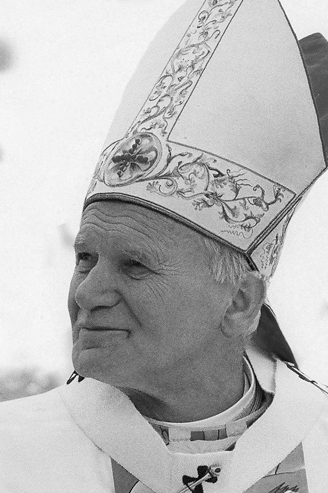
Pope Saint John Paul II’s First Good Friday Homily
ADDRESS OF HIS HOLINESS JOHN PAUL II AT THE CONCLUSION OF THE STATIONS OF THE CROSS AT THE COLOSSEUM Good Friday, 13 April 1979 When we make the Way of the Cross from one station to the next, in spirit we are always at the spot wherethis journey had its “historical” place: where it[…]Continue reading→