
Abuse. Blasphemy. Communion in the hand?
“I’m heartbroken to announce that last week, we discovered a crushed consecrated Host beneath one of the kneelers,” the pastor of a small yet devout Californian parish says. He pauses for a moment before he goes on, his voice choked by just indignation and sadness: “This is God, people. God.” Then he drops the bomb. “I’m writing to Pope Francis to do away with the practice of Communion in the hand altogether. I believe most of the abuses and blasphemies that the Eucharist has undergone is because of this practice.”
Since the practice of Communion in the hand has become the common observance in most countries, there has been, whether you like to admit it or not, a spike in Eucharistic abuse. Communion in the hand has given those who wish to do harm and those who are careless the opportunity to do what they want with the Body of Christ. Unfortunately, the situation described above is not uncommon. In fact, it’s quite the opposite.
Furthermore, Communion in the hand has the potential to promote or at least foster a disrespect for the Body of Christ. As Catholics, we believe this small Host does not represent Christ, but is Christ Himself. How can we, then, possibly touch the living presence of God with our bare, dirty, unconsecrated, and unworthy hands? How? How have we even considered this as an option in the first place?
The answer can be given using one word: disobedience. The practice came about in the early 1960s (after Vatican II, though the Council never actually called for it), when certain parishes around the world began to disobey the Church’s rule of receiving the Host on the tongue, making their own rules as to whether or not you could receive in the hand. The Vatican immediately responded in disapproving words, saying that this disobedient practice would lead to “the possibility of a lessening of reverence toward the august sacrament of the altar, its profanation, and the watering down of the true doctrine of the Eucharist” (Memoriale Domini).
When Pope Paul VI in 1968 sent out a questionnaire to every bishop in the world asking if the Church should alter how Communion was being distributed, the answer came back loud and clear: in the hand was overwhelmingly disapproved of and should not be allowed. The Vatican agreed, stating that if the practice of Communion in the hand be allowed, “it would be an offense to the sensibilities and spiritual outlook of these bishops and a great many of the faithful” (Memoriale Domini).
Unfortunately, the practice continued to be promulgated by parishes and dioceses alike, most especially in France. So, in 1969, Paul VI granted the French bishops an indult—a special permission (not a norm)—to decide the question on their own. What happened next was an abuse of that indult: parishes around the world took advantage and permitted the practice of Communion in the hand. Despite the Vatican’s best efforts, the disobedience continued and today, most Catholics are under the erroneous idea that Communion in the hand is the norm, because it is seemingly most common. However, the norm does not mean the most common, but instead is the practice which is supported by the Universal Church and to which the laity should be adhering.
You want to know what that norm is? Kneeling or standing to receive the Eucharist on the tongue and, if standing, to receive with arms crossed or in another way as reverential. Look it up if you don’t believe me. (This is the norm of the Universal Church; in the US, however, as in other countries, the Conference of Bishops have established the norm of standing to receive, and that it is up the the communicant to decide whether he wants to receive in the hand or on the tongue).
Monsignor Marini, master of papal liturgical ceremonies, was interviewed by the Vatican newspaper in 2008 after then-Pope Benedict XVI established that everyone should be kneeling when receiving Communion at a papal Mass. He said, “It is necessary not to forget that the distribution of Communion in the hand, from a juridical standpoint, remains up to now an indult” (emphasis added). He goes on to say that the pope’s return to the traditional practice “aims to highlight the force of the valid norm for the whole Church.”
These days, the practice of Communion on the hand is increasingly frowned upon by bishops, priests, and the laity. Several dioceses in South America have banned the practice altogether, while Sri Lanka never allowed it in the first place—both of which the Congregation of the Doctrine of the Faith fully supports.
Pope Emeritus Benedict XVI, Pope John Paul II, Pope Francis (at whose papal Masses many people have been gently reminded to receive on the tongue if at first they extended their hands), and numerous Cardinals have all spoken publicly and loudly against the practice. Cardinals Thorne (Peru) and Caffarra (Bologna) have banned Communion in the hand, citing reasons of abuse and disrespect. Pope Benedict was asked why he chose to distribute Communion only to those kneeling and on the tongue and he responded, because it highlights “the truth of the real presence [of Christ] in the Eucharist, helps the devotion of the faithful and introduces the sense of mystery more easily.”
A Muslim man once approached a Catholic, asking him if he really believed that the Host was God Himself. The Catholic responded, “Yes.” The Muslim paused for a moment, thinking it over. “If I believed that was truly Allah,” he said finally, “then I would crawl up on my hands and knees, bowing my head to receive Him.”
If the Eucharist is God, then why are we touching Him? Moses could not come within ten feet of the burning bush without taking off his shoes; the haemorrhaging woman crawled up to Jesus and barely grazed the hem of His garment; the saints have extolled the utter profundity of receiving the Eucharist. In the Eucharist, the mysticism, the beauty, the awesomeness of God are all present. We must, we absolutely must, remember this when we approach Him at Mass. We should never forget that we owe everything to Him, and if we do not receive Him respectfully out of sheer reverence, then we should at least do so out of gratitude.
As the pastor at this Californian church finished his short exhortation by saying, “I urge all of you to receive on the tongue, and if you don’t like to, offer it up!”

Saint Kateri , Canada’s Protectress
This was the title given to Saint Kateri Tekakwitha, by Pope Benedict XVI, when he canonized her on October 28th, 2012, along with six others, in Saint Peter’ Square (she had been beatified by Pope John Paul II back in 1980). With Saint Joseph as our protector, along with the Canadian martyrs, we seem to[…]Continue reading→

Remembering Father Alphonse de Valk
(Today marks the sixth anniversary of the death of Father Alphonse de Valk, C.S.B., a faithful, courageous and indefatigable Basilian priest, pro-life-and-family apostle, and the founder of Catholic Insight magazine. Here is what we wrote those on his entering into eternity five years ago, as we continue to remember him in our prayers and thoughts)[…]Continue reading→

My Name is Bernadette
April 16th is a propitious day, for besides the anniversary of Father de Valk’s death, who founded Catholic Insight in its print form decades ago, and the commemoration of the ‘two Benedicts’, mentioned in accompanying posts, today we also recall Saint Bernadette Soubirous, the young visionary to whom the Virgin Mary appeared numerous times at[…]Continue reading→
Canonizing Sister Faustina and Divine Mercy
HOMILY OF THE HOLY FATHER MASS IN ST PETER’S SQUARE FOR THE CANONIZATION OF SR MARY FAUSTINA KOWALSKA Sunday, 30 April 2000 1. “Confitemini Domino quoniam bonus, quoniam in saeculum misericordia eius”; “Give thanks to the Lord for he is good; his steadfast love endures for ever” (Ps 118: 1). So the Church sings on the Octave of[…]Continue reading→

Divine Mercy Sunday – An Echo of Every Mass
Reach out your hand and put it in my side. Do not doubt but believe’… ‘My Lord and my God!’ (Jn. 20:18)). Today is Divine Mercy Sunday, and as we celebrate the end of the Easter Octave, we contemplate the wounded side of our Saviour, the Church’s source of life. On Good Friday in the[…]Continue reading→
First Holy Communion: Sermon from May 16, 1943
Here is a sermon from the good old days by +Rev. Msgr. Vincent Nicholas Foy (August 14, 1915 – March 13, 2017), from 1943. Readers may recall that Pope Saint Pius X, by the decree Quam Singulari in 1910, lowered the customary age of reception of Holy Communion – after the rigours of the plague[…]Continue reading→
In the Glorious Light of Easter, Alleluia!
Set your minds on things that are above, not on things that are on earth, for you have died, and your life is hidden with Christ in God. When Christ who is your life is revealed, then you also will be revealed with him in glory (Col. 3:3-4). The Resurrection of Our Lord and Saviour[…]Continue reading→

An Ancient Homily for Holy Saturday
The time between Good Friday and Easter Sunday is one of waiting, in silence, as the world wonders – anticipates – what will happen, after the death of Christ. We re-live this time each year in the anamnesis of our liturgy, and in turn look forward to the glorious re-creation of all things at the[…]Continue reading→
Europe’s Long Descent
(As we meditate on this day on Christ’s burial, and His descent into hell, it is fitting to ponder here with contributor Peter Marcus how the world seems to be heading there as well. The difference is that, although God cannot ‘redeem’ hell, nor those therein, He can and did redeem the world. There is[…]Continue reading→
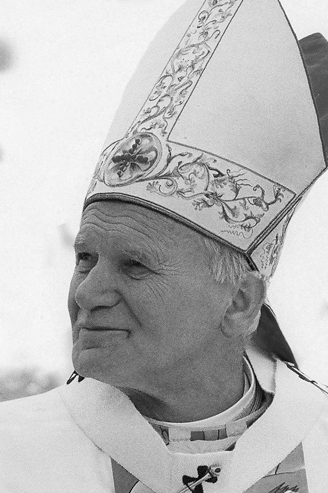
Pope Saint John Paul II’s First Good Friday Homily
ADDRESS OF HIS HOLINESS JOHN PAUL II AT THE CONCLUSION OF THE STATIONS OF THE CROSS AT THE COLOSSEUM Good Friday, 13 April 1979 When we make the Way of the Cross from one station to the next, in spirit we are always at the spot wherethis journey had its “historical” place: where it[…]Continue reading→
One thought on “Abuse. Blasphemy. Communion in the hand?”
Comments are closed.
An Episcopal President and his Catholic FLOTUS refuse to sin until #MAGA https://uploads.disquscdn.com/images/ea60a364ae01e2910346f3c9bbea618549e5aebdaf7693c27c427a4ac4b9630b.jpg