
Spiritual giraffes
Sometime after my family started traveling, my sister and her husband began traveling full time as well. They now travel with their two children, my two-year-old niece and my four-month-old nephew. My niece has spent a surprising amount of her life traveling from place to place. She handles moving pretty well, and seems to like it. It’s just a part of how her life works.
Another part of how her life works is that from time to time we all end up in the same place. It’s a perk of my brother-in-law working for the same company as my parents that our paths cross every so often. Sometimes it’s for a week, sometimes a weekend, and sometimes there is just enough time to meet up for dinner as we sail on to a new destination. This, too, is something she takes in stride—every now and then, some of her relatives just show up at her hotel room, in a store, climbing up the side of a large hill, or at some random RV park. Her response to our appearance is quite routine. She smiles at us, yells “Bob!” at my dog (my dog’s name is Robyn, not Bob) then goes inside the RV to raid the refrigerator or the fruit bowl. It doesn’t really faze her at all. It is something that she expects to happen at irregular intervals.
In the book The Warm Place by Nancy Farmer, a baby giraffe is trying to get back to her mother after being captured by poachers and taken to a zoo. In order to get back from the United States to Africa, she naturally stows away on a ship along with her friends: a chameleon, two rats, and a runaway boy. The people who own the ship are a particularly nasty family. Several times during the story, they all but bump into the baby giraffe, but somehow fail to see her. This prompts a reminder to the reader that humans can only see what they expect to see, or what they believe is possible.
This same idea is expressed by C. S. Lewis at the end of The Last Battle, when the dwarves refuse to see that they are no longer trapped in a disgusting stable. In a world where we are supposed to expect the unexpected, human beings do an awfully good job of ignoring it. For instance, in the aftermath of a hurricane, news reporters make sure to cover all the things that people expect. They show all of the destruction, the flooding, the deaths, the looters, and they tell viewers over and over again how much money it will take to rebuild everything. But they tend to neglect aspects that are less expected (and less dramatic and less newsworthy) such as people helping each other, and regular people doing brave or selfless things. They cannot see the part of the storm where people sit around laughing at the weather reporters freaking out, joking about whether a branch will fall on a roof that needs to be replaced. Nobody seems to remember that the sky is never quite as gorgeous as it is the day after a hurricane. People don’t expect that to be a part of experiencing a hurricane and, so, many people don’t see those parts of it.
It is easy to get into the habit of ignoring the unexpected in everyday life. Too many things get in the way of noticing everything that changes. The human mind is extremely good at making everything seem normal. Normal eventually becomes mundane, and sometimes even adventures feel like drudgery. That’s unfortunate, because the world is full of unexpected things, and those are the things that turn drudgery into an adventure.
The inability to see unexpected things affects people spiritually perhaps even more than it affects us physically. We get into the habit of being Catholic. We get used going to Mass on Sundays and Holy Days, saying the Rosary—going through the motions without seeing anything special about it.
All it usually takes to be able to see things is someone else saying, “Look at the sky; it’s really pretty today” or “Whoa! There appears to be a nine-foot-tall baby giraffe hiding in our hall closet. We should probably do something about that.” Fortunately for our souls, Lent does just that. It reminds us that being Christians shouldn’t be something that we settle into. Being Catholic should be a bit difficult. It should make going about life as society dictates it uncomfortable and even impossible. Lent reminds us that there is more to life than the ordinary and expected things. It cuts through the layers of ordinary. Now, halfway through Lent, we are well on our way to being able to see all those spiritual giraffes. At least, that’s what I tell myself as I’m drooling over a bottle of chocolate milk.

Saint Kateri , Canada’s Protectress
This was the title given to Saint Kateri Tekakwitha, by Pope Benedict XVI, when he canonized her on October 28th, 2012, along with six others, in Saint Peter’ Square (she had been beatified by Pope John Paul II back in 1980). With Saint Joseph as our protector, along with the Canadian martyrs, we seem to[…]Continue reading→

Remembering Father Alphonse de Valk
(Today marks the sixth anniversary of the death of Father Alphonse de Valk, C.S.B., a faithful, courageous and indefatigable Basilian priest, pro-life-and-family apostle, and the founder of Catholic Insight magazine. Here is what we wrote those on his entering into eternity five years ago, as we continue to remember him in our prayers and thoughts)[…]Continue reading→

My Name is Bernadette
April 16th is a propitious day, for besides the anniversary of Father de Valk’s death, who founded Catholic Insight in its print form decades ago, and the commemoration of the ‘two Benedicts’, mentioned in accompanying posts, today we also recall Saint Bernadette Soubirous, the young visionary to whom the Virgin Mary appeared numerous times at[…]Continue reading→

Canonizing Sister Faustina and Divine Mercy
HOMILY OF THE HOLY FATHER MASS IN ST PETER’S SQUARE FOR THE CANONIZATION OF SR MARY FAUSTINA KOWALSKA Sunday, 30 April 2000 1. “Confitemini Domino quoniam bonus, quoniam in saeculum misericordia eius”; “Give thanks to the Lord for he is good; his steadfast love endures for ever” (Ps 118: 1). So the Church sings on the Octave of[…]Continue reading→

Divine Mercy Sunday – An Echo of Every Mass
Reach out your hand and put it in my side. Do not doubt but believe’… ‘My Lord and my God!’ (Jn. 20:18)). Today is Divine Mercy Sunday, and as we celebrate the end of the Easter Octave, we contemplate the wounded side of our Saviour, the Church’s source of life. On Good Friday in the[…]Continue reading→

First Holy Communion: Sermon from May 16, 1943
Here is a sermon from the good old days by +Rev. Msgr. Vincent Nicholas Foy (August 14, 1915 – March 13, 2017), from 1943. Readers may recall that Pope Saint Pius X, by the decree Quam Singulari in 1910, lowered the customary age of reception of Holy Communion – after the rigours of the plague[…]Continue reading→

In the Glorious Light of Easter, Alleluia!
Set your minds on things that are above, not on things that are on earth, for you have died, and your life is hidden with Christ in God. When Christ who is your life is revealed, then you also will be revealed with him in glory (Col. 3:3-4). The Resurrection of Our Lord and Saviour[…]Continue reading→

An Ancient Homily for Holy Saturday
The time between Good Friday and Easter Sunday is one of waiting, in silence, as the world wonders – anticipates – what will happen, after the death of Christ. We re-live this time each year in the anamnesis of our liturgy, and in turn look forward to the glorious re-creation of all things at the[…]Continue reading→

Europe’s Long Descent
(As we meditate on this day on Christ’s burial, and His descent into hell, it is fitting to ponder here with contributor Peter Marcus how the world seems to be heading there as well. The difference is that, although God cannot ‘redeem’ hell, nor those therein, He can and did redeem the world. There is[…]Continue reading→
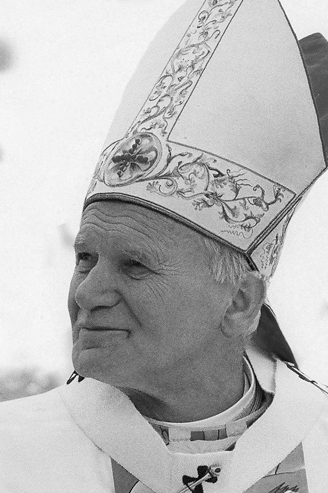
Pope Saint John Paul II’s First Good Friday Homily
ADDRESS OF HIS HOLINESS JOHN PAUL II AT THE CONCLUSION OF THE STATIONS OF THE CROSS AT THE COLOSSEUM Good Friday, 13 April 1979 When we make the Way of the Cross from one station to the next, in spirit we are always at the spot wherethis journey had its “historical” place: where it[…]Continue reading→