
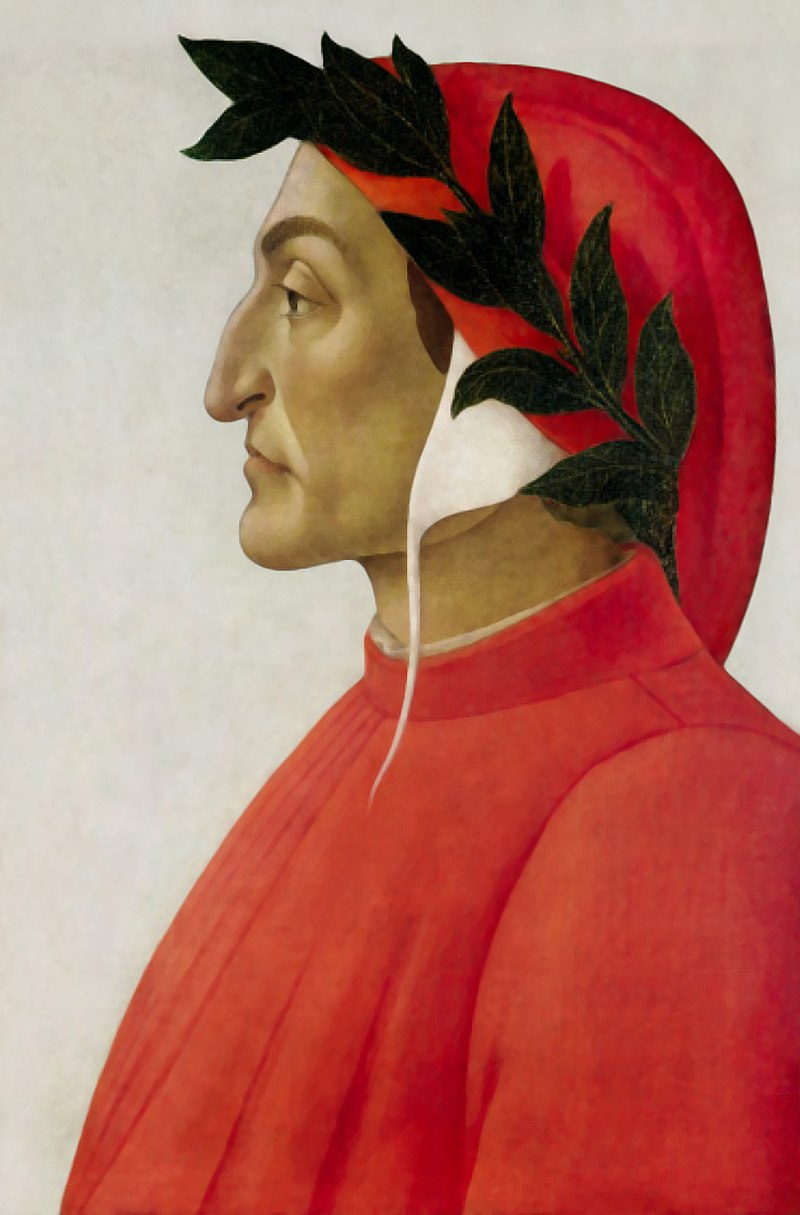
The Catholic Dante 1265–1321
Dante Alighieri, one of the world’s greatest poets, was born in Florence, Italy, in 1265. Early in life he inherited the benefits of growing up in the newly founded Florentine democracy. In his youth he became a champion of liberal policies. When the reigning Pope Boniface VIII sided with the old aristocratic party, Dante fought with all his might. He was subsequently banished from Florence and sentenced to death should he return to the city. Perhaps Dante settled some old scores by damning several popes to the Inferno, that part of his epic poem The Divine Comedy which consists of a travelogue through Hell, Purgatory, and Heaven.
In his twenties Dante joined the guild of physicians and apothecaries. At the age of twenty-five his childhood sweetheart, Beatrice, died. There is no evidence that Dante had any more than a platonic or deeply Christian love for Beatrice; but, being the great idol of his life, he elevated her to immortality as a main character in his Divine Comedy.
In 1309 Dante wrote his work, On Monarchy, in which he argued the essential need to separate the Church from the State, lest both be corrupted by each other. The emperor’s right to rule, he said, comes not from the pope, but directly from God. Having thus made a friend of imperial authority, it was Dante’s misfortune to see the emperor die the following year and himself chased once again into seclusion. Perhaps it was about this time that he began The Divine Comedy, which he wrote in the Italian vernacular rather than in standard Latin.
With the ancient Roman poet Virgil and the beloved Beatrice as his guides, Dante imagines himself being led from a darkly wooded area through the three realms of the afterlife: Hell (Inferno), Purgatory (Purgatorio), and finally Heaven (Paradiso). Presuming to read the mind of God, Dante judges the great men and women of history and accords each one a well deserved doom or reward. In the most vivid passages of the Inferno a monstrously large and three-headed Lucifer is depicted munching on the heads of Judas, Brutus, and Cassius. Those in hell did not love, or had betrayed the ones they loved. Those in purgatory loved but did not know the highest love, and are there to learn how to desire it. Those in heaven have entered fully into the love of God. The description of the beatific vision in Paradiso is not nearly so vivid as the encounter with Lucifer, but Chesterton explained why. “The beatific vision is described by Dante about as well as it could be described by anybody – that is, chiefly by saying that it cannot be described at all.”
If to us today the word “comedy” seems not rightly applied to Dante’s subject, that is because we do not understand that the word originally described a world in which the will of God justly prevails over every opposition (“all’s well that ends well”). Throughout the three acts of his epic journey through the afterlife Dante shows us his mastery of the ancient and medieval wisdoms, from Aristotle through Aquinas. He weaves philosophy and poetry together with such natural and perfect ease that we are reminded at the very least of Shakespeare at his very best.
The poet Boccacio wrote an account of the last days of Dante that is worth telling. Having been called to participate in negotiations for peace between the warring cities of Venice and Ravenna, Dante caught malaria during his trip and died on September 14th, in 1321, the Triumph of the Cross, just days before he had finished the last thirteen cantos of the Comedy. Not having time to make copies, he hid them in a cabinet. When after his funeral his sons Pietro and Jacopo went to look among his papers for the last cantos, they were dismayed at not being able to find them. But eight months later Jacopo had a dream in which his father appeared to him, led him to his house, and showed him where he had hidden the now mildewed manuscripts.
By placing several popes in hell, speculation has arisen that Dante was a precursor of modern Protestantism. Not so. Dante’s loyalty to traditional Catholic doctrine is unquestioning. It was mainly the worldly corruption of the papacy to which he strongly objected because it had grown cancerous and infected the social order. In this respect two centuries later he would have been much closer to the loyal Erasmus than to the battling Luther. Indeed, as Dante’s own son Pietro noted, his father was so thoroughly Catholic that if the faith disappeared from the face of the earth, it would be possible to reconstruct it by following Dante’s epic journey through the afterlife.
Some Dante Insights
The darkest places in hell are reserved for those who maintain their neutrality in times of moral crisis.
There is no greater sorrow than to recall a happy time when miserable.
The more a thing is perfect, the more it feels pleasure and pain.
There is no greater sorrow than to recall our times of joy in wretchedness.
He who sees a need and waits to be asked for help is as unkind as if he had refused it.
Beauty awakens the soul to act
Nature is the art of God.

Saint Kateri , Canada’s Protectress
This was the title given to Saint Kateri Tekakwitha, by Pope Benedict XVI, when he canonized her on October 28th, 2012, along with six others, in Saint Peter’ Square (she had been beatified by Pope John Paul II back in 1980). With Saint Joseph as our protector, along with the Canadian martyrs, we seem to[…]Continue reading→

Remembering Father Alphonse de Valk
(Today marks the sixth anniversary of the death of Father Alphonse de Valk, C.S.B., a faithful, courageous and indefatigable Basilian priest, pro-life-and-family apostle, and the founder of Catholic Insight magazine. Here is what we wrote those on his entering into eternity five years ago, as we continue to remember him in our prayers and thoughts)[…]Continue reading→

My Name is Bernadette
April 16th is a propitious day, for besides the anniversary of Father de Valk’s death, who founded Catholic Insight in its print form decades ago, and the commemoration of the ‘two Benedicts’, mentioned in accompanying posts, today we also recall Saint Bernadette Soubirous, the young visionary to whom the Virgin Mary appeared numerous times at[…]Continue reading→

Canonizing Sister Faustina and Divine Mercy
HOMILY OF THE HOLY FATHER MASS IN ST PETER’S SQUARE FOR THE CANONIZATION OF SR MARY FAUSTINA KOWALSKA Sunday, 30 April 2000 1. “Confitemini Domino quoniam bonus, quoniam in saeculum misericordia eius”; “Give thanks to the Lord for he is good; his steadfast love endures for ever” (Ps 118: 1). So the Church sings on the Octave of[…]Continue reading→

Divine Mercy Sunday – An Echo of Every Mass
Reach out your hand and put it in my side. Do not doubt but believe’… ‘My Lord and my God!’ (Jn. 20:18)). Today is Divine Mercy Sunday, and as we celebrate the end of the Easter Octave, we contemplate the wounded side of our Saviour, the Church’s source of life. On Good Friday in the[…]Continue reading→

Saint Stanislaus of Szczepanów
We celebrate Saint Stanislaus today (+ April 11, 1079), in light of this Easter Octave, a bishop and martyr who accepted the episcopacy only at the direct order of Pope Alexander II. He proved a wise and courageous leader of his flock, put to death by his own king, Boleslaus, for rebuking the monarch’s ‘immoral[…]Continue reading→

First Holy Communion: Sermon from May 16, 1943
Here is a sermon from the good old days by +Rev. Msgr. Vincent Nicholas Foy (August 14, 1915 – March 13, 2017), from 1943. Readers may recall that Pope Saint Pius X, by the decree Quam Singulari in 1910, lowered the customary age of reception of Holy Communion – after the rigours of the plague[…]Continue reading→

In the Glorious Light of Easter, Alleluia!
Set your minds on things that are above, not on things that are on earth, for you have died, and your life is hidden with Christ in God. When Christ who is your life is revealed, then you also will be revealed with him in glory (Col. 3:3-4). The Resurrection of Our Lord and Saviour[…]Continue reading→

An Ancient Homily for Holy Saturday
The time between Good Friday and Easter Sunday is one of waiting, in silence, as the world wonders – anticipates – what will happen, after the death of Christ. We re-live this time each year in the anamnesis of our liturgy, and in turn look forward to the glorious re-creation of all things at the[…]Continue reading→

Europe’s Long Descent
(As we meditate on this day on Christ’s burial, and His descent into hell, it is fitting to ponder here with contributor Peter Marcus how the world seems to be heading there as well. The difference is that, although God cannot ‘redeem’ hell, nor those therein, He can and did redeem the world. There is[…]Continue reading→