
The Witness of Joseph Moscati, Physician and Saint
November 16th was the feast of the holy doctor of Naples, St Joseph Moscati. Giuseppe Moscati, who was born in Benevento (southern Italy), on July 25, 1880 and died on Holy Tuesday, April 12, 1927, and he remains a great figure to be imitated. His is a holiness of the lay people who put Christ in the most challenging life situations, as certainly those suffering illness ‘in need of a physician’ surely are.
Pope St John Paul II, who generously and wisely dedicated a great amount of his Petrine ministry to alleviate those who are suffering, had this to say to the medical community in 1986 he told them:
Medical professionals have not only a technique to use, but a warm devotion that comes from the heart, mindfulness to the dignity of individuals. Remain careful not to reduce the patient to an object of care, but to make him or her the primary partner in a battle that is his battle. And, in the grave ethical problems that arise in your professions, I encourage you to find the necessary responses that are in keeping with the dignity of the patient’s life, in his capacity as a person.
Without a shadow of a doubt St Joseph Moscati, who was canonized on October 25, 1987, diligently followed this path of holiness with great heart, will and soul. His life was truly, as Pope St John Paul II would say of him, the concrete realization of the ideal of the Christian lay person.
From the early days of his childhood, the young Giuseppe had the grace of being surrounded with people who helped him greatly to love God in his suffering neighbour. His family environment full of faith both professed and lived by his father Francesco and his mother Rosa. Like Blessed Bartolo Longo, the founder of the Shrine of the Blessed Virgin of the Rosary of Pompeii, Giuseppe would become also his doctor; Caterina Volpicelli, the foundress of the Maids of the Sacred Heart of Jesus, later canonized by Pope Benedict XVI on April 29, 2009, also instilled in him a great opening for God. Already from the tender age of eight, the little Giuseppe would look at the Hospital of the Incurables and would feel that acute sense of the precariousness of human life. Later in life he wrote:
I looked with interest at the Hospital of the Incurables, which my father had pointed out to me from our house in the distance, inspiring in me feelings of pity for the nameless suffering that was alleviated there. A salutary dismay seized me, and I began to think of the transitory character of all things. My illusions passed away, as the blossoms fell in the orange groves that surrounded me.
The tragic event of his brother Alberto, who fell from a horse during a military parade in Turin in 1892 which rendered him epileptic as well as the death of his father, in 1897, due to a cerebral hemorrhage, made Giuseppe enroll resolutely in the faculty of medicine. As time went by Giuseppe would reveal his reason for choosing the medical profession in the following remarks he made to his students: Remember that in choosing medicine, you are committing yourselves to a sublime mission. With God in your heart, persevere in practicing the good teachings of your parents, love and pity towards those who suffer, with faith and enthusiasm, deaf to both praise and criticism, aiming only to do good.
Amid the wind of revolution and the prevailing atheist positivism that was greatly blowing on the university of Naples, particularly those of philosophy and medicine, the young Giuseppe excelled in his studies and was strengthened in his faith. On August 4, feast of St John Mary Vianney, of 1903, at the young age of twenty-three years old, Giuseppe obtained his doctorate in medicine with top grade as well as the jury’s commendation. After winning the competitive exam for assistant at the Institute of Chemical Physiology in 1908, instead of following a brilliant university career, he preferred to serve patients, especially the poorest of the poor in Naples of his time. His life story tells us that Giuseppe had very profound instincts and a compassion that went beyond the physical ailment. He would tell his students: Remember that life is a mission, a duty; it is suffering! Every one of us must have his battle station. Remember that you must be concerned not only about the body, but about the groaning souls that turn to you for help. Within this vein of thought, St John Paul II would say to medical professionals on October 5, 1986: “Your patients need the most humane care possible. They need spiritual care. You feel yourselves on the threshold of a mystery that is theirs alone.
Throughout his life, Giuseppe put into practice Jesus’ words on love of one’s neighbor made real by serving him, to the point of laying His very life. After having washed the feet of His disciples, Jesus told them: Do you know what I have done to you? You call Me Master and Lord; and you are right, for so I am. If I then, your Lord and Master, have washed your feet, you also ought to wash one another’s feet. For I have given you an example, that you also should do as I have done to you. Amen, amen, I say to you, a servant is not greater than his master; nor is he who is sent greater than he who sent him. If you know these things, blessed are you if you do them (Jn. 13:12-17).
Let us not also forget what Pope Francis said to the youth on June 21, 2015: Love makes sacrifices for others. Look at the love of parents, of so many mothers, of so many fathers who in the morning arrive at work tired because they haven’t slept well in order to look after their sick child—this is love! This is respect. This is not having a good time. This is—let’s go to another key word—this is ‘service’. Love is service. It is serving others. When after the washing of the feet Jesus explained the gesture to the Apostles, He taught that we are made to serve one another, and if I say that I love but I don’t serve the other, don’t help the other, don’t enable him to go forward, don’t sacrifice myself for him, this isn’t love. You have carried the Cross [the World Youth Day Cross]: there is the sign of love. That history of God’s love involved in works and dialogue, with respect, with forgiveness, with patience during so many centuries of history with His people, ends there—his Son on the Cross, the greatest service, which is giving one’s life, sacrificing oneself, helping others.
St Joseph Moscati risked his life for a number of paralytic or elderly patients who lived in Torre del Greco when the Volcano Vesuvius erupted, shortly before the roof collapsed, in April 1906. Furthermore, his outstanding contribution in combating the cholera epidemic of 1911 which plunged Naples into great mourning. Many of Doctor Moscati did control and better the situation.
This great doctor, according to Jesus’ heart, put Christ at the centre of this medical ministry. He dedicated his life to the Lord by choosing to remain celibate. His love for the Virgin Mary was expressed in his great devotion to the Rosary and the prayer of the Angelus. Whilst casting a lucid and compassionate gaze on human fragility, St Joseph Moscati invited others to purify their hearts. He said: Oh, if youth with their exuberance knew that the illusions of love are passing and that they are the fruit of a lively exaltation of the senses! If an angel warned them that all that which is impure must die because impurity is evil, while they so easily swear eternal fidelity in the delirium that overcomes them, perhaps they would suffer much less and be better.
Moscati was also famous for the great charitable heart he showed to his patients, particularly those who had nothing. He had neither car nor horse, but always traveled on foot. When asked why he simply said: I am poor. I do not have the means, due to my professional obligations, for such expenses! I beg you to believe me! And, upon his death, this sentence that speaks volumes was written in the register of condolences: “You did not want either flowers or tears, but we weep all the same, because the world has lost a saint, and Naples an example of virtue; but the poor sick, they have lost everything!
O Saint Joseph Moscati, physician with a huge heart, in the exercise of your profession you cured the body and spirit of your patients, turn towards us too who now run to you with faith in your intercession. Give us physical and spiritual health, so that we can serve our brothers with generosity.
Alleviate the pain of those that suffer, give comfort to the sick, consolation to the afflicted, and hope to the hopeless. May the sick encounter doctors like you: human and Christian, may the youth find in you a model of life, the workers, an example, the old, comfort, and the dying, hope in eternal salvation. Be for all of us a sure guide: teach us to work with serenity, honesty and charity, to be able to complete in a Christian way our everyday tasks. Amen.
A Closed, Unsustainable, Descending Loop
As a follow-up to my thoughts on Payette’s payout, here be a stark image of where are here in Canada. As the graph shows in, well, graphic terms, since 2025, the public sector has contributed to 95.5% of economic growth. The private sector – which funds the public sector, or is supposed to – has[…]Continue reading→
Presidential Pardon of Weronika Krawczyk
As a good news, follow-up to our story from Poland, of the persecution of Weronika Krawczyk for her pro-life views, we heard that she has been granted a presidential pardon. One might still wonder why one needs a presidential pardon for simply holding the long-held belief that the child within the womb is a child,[…]Continue reading→
Pope Leo and a Rosary for Peace
Pope Leo XIV has asked Catholics across the world to join him in a Rosary for peace today, at 18:00 Rome time (6 pm), which would be noon from where I write (EST). If you are able, whether at that time or another, and in whatever way you pray, to join in intercession with the[…]Continue reading→
Payette’s Payout
I was glancing through some headlines, and noticed a mention of Julie Payette – engineer and astronaut and sometime the Queen’s representative in Canada – which brought back vague memories. She was appointed Governor-General by Justin Trudeau in 2017. Ms. Payette resigned in 2021, amidst claims that she created a ‘toxic work environment’, with allegations[…]Continue reading→
Weronika Krawczyk and Injustice in Poland
Catholic Action in Poland has issued a formal statement appealing to the President of the Republic of Poland to pardon Weronika Krawczyk—convicted for warning other women against an abortion-performing gynaecologist. Catholic Action (AK) emphasizes that no apology is owed to a doctor who has performed numerous abortions and proposed others; furthermore, the organization considers the[…]Continue reading→
Saint Isidore of Seville, the Internet and Industriousness
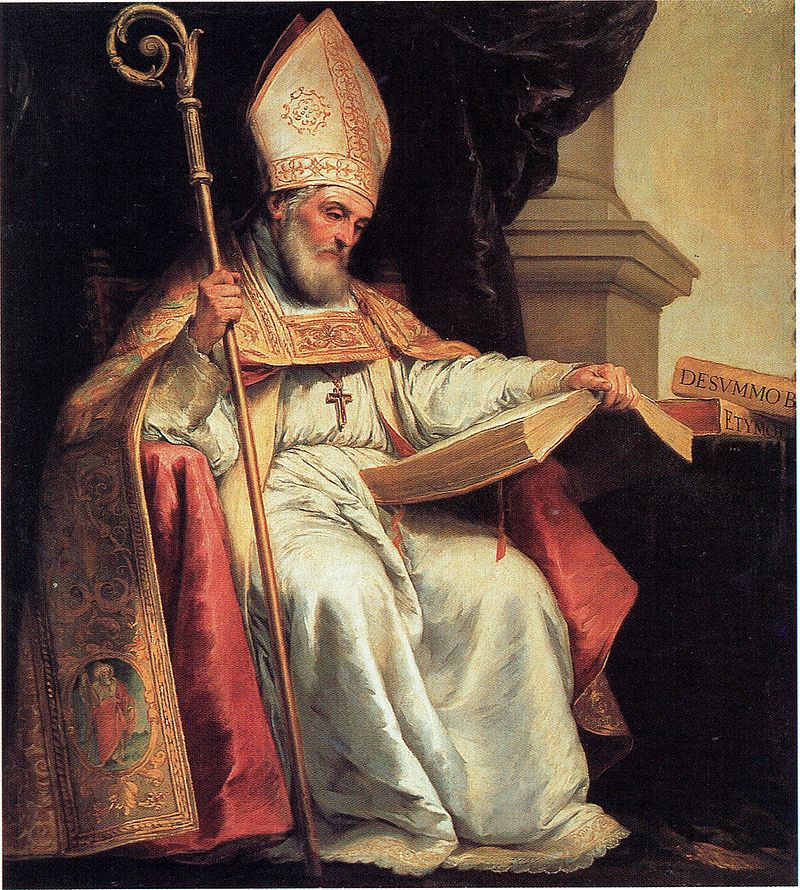
Today, April 4th, muted this year by Holy Saturday, is the commemoration of Saint Isidore of Seville (560-636) a bishop and doctor of the Church during a tumultuous age, when civilization was crumbling, coming apart at its very seams, which may sound sort of au courant. Then again, the form of this world has always[…]Continue reading→
Bishop Fulton Sheen’s 58th Good Friday Reflection
Incredible, at the beginning of this reflection, that the Venerable Bishop Sheen declares that he has given nearly 58 Good Friday reflections – this, as far as I can gather, was his final one, and he seems in full vigour in mind and body. The good bishop and evangelist died in his 84th year on[…]Continue reading→
A Minimal Friar and the Death of a Great Pope
This April the second- overshadowed by Holy Thursday this year – marks the memorial of Saint Francis of Paola (1417-1507), founder of the ‘Minim’ friars, so called for their humility and poverty, who interpreted the rule of Saint Francis of Assisi in quite a literal sense: extreme poverty, trust in God, foregoing all animal and[…]Continue reading→
Woven versus Seamless Garments
The reflection on the worthy project by Magie Dominic was intriguing, and I thought I would offer a brief follow-up commentary. The garment woven out of many pieces is a poignant symbol, even a ‘sacramental’, inspired by prayer and grace. We are all united in some way, and should strive for such unity, wherever we[…]Continue reading→
Bill C-9: Prelude to Persecution?
Well, it happened, as I suppose was inevitable, at least in a secular sense (from God’ perspective, there’s always hope). Bill C-9, the ironically named ‘Combatting Hate Act’ passed the House of Commons with a 186-137 vote. Look on the good side – there’s still over a hundred sane people in parliament who believe in[…]Continue reading→