
Blessed John Duns Scotus, One of the Great Lights of the Franciscan Order, the Church and the world
On the 8th day of November, the Franciscan Order celebrated its important beati, John Duns Scotus. This famous Scottish Franciscan reverbated God’s knowledge and holiness throughout the centuries.
In his Apostolic Letter in honour of John Duns Scotus, Alma Parens, Pope St Paul VI praised Scotus’ with these words:
Saint Francis of Assisi’s most beautiful ideal of perfection and the ardour of the Seraphic Spirit are embedded in the work of Scotus and inflame it, for he ever holds virtue of greater value than learning. Teaching as he does the pre-eminence of love over knowledge, the universal primacy of Christ, who was the greatest of God’s works, the magnifier of the Holy Trinity and Redeemer of the human race, King in both the natural and supernatural orders, with the Queen of the world, Mary Immaculate, standing beside him, resplendent in her untarnished beauty, Scotus develops to its full height each point of revealed Gospel truth: those Saint John the Evangelist and Saint Paul understood to be pre-eminent in the divine plan of salvation.
Pope St John Paul II also admired Blessed Duns Scotus’ intellect, that could be of great help in comabtting contemporary atheism. This formidable Franciscan brother, whose medieval philosophy still attracts many to study it, was always considered as one of the most influential philosophers in history. The widespread devotion to him culminated in his beatification on March 20, 1993.
For Pope Wojtyła Blessed Duns Scotus was both a genius and, much more, a man who led a holy life. In his homily regarding the confirmation of the cult of Blessed John Duns Scotus, on Saturday 20 March, 1993, he said: In our age, although rich in immense human, technical and scientific resources, but in which many have lost the sense of faith and lead a life far from Christ and his Gospel (cf. Redemptoris missio , 33), Blessed Duns Scotus presents himself not only with the acuteness of his ingenuity and the extraordinary ability to penetrate into the mystery of God, but also with the persuasive force of his holiness of life which makes him, for the Church and for all humanity, a Master of thought and life.
Following Paul VI, he continued: His doctrine, from which, as my venerable Predecessor Paul VI affirmed, “it will be possible to draw lucid weapons to fight and ward off the black cloud of atheism that obscures our age” (Epist. Apost. Alma Parens: AAS 58 [1966] 612), vigorously builds up the Church, supporting her in her urgent mission of new evangelization of the peoples of the earth. In particular, for Theologians, Priests, Pastors of souls, Religious, and especially for Franciscans, Blessed Duns Scotus is an example of fidelity to revealed truth, of fruitful priestly action, of serious dialogue in research…May his spirit and his memory illuminate the suffering and hopes of our society with the very light of Christ.
Scotus managed to develop the sensitive point of freedom in its relationship with both the will and the intellect. In his beautiful catechesis of July 7, 2010, on blessed John Duns Scotus, Pope Benedict XVI expounded this relationship in this magnificent way:
Duns Scotus has developed a point to which modernity is very sensitive. It is the topic of freedom and its relationship with the will and with the intellect. Our author underlines freedom as a fundamental quality of the will, introducing an approach that lays greater emphasis on the will. Unfortunately, in later authors, this line of thinking turned into a voluntarism, in contrast to the so-called “Augustinian and Thomist intellectualism”. For St Thomas Aquinas, who follows St Augustine, freedom cannot be considered an innate quality of the will, but, the fruit of the collaboration of the will and the mind. Indeed, an idea of innate and absolute freedom – as it evolved, precisely, after Duns Scotus – placed in the will that precedes the intellect, both in God and in man, risks leading to the idea of a God who would not even be bound to truth and good. The wish to save God’s absolute transcendence and diversity with such a radical and impenetrable accentuation of his will does not take into account that the God who revealed himself in Christ is the God “Logos”, who acted and acts full of love for us. Of course, as Duns Scotus affirms, love transcends knowledge and is capable of perceiving ever better than thought, but it is always the love of the God who is “Logos” (cf. Benedict XVI, Address at the University of Regensburg, 12 September 2006). In the human being too, the idea of absolute freedom, placed in the will, forgetting the connection with the truth, does not know that freedom itself must be liberated from the limits imposed on it by sin. All the same, the Scotist vision does not fall into these extremes: for Duns Scotus a free act is the result of the concourse of intellect and will, and if he speaks of a “primacy” of the will, he argues this precisely because the will always follows the intellect.
In his letter on the 30th anniversary of the confirmation of the cult of Blessed John Duns Scotus to the whole Order, written on March 12, 2023, and bearing the title: In Sanctity of Life and Knowledge of Faith, the ever-timely testimony of Blessed John Duns Scotus, the General Minister of the Franciscan Order, Br Massimo Fusarelli OFM gives two reasons why the study of Duns Scotus’ thought is most profitable.
The study of Duns Scotus’ thought is most opportune for at least two reasons. First of all, to adequately understand our cultural tradition, which has been forged through the centuries thanks to the doctrinal elaborations of those who were formed at the school of Scotus and – perhaps to a lesser extent – of Bonaventure. Our charismatic identity is shaped not only by reference to the founder, Francis of Assisi, but also, in his light, by the history of the friars of the following generations who were educated in the studia of the Order in the via Scoti. Secondly, Scotus’ thought can be a useful tool in our work of evangelisation. Francis of Assisi, in our Rule, in chapter nine, tells us: “I also admonish and exhort the brothers themselves that in their preaching their words be thoughtful and chaste for the benefit and edification of the people, announcing to the faithful the vices and virtues, the punishment and the glory with brevity of speech since the Lord spoke brief words on earth” (no.2).
Blessed John Duns Scotus, you strove to understand, explain, and defend the truths of the holy Christian Faith in the light of human reason.
For all truths, natural and supernatural, are from one and the same Source: the eternal God who is truth and light and love.
And so you proposed and expounded the perfect purity and holiness of the Blessed Virgin Mary in the first moment of her Immaculate Conception.
By her intercession and yours, may the Most Holy Trinity grant the conversion of sinners and the favor of: [add your request] Amen.
A Closed, Unsustainable, Descending Loop
As a follow-up to my thoughts on Payette’s payout, here be a stark image of where are here in Canada. As the graph shows in, well, graphic terms, since 2025, the public sector has contributed to 95.5% of economic growth. The private sector – which funds the public sector, or is supposed to – has[…]Continue reading→
Presidential Pardon of Weronika Krawczyk
As a good news, follow-up to our story from Poland, of the persecution of Weronika Krawczyk for her pro-life views, we heard that she has been granted a presidential pardon. One might still wonder why one needs a presidential pardon for simply holding the long-held belief that the child within the womb is a child,[…]Continue reading→
Pope Leo and a Rosary for Peace
Pope Leo XIV has asked Catholics across the world to join him in a Rosary for peace today, at 18:00 Rome time (6 pm), which would be noon from where I write (EST). If you are able, whether at that time or another, and in whatever way you pray, to join in intercession with the[…]Continue reading→
Payette’s Payout
I was glancing through some headlines, and noticed a mention of Julie Payette – engineer and astronaut and sometime the Queen’s representative in Canada – which brought back vague memories. She was appointed Governor-General by Justin Trudeau in 2017. Ms. Payette resigned in 2021, amidst claims that she created a ‘toxic work environment’, with allegations[…]Continue reading→
Weronika Krawczyk and Injustice in Poland
Catholic Action in Poland has issued a formal statement appealing to the President of the Republic of Poland to pardon Weronika Krawczyk—convicted for warning other women against an abortion-performing gynaecologist. Catholic Action (AK) emphasizes that no apology is owed to a doctor who has performed numerous abortions and proposed others; furthermore, the organization considers the[…]Continue reading→
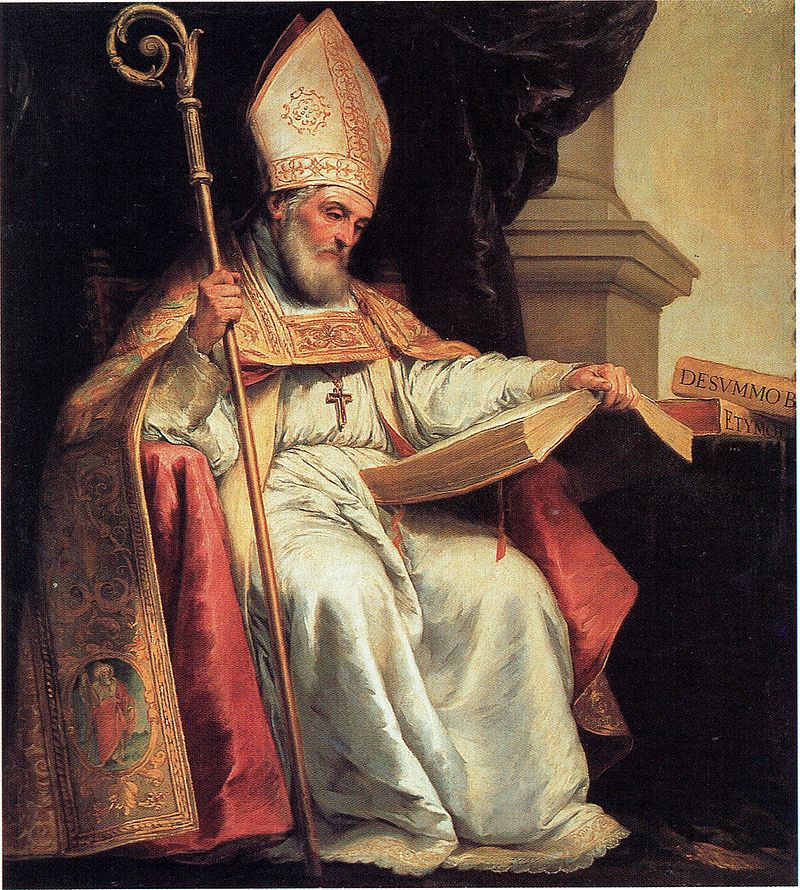
Saint Isidore of Seville, the Internet and Industriousness
Today, April 4th, muted this year by Holy Saturday, is the commemoration of Saint Isidore of Seville (560-636) a bishop and doctor of the Church during a tumultuous age, when civilization was crumbling, coming apart at its very seams, which may sound sort of au courant. Then again, the form of this world has always[…]Continue reading→
Bishop Fulton Sheen’s 58th Good Friday Reflection
Incredible, at the beginning of this reflection, that the Venerable Bishop Sheen declares that he has given nearly 58 Good Friday reflections – this, as far as I can gather, was his final one, and he seems in full vigour in mind and body. The good bishop and evangelist died in his 84th year on[…]Continue reading→
A Minimal Friar and the Death of a Great Pope
This April the second- overshadowed by Holy Thursday this year – marks the memorial of Saint Francis of Paola (1417-1507), founder of the ‘Minim’ friars, so called for their humility and poverty, who interpreted the rule of Saint Francis of Assisi in quite a literal sense: extreme poverty, trust in God, foregoing all animal and[…]Continue reading→
Woven versus Seamless Garments
The reflection on the worthy project by Magie Dominic was intriguing, and I thought I would offer a brief follow-up commentary. The garment woven out of many pieces is a poignant symbol, even a ‘sacramental’, inspired by prayer and grace. We are all united in some way, and should strive for such unity, wherever we[…]Continue reading→
Bill C-9: Prelude to Persecution?
Well, it happened, as I suppose was inevitable, at least in a secular sense (from God’ perspective, there’s always hope). Bill C-9, the ironically named ‘Combatting Hate Act’ passed the House of Commons with a 186-137 vote. Look on the good side – there’s still over a hundred sane people in parliament who believe in[…]Continue reading→