
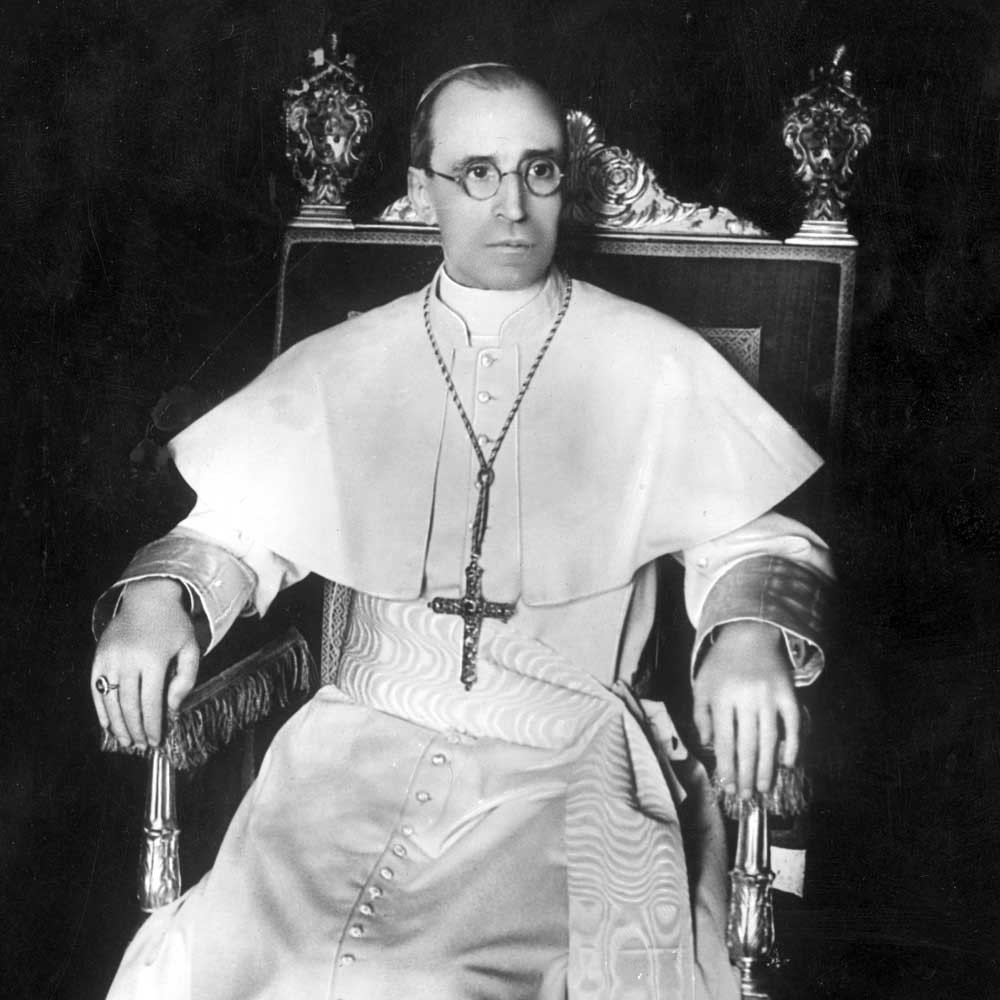
The Myth of “Hitler’s Pope”
Now and then we hear someone who is not well educated in history complain that Hitler was a Catholic and that the Vatican was complicit in helping the Nazis to murder millions of Jews.
It’s true that Hitler was baptized a Catholic, but it did not seem to take – by his own choice. By the time he was in his twenties he had ceased attending Mass. When he helped to establish the Nazi Party, the Catholic clergy in Germany were among his earliest and most vigorous critics. When he rose to absolute power in 1932, the largest single bloc of votes against him was the Catholic vote.
Here is an interesting comment on Hitler by G.K. Chesterton, the most famous Catholic writer of the 20th century:
“Having been asked the question ‘What in your opinion were the most stupid things of 1933,’ I can answer it very simply if I may be permitted to answer it sincerely. By far the stupidest thing done, not only in the last year, but in the last two or three centuries, was the acceptance by the Germans of the Dictatorship of Hitler.”
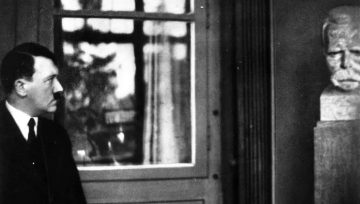
No Catholic writer is known to have strongly influenced Hitler. Indeed, one of his favorite writers was the atheist Frederick Nietzsche. There is a famous photo of Hitler admiring the unveiling of a bust of Nietzsche at the dedication of a newly erected museum in Nietzsche’s honor. It was Nietzsche who first conceived the Ubermensche (Superman) that Hitler no doubt imagined himself to be.
Immediately upon coming to power, Hitler sought to gain the recognition of the Catholic Church. This was accomplished by a concordat with the Vatican, but so far as the Church was concerned on one condition only, that the Nazis would not persecute the Church. As soon as the treaty with the Church was signed, Hitler immediately broke it and began closing down Catholic publishing houses and arresting priests, nuns, and laity known to oppose him. Many disappeared without a trial and ended up in prison camps with the Jews. The story of the persecution of the Catholic Church by the Nazis has never been fully told because it was eclipsed the the tragedy of the Holocaust.
By the time the Holocaust was in full swing, the Church was powerless to stop Hitler. All anyone could do was to run and hide from a nation swarming with Gestapo spies and informers. Hitler continued to pretend to be a Christian for political reasons, but he said privately to one confidant:
“The religions are all alike, no matter what they call themselves. They have no future – certainly none for the Germans. Fascism, if it likes, may come to terms with the Church. So shall I. Why not? That will not prevent me from tearing up Christianity root and branch and annihilating it in Germany.”
Jews were not the only victims of Nazi Germany. By most fair estimates, about three million Catholics were persecuted. Thousands of priests and nuns perished. In Germany the Catholic Church stood alone against the mighty power of the Nazis. Near the end of the War, Hitler, by then completely deranged, planned to kidnap the Pope, who had risked infuriating Hitler by arranging for the protection of several thousand Jews in Rome. SS General Karl Wolff had been charged with the mission that was eventually aborted.
The following remarks of Martin Niemöller, a Lutheran pastor in Germany who spent several years in one of Hitler’s concentration camps, appeared in the United States Congressional Record, October 14, 1968, page 31636:
“When Hitler attacked the Jews I was not a Jew, therefore I was not concerned. And when Hitler attacked the Catholics, I was not a Catholic, and therefore, I was not concerned. And when Hitler attacked the unions and the industrialists, I was not a member of the unions and I was not concerned. Then Hitler attacked me and the Protestant church — and there was nobody left to be concerned.”
The December 1940 edition of Time magazine included the following quote from Albert Einstein.
“Only the Church stood squarely across the path of Hitler’s campaign for suppressing truth. I never had any special interest in the Church before, but now I feel a great affection and admiration because the Church alone has had the courage and persistence to stand for intellectual truth and moral freedom. I am forced thus to confess that what I once despised I now praise unreservedly.”
Israel Zoli was the Chief Rabbi of Rome from 1939 to 1945, the worst years of the Holocaust. Zoli later became a Catholic and took for his baptismal name Eugenio, the given name of Pope Pius XII.
Here are remarks by Golda Meir, prime minister of Israel, upon the death of Pope Pius in 1958:
”During the 10 years of Nazi terror, when our people went through the horrors of martyrdom, the Pope raised his voice to condemn the persecutors and commiserate with their victims.”
There is much more evidence to be heard in favour of Pope Pius XII and other Catholics opposing Hitler and the Nazi regime. To examine this matter further the reader might consult Rabbi David G. Dalin’s book The Myth of Hitler’s Pope.
Pope Pius XII was declared by the Church a Servant of God in 1990 and Venerable in 2009, yet there are persistent ongoing attempts by enemies of the Church to slander him and ultimately prevent his canonization. We will see.

Remembering Father Alphonse de Valk
(Today marks the sixth anniversary of the death of Father Alphonse de Valk, C.S.B., a faithful, courageous and indefatigable Basilian priest, pro-life-and-family apostle, and the founder of Catholic Insight magazine. Here is what we wrote those on his entering into eternity five years ago, as we continue to remember him in our prayers and thoughts)[…]Continue reading→

Divine Mercy Sunday – An Echo of Every Mass
Reach out your hand and put it in my side. Do not doubt but believe’… ‘My Lord and my God!’ (Jn. 20:18)). Today is Divine Mercy Sunday, and as we celebrate the end of the Easter Octave, we contemplate the wounded side of our Saviour, the Church’s source of life. On Good Friday in the[…]Continue reading→

Saint Stanislaus of Szczepanów
We celebrate Saint Stanislaus today (+ April 11, 1079), in light of this Easter Octave, a bishop and martyr who accepted the episcopacy only at the direct order of Pope Alexander II. He proved a wise and courageous leader of his flock, put to death by his own king, Boleslaus, for rebuking the monarch’s ‘immoral[…]Continue reading→
First Holy Communion: Sermon from May 16, 1943
Here is a sermon from the good old days by +Rev. Msgr. Vincent Nicholas Foy (August 14, 1915 – March 13, 2017), from 1943. Readers may recall that Pope Saint Pius X, by the decree Quam Singulari in 1910, lowered the customary age of reception of Holy Communion – after the rigours of the plague[…]Continue reading→
In the Glorious Light of Easter, Alleluia!
Set your minds on things that are above, not on things that are on earth, for you have died, and your life is hidden with Christ in God. When Christ who is your life is revealed, then you also will be revealed with him in glory (Col. 3:3-4). The Resurrection of Our Lord and Saviour[…]Continue reading→
An Ancient Homily for Holy Saturday
The time between Good Friday and Easter Sunday is one of waiting, in silence, as the world wonders – anticipates – what will happen, after the death of Christ. We re-live this time each year in the anamnesis of our liturgy, and in turn look forward to the glorious re-creation of all things at the[…]Continue reading→
Europe’s Long Descent
(As we meditate on this day on Christ’s burial, and His descent into hell, it is fitting to ponder here with contributor Peter Marcus how the world seems to be heading there as well. The difference is that, although God cannot ‘redeem’ hell, nor those therein, He can and did redeem the world. There is[…]Continue reading→
Pope Saint John Paul II’s First Good Friday Homily
ADDRESS OF HIS HOLINESS JOHN PAUL II AT THE CONCLUSION OF THE STATIONS OF THE CROSS AT THE COLOSSEUM Good Friday, 13 April 1979 When we make the Way of the Cross from one station to the next, in spirit we are always at the spot wherethis journey had its “historical” place: where it[…]Continue reading→
A Meditation for Good Friday: How To Undo the Effects of Sin?
Cardinal Newman, now Saint John Henry Newman, was a towering figure of nineteenth-century Catholicism who is almost universally admired. I say “almost” because not everyone likes him. I knew a priest once, Arthur Caulkins, who has become disenchanted with Newman. As an undergraduate Arthur had been enamoured of Newman, and this interest continued when he[…]Continue reading→
Pope Benedict’s Last Holy Thursday Homily
MASS OF THE LORD’S SUPPER HOMILY OF HIS HOLINESS BENEDICT XVI Basilica of St John Lateran Holy Thursday, 5 April 2012 Photo Gallery (Video) Dear Brothers and Sisters! Holy Thursday is not only the day of the institution of the Most Holy Eucharist, whose splendour bathes all else and in some ways draws it to[…]Continue reading→