
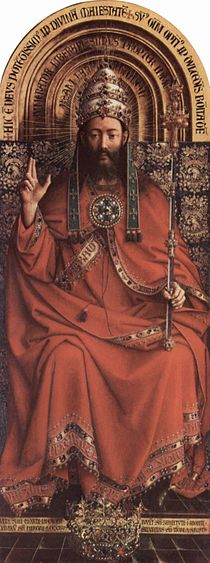
St. Michael of the Saints and the Mystical Exchange of Hearts
How do you calculate infinity? John Hopkin’s university Mathematician Emily Reil tried to explain the baffling concept of infinity to various audiences ranging from a toddler to graduate student qualifier. She explained that one of the fundamental understandings of infinity is that it is outside the bounds of finite reality. Therefore, to understand infinity is to inquire within the ambit of dark matter where time and locality are void and meaningless.
Two weeks ago, one of my colleagues from the University of the Philippines discovered the movement of particles in quantum physics paving the way to further understanding the M Theory or the 4-dimensional worldview. In their proceedings, he, together with some German mathematicians, saw the possibility of containing infinite numbers in a finite banality giving a closer look at the multi-dimensional facet of reality. This is a great leap in the scientific community after Heisenberg and a closer leap to proving Einstein’s theory of gravity and relativity in quantum mechanics. If this is proven, a whole array of studies in the field of metaphysics will begin, part of which is the proof of immateriality and doctrine of the soul.
A finite can contain an infinity, a limited with limitless, humanity with divinity.
Michael of the saints as known to us Trinitarians is one of the big guys of the Trinitarian hagiography. Not only was he one of the fastest canonizations we had, but because of the overflow of testimonies of life and miracles through his intercession. He is our St. Therese in the Trinitarian family.
But though his life is adorned with millions of attestations, one anecdote is seemingly forgotten, his mystical exchange of heart. In the biographical account of Miguel written by our Brother Eric Beardsley, he identified the exchange of hearts between Miguel and Jesus. In the story, one night Michael is praying that he be the heart of Jesus to the parish he served, and so granting his desire, Jesus took his heart and exchanged it for his. In the account of Br. Louis. One night, while doing the rounds, he saw Miguel lifted up in the air with Jesus holding him on the side, then with a quick flash of light, he saw Jesus take Miguel’s heart and put his own. Panicked by what he saw, he went inside the room and found Michael burning with fever and unconscious, then looking at the place where Jesus had put his heart he saw in blurred dim vision a heart beating inside Miguel’s habit, a palm-heart-shaped with a crown of piercing thorns. Gaining consciousness Michael forbade Louis to tell no one about what he saw and plead that he kept it secret until his death.
How can the human contain the divine?
We celebrated the feast of Corpus Christi last Sunday. It is traditionally celebrated on Thursday after Trinity Sunday to show the relevance of the divinity and Humanity of Christ in the person of the Trinity. A mystery that echoes the proposition of St. Cyril hundreds and hundreds of years ago to the possibility of humanity containing divinity.
This then will be developed by St. Thomas Aquinas in his famous explanation of the doctrine of transubstantiation, the unity of Divinity and Humanity of Christ in the Eucharist, under the appearance of bread, which we receive.
The Second Vatican Council, in safeguarding this most solemn teaching, extends the real presence of Christ to the Church itself. Sacrosanctum Concilium (par. 7) states that Christ is not only present in the Eucharist, but – in an analogous way – also in the Minister and in the congregation, all forming the one body of Christ, a mystery that has been understood in the time of early Christians where Paul addresses the people as the “body of Christ.”
Christ now becomes present not just in the species of bread, but He is present to every Christian at the very moment of the holy Sacrifice where the entire creation is consecrated back to God himself, a soteriological action of Christ which was, is, and will be until the end of the times.
This is primarily the reason why the Catholic faith safeguards human dignity, as reflected in every individual is the very same Christ himself. Thus, this celebration of the Body and Blood of Christ is not just a festal commemoration of triumphant Christ the King, but a challenge to every Christian to see Christ in every person we meet, a Christ that is wounded, hungry, homeless, sick, and even dying.
Yves Congar put it well: If you cannot see Christ in the suffering of your neighbor, I highly doubt that you can see him in this Eucharist; for how can you say that you love God and at the same time hate your neighbor? How is it possible to love what you cannot see and hate what you can?
Quantum mechanics may be at its initial stage in fathoming the possibility of containing the infinite within the finite, but the Church and the very mystery we celebrate every day are already a testament to the possibility of a finite containing an infinity. Within the limits of what seems bread, contains the immensity of God.
This is also mirrored in the life of Michael of the saints, especially in the mystical exchange of heart, a finite human being containing within him the infinite divinity of the heart of Jesus.
How do you calculate infinity? John Hopkin’s university Mathematician Emily Reil tried to explain the baffling concept of infinity to various audiences ranging from a toddler to graduate student qualifier. She explained that one of the fundamental understandings of infinity is, it is outside the bounds of finite reality but for us Catholic Christians, infinity cannot be outside the bounds of finite reality, for Jesus, who is divine is seen, mirrored, and experienced in our neighbors in need.
Humanity containing divinity, a finite containing infinity, a faith and a mystery.

Saint Kateri , Canada’s Protectress
This was the title given to Saint Kateri Tekakwitha, by Pope Benedict XVI, when he canonized her on October 28th, 2012, along with six others, in Saint Peter’ Square (she had been beatified by Pope John Paul II back in 1980). With Saint Joseph as our protector, along with the Canadian martyrs, we seem to[…]Continue reading→

Remembering Father Alphonse de Valk
(Today marks the sixth anniversary of the death of Father Alphonse de Valk, C.S.B., a faithful, courageous and indefatigable Basilian priest, pro-life-and-family apostle, and the founder of Catholic Insight magazine. Here is what we wrote those on his entering into eternity five years ago, as we continue to remember him in our prayers and thoughts)[…]Continue reading→

My Name is Bernadette
April 16th is a propitious day, for besides the anniversary of Father de Valk’s death, who founded Catholic Insight in its print form decades ago, and the commemoration of the ‘two Benedicts’, mentioned in accompanying posts, today we also recall Saint Bernadette Soubirous, the young visionary to whom the Virgin Mary appeared numerous times at[…]Continue reading→
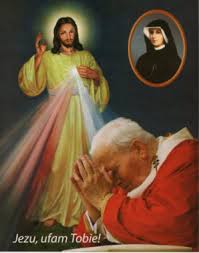
Canonizing Sister Faustina and Divine Mercy
HOMILY OF THE HOLY FATHER MASS IN ST PETER’S SQUARE FOR THE CANONIZATION OF SR MARY FAUSTINA KOWALSKA Sunday, 30 April 2000 1. “Confitemini Domino quoniam bonus, quoniam in saeculum misericordia eius”; “Give thanks to the Lord for he is good; his steadfast love endures for ever” (Ps 118: 1). So the Church sings on the Octave of[…]Continue reading→
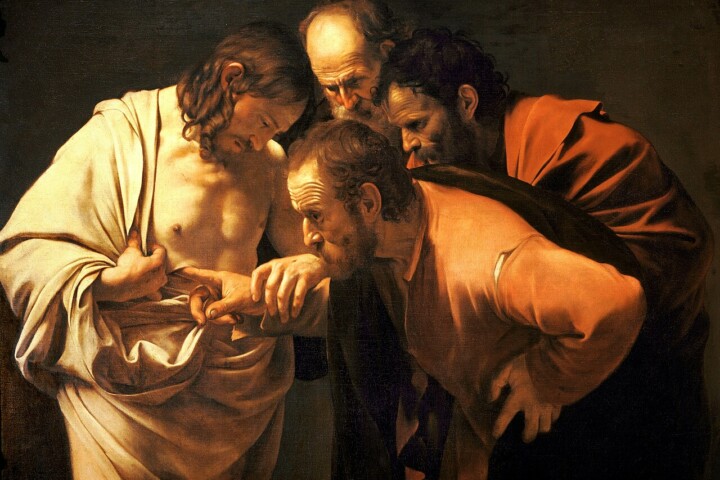
Divine Mercy Sunday – An Echo of Every Mass
Reach out your hand and put it in my side. Do not doubt but believe’… ‘My Lord and my God!’ (Jn. 20:18)). Today is Divine Mercy Sunday, and as we celebrate the end of the Easter Octave, we contemplate the wounded side of our Saviour, the Church’s source of life. On Good Friday in the[…]Continue reading→

Saint Stanislaus of Szczepanów
We celebrate Saint Stanislaus today (+ April 11, 1079), in light of this Easter Octave, a bishop and martyr who accepted the episcopacy only at the direct order of Pope Alexander II. He proved a wise and courageous leader of his flock, put to death by his own king, Boleslaus, for rebuking the monarch’s ‘immoral[…]Continue reading→
First Holy Communion: Sermon from May 16, 1943
Here is a sermon from the good old days by +Rev. Msgr. Vincent Nicholas Foy (August 14, 1915 – March 13, 2017), from 1943. Readers may recall that Pope Saint Pius X, by the decree Quam Singulari in 1910, lowered the customary age of reception of Holy Communion – after the rigours of the plague[…]Continue reading→
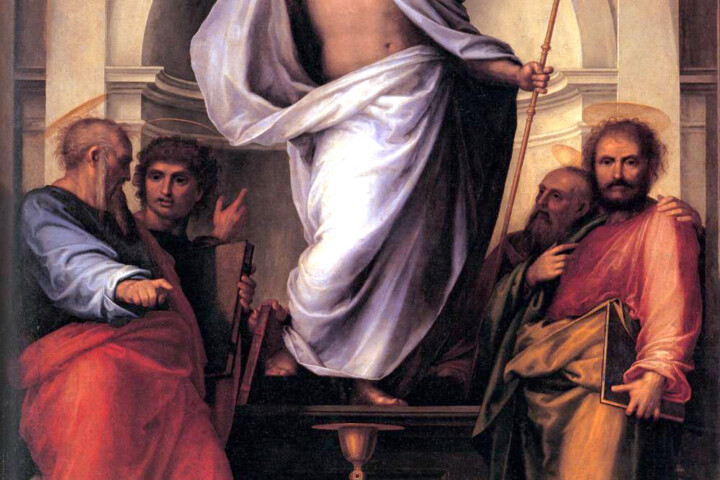
In the Glorious Light of Easter, Alleluia!
Set your minds on things that are above, not on things that are on earth, for you have died, and your life is hidden with Christ in God. When Christ who is your life is revealed, then you also will be revealed with him in glory (Col. 3:3-4). The Resurrection of Our Lord and Saviour[…]Continue reading→
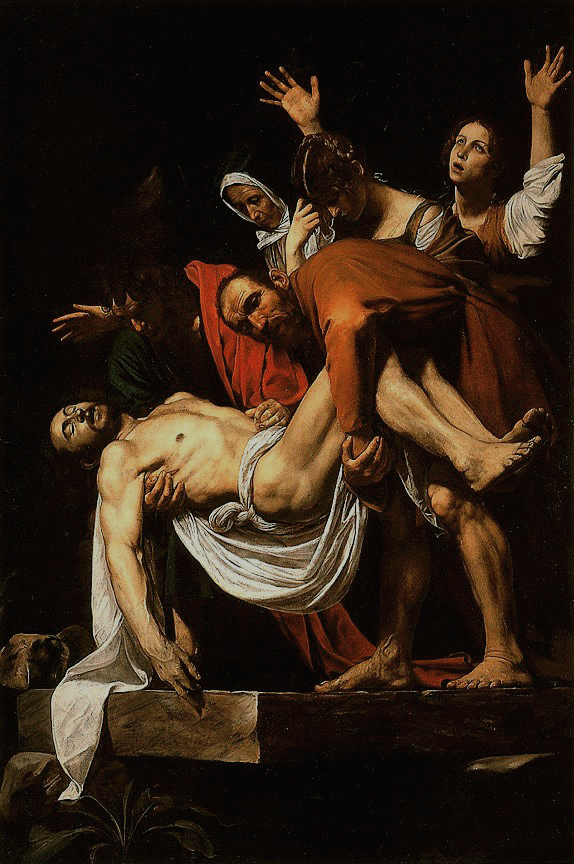
An Ancient Homily for Holy Saturday
The time between Good Friday and Easter Sunday is one of waiting, in silence, as the world wonders – anticipates – what will happen, after the death of Christ. We re-live this time each year in the anamnesis of our liturgy, and in turn look forward to the glorious re-creation of all things at the[…]Continue reading→
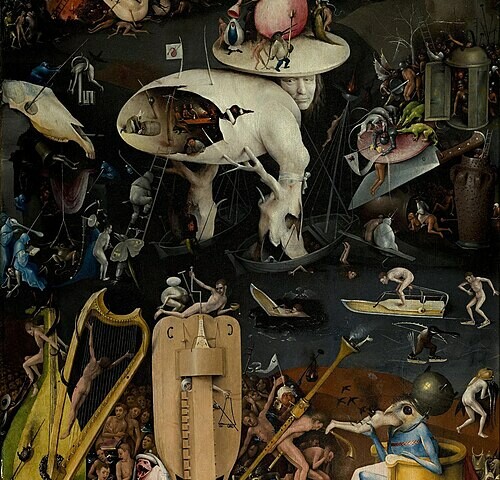
Europe’s Long Descent
(As we meditate on this day on Christ’s burial, and His descent into hell, it is fitting to ponder here with contributor Peter Marcus how the world seems to be heading there as well. The difference is that, although God cannot ‘redeem’ hell, nor those therein, He can and did redeem the world. There is[…]Continue reading→