
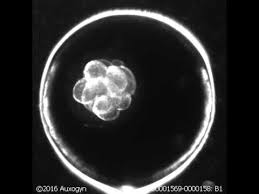
The Term Pre-Embryo Within the Abortion Debate
It has been suggested by some, primarily within the pro-life movement, that the term pre-embryo should not be used in discussing the stages of pregnancy and fetal development. Their argument is that the term diminishes the value of the embryo proper as being less than a human person. This could then be used to advocate for abortion and embryo experimentation in the very early stages of pregnancy because an individual person does not yet exist. For these reasons, the term pre-embryo has become and remains highly contentious.
In its 1987 Instruction, Donum Vitae, the Congregation for the Doctrine of the Faith stated: The terms “zygote”, “pre-embryo”, “embryo” and “foetus” can indicate in the vocabulary of biology successive stages of the development of a human being. The present Instruction makes free use of these terms, attributing to them an identical ethical relevance, in order to designate the result (whether visible or not) of human generation, from the first moment of its existence until birth.[1]
The term pre-embryo and the various discussions related to its use can be traced to 1978 when the first test tube baby, Louise Brown, was born. The Ethics Advisory Board in the United States felt the need to carefully examine the ethical aspects of artificial reproductive techniques such as in-vitro fertilization. Their report, published in May, 1979, indicated that the human embryo in its first days of existence is only a growing form of human life, with a high degree of natural mortality and lacking individuality, arguing that the appearance of the primitive streak is one of the basic elements of embryo individualization. The report identified an interval of fourteen days after fertilization during which the human embryo was considered to have no special status, and suggested that most scientific research was ‘ethically’ acceptable. As noted above, the word pre-embryo did not appear in any section of the report. Neither did any specialist in human embryology form part of the committee.[2]
Soon thereafter, the term pre-embryo was first used in 1979 by a developmental biologist by the name of Clifford Grobstein.[3] Grobstein was not a human embryologist. During his career and in his writings the evidence suggests that in 1986 he was a strong believer of the idea that the embryo in its pre-implantation stage had no moral value.[4]
In 1986, the Ethics Committee of The American Fertility Society, published a report entitled Ethical Considerations of the New Reproductive Technologies. During their deliberations it became apparent that a designation was required for the stage of the conceptus for the interval between the end of the process of fertilization until the establishment of biologic individuation – that is, only one unique individual from the development of the fertilized egg. This timeframe extends from fertilization to the formation of the primitive streak. Prior to this individuation a fertilized egg could split into twins, triplets, or even more individuals. The committee selected the term pre-embryo to describe this stage. At the same time, quite independently, the Volunteer Licensing Authority (established by the Royal College of Obstetricians and Gynaecologists) also selected the same term.[5]
It is generally agreed that the independent yet simultaneous selection of the term pre-embryo by both these organizations was instrumental in bringing it into common usage.
Unfortunately, in spite of this seemingly rational argument for the use of the term pre-embryo, many have continued to argue against its use.
As recently as 1997, in its Cloning Human Beings: Report and Recommendations, the National Bioethics Advisory Commission published the definition of embryo as “the developing organism from the time of fertilization until significant differentiation has occurred, when the organism becomes known as a fetus.” The term pre-embryo was never used.[6]
In its 1993 edition, The Harper Collins Illustrated Medical Dictionary defines an embryo “as an organism in the earliest stage of development; in a man, from the time of conception to the end of the second month in the uterus.” [7]
Dr. John Eppig, Senior Staff Scientist, a member of the National Institutes of Health Human Embryo Research Panel has stated that, “I would say that among most scientists, the word ‘embryo’ includes the time from after fertilization…” [8]
These references indicate that, even through recent time, prominent authors and institutions continue to use the term embryo from the time of fertilization
Indeed, in 1997, C. Ward Kischer argued that the term pre-embryo has been seized upon and used for the justification for discarding human embryos in abortion procedures, their use in fetal tissue research, and human embryo research.[9] Other terms equivalent to pre-embryo, such as preimplantation embryo,[10] have also raised objections within the pro-life movement.
In short, there appears to be no clear agreement on a precise definition for the term pre-embryo.
So, the question arises: can the term pre-embryo be used non-prejudicially within the abortion debate?
Since it was first coined in 1979 by Clifford Grobstein, the term pre-embryo has unfortunately been used in various ways and at various times seemingly to fit the writer’s agenda, be it political or scientific.
There can be no doubt that the term pre-embryo can be used by pro-abortion or pro-embryo/fetal experimentation advocates.
Precise terminology is crucial for communication in the sciences. As such, pre-embryo can be a valuable descriptive term to refer to that period of time from fertilization to the development of the primitive streak which indicates one individual person. Prior to the development of the primitive streak the pre-embryo can split into multiple individual persons.
Biologic development as a factor for moral status is a subject unto itself, but goes back at least to Aristotle and was used in the Christian era by Aquinas, Augustine, and others. Even today is a critical consideration by moral theologians in assigning moral status.[11]
[1] Donum Vitae: Instruction on Respect for Human Life in its Origin and on the Dignity of Procreation. Congregation for the Doctrine of the Faith, 1987.
[2] Modesto, F.C. The Pre-embryo’s Short Lifetime: The History of a Word. Cuadernos de bioetica, 23, 2012/3.
[3] Grobstein, C. 1995. Human Development from Fertilization to Birth. In Encyclopedia of Bioethics. R.W. Thomas, ed. New York: McMillan. Vol 2, Fetus I: 847-851.
[4] Ibid.
[5] Jones, H.W. And Just What is a Pre-embryo? Fertility and Sterility, 52:2, 1989.
[6] Report and Recommendations of the National Bioethics Advisory Commission. Rockville, MD: GPO, 1997, Appendix-2.
[7] Dox, Ida G. et al. The Harper Collins Illustrated Medical Dictionary. New York: Harper Perennial, 1993, p. 146.
[8] NIH Human Embryo Research Panel — Panel Transcript, February 2, 1994, p. 31.
[9] Kischer, C. Ward. The Big Lie in Human Embryology: The Case of the Preembryo. The Linacre Quarterly 64: 4.
[10] National Institutes of Health (NIH), Transcripts of the Human Embryo Research Panel, 1994, September 27 session, p. 2-7.
[11] Ford NF: When Did I Begin? Cambridge, University Press, 1988.

Remembering Father Alphonse de Valk
(Today marks the sixth anniversary of the death of Father Alphonse de Valk, C.S.B., a faithful, courageous and indefatigable Basilian priest, pro-life-and-family apostle, and the founder of Catholic Insight magazine. Here is what we wrote those on his entering into eternity five years ago, as we continue to remember him in our prayers and thoughts)[…]Continue reading→

Divine Mercy Sunday – An Echo of Every Mass
Reach out your hand and put it in my side. Do not doubt but believe’… ‘My Lord and my God!’ (Jn. 20:18)). Today is Divine Mercy Sunday, and as we celebrate the end of the Easter Octave, we contemplate the wounded side of our Saviour, the Church’s source of life. On Good Friday in the[…]Continue reading→

Saint Stanislaus of Szczepanów
We celebrate Saint Stanislaus today (+ April 11, 1079), in light of this Easter Octave, a bishop and martyr who accepted the episcopacy only at the direct order of Pope Alexander II. He proved a wise and courageous leader of his flock, put to death by his own king, Boleslaus, for rebuking the monarch’s ‘immoral[…]Continue reading→

First Holy Communion: Sermon from May 16, 1943
Here is a sermon from the good old days by +Rev. Msgr. Vincent Nicholas Foy (August 14, 1915 – March 13, 2017), from 1943. Readers may recall that Pope Saint Pius X, by the decree Quam Singulari in 1910, lowered the customary age of reception of Holy Communion – after the rigours of the plague[…]Continue reading→

In the Glorious Light of Easter, Alleluia!
Set your minds on things that are above, not on things that are on earth, for you have died, and your life is hidden with Christ in God. When Christ who is your life is revealed, then you also will be revealed with him in glory (Col. 3:3-4). The Resurrection of Our Lord and Saviour[…]Continue reading→

An Ancient Homily for Holy Saturday
The time between Good Friday and Easter Sunday is one of waiting, in silence, as the world wonders – anticipates – what will happen, after the death of Christ. We re-live this time each year in the anamnesis of our liturgy, and in turn look forward to the glorious re-creation of all things at the[…]Continue reading→

Europe’s Long Descent
(As we meditate on this day on Christ’s burial, and His descent into hell, it is fitting to ponder here with contributor Peter Marcus how the world seems to be heading there as well. The difference is that, although God cannot ‘redeem’ hell, nor those therein, He can and did redeem the world. There is[…]Continue reading→
Pope Saint John Paul II’s First Good Friday Homily
ADDRESS OF HIS HOLINESS JOHN PAUL II AT THE CONCLUSION OF THE STATIONS OF THE CROSS AT THE COLOSSEUM Good Friday, 13 April 1979 When we make the Way of the Cross from one station to the next, in spirit we are always at the spot wherethis journey had its “historical” place: where it[…]Continue reading→
A Meditation for Good Friday: How To Undo the Effects of Sin?
Cardinal Newman, now Saint John Henry Newman, was a towering figure of nineteenth-century Catholicism who is almost universally admired. I say “almost” because not everyone likes him. I knew a priest once, Arthur Caulkins, who has become disenchanted with Newman. As an undergraduate Arthur had been enamoured of Newman, and this interest continued when he[…]Continue reading→
Pope Benedict’s Last Holy Thursday Homily
MASS OF THE LORD’S SUPPER HOMILY OF HIS HOLINESS BENEDICT XVI Basilica of St John Lateran Holy Thursday, 5 April 2012 Photo Gallery (Video) Dear Brothers and Sisters! Holy Thursday is not only the day of the institution of the Most Holy Eucharist, whose splendour bathes all else and in some ways draws it to[…]Continue reading→