
Fourth Sunday and the Spirit of Advent
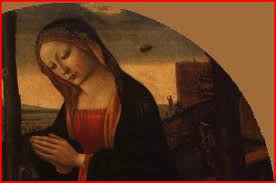
The figures of Advent we have met in the liturgy are the prophet Isaiah, John the Baptist and now, on the fourth Sunday, Our Lady, the Blessed Virgin. Saint Matthew’s account is brief, almost matter of fact: “She was found to be with child by the Holy Spirit.” It is Luke’s account, read this morning, that has captured the imagination of artists, who delighted to show the Archangel Gabriel as he invited Mary to be the mother of the Christ. The Eastern Church has a fine way of describing the event; it’s known as “the evangelization of Mary,” thus highlighting the moment that she, before all others, received the good news about the coming of the Messiah. Some painters have included the Holy Spirit in the form of a dove. There was a charming conceit in some of those pictures. If you examine carefully the rays of light emanating from the dove, you can discern on one of them a tiny infant making his way to the womb of the Virgin.
Scripture places great emphasis on childbearing. It was important because being born of Jewish parents meant that the child was a member of the chosen people. It is not surprising, then, that the heroes of Israel were marked by God from the moment of their conception, which was often marvelous: Isaac was born to Sarah in her old age; Jacob and Esau were twins, already at loggerheads in the womb; the Joseph of the Old Testament, the man who saved the nation in time of famine, was born to Rachel, previously barren, as was Samuel to Hannah. Scripture has a charming way of describing pregnancy: the woman is said “to be with child.” But if those Old-Testament births were wonderful, they pale in comparison with that of John the Baptist, carried in the womb of the previously barren Elizabeth, and the miraculous conception of Jesus, which we celebrate today. John was precocious; he leapt in his mother’s womb when he sensed the presence of Jesus in the womb of Mary as she approached the house of Zechariah.
Protestants typically have a much better acquaintance with the Bible than Catholics. One effect of their careful reading and rereading of Scripture has been a strong commitment to the personhood, even to the personality, of a child before birth, an attitude that has weakened among some Protestants, probably owing to a certain scepticism about the historicity of Scripture that rose among their biblical scholars. Catholics, traditionally, share this reverence for life in the womb, but for another reason. It arose and is strengthened mainly by the intense devotion of Catholics to the Blessed Virgin. She has been the subject of countless paintings and statues, usually as the Madonna with the child Jesus in her arms. Some paintings of the Visitation, like a sort of X-ray, show John leaping in the womb of his mother and Jesus reposing in Mary’s. Countless churches have been dedicated to her, and children—boys as well as girls—have been christened with her name. Hymns from mediæval times celebrated her vocation and her virtue. One poetic image was particularly popular. It pointed to the paradox that He who created the planets and the stars was confined to Mary’s womb, and He who provided food for the beasts of the field and the birds of the air was nursed as his mother’s breast. “The Son of God,” they sang, “is now Son of Mary.” Mary’s own conception is observed in the popular feast of the Immaculate Conception on 8th of December. (I might note here that this conception was not miraculous; she was conceived in the usual way. It is “immaculate” because, by an anticipation of the merits of Christ Jesus, she was preserved from Original Sin.) These various considerations, along with the witness of the Bible, have produced in Catholics an unshakeable conviction of the full humanity of the unborn child. The popes, especially John Paul II, have merely expressed officially this universal conviction.
Not all Catholics today share this conviction. Like progressive elements in contemporary Canada, many Catholics challenge the rights of the unborn. One may wonder how such a change could occur. There were, no doubt, many influences at work to effect so fundamental an alteration in piety and belief. If I had to account for it, I would say that it arose indirectly from the liturgical changes over the last fifty years or so that have made Catholics much more responsive to our secular society. Many of the changes were welcome as the use of the vernacular made the Mass immediately accessible and the wider use of the Bible for the readings brought home the power of God’s word. What was lacking, I would say, were new devotional practices that would transform Catholicism from a mere Sunday observance into a way of life for its practitioners. There were many such devotions in the past. Consider “holy days of obligation,” e.g., on which Catholics were required to attend Mass: the 8th of December was one, as was the Epiphany (6 January) and All Saints Day (1 November). The effect was to draw attention to these important feasts. Similarly, the fast before receiving Communion was from midnight the day before, and it was absolute, broken even by water. It was an effective way to instill reverence in the communicant. “Evening devotions” were also well attended, consisting of the rosary, sometimes a sermon, and benediction of the Blessed Sacrament. Days of fast and abstinence were observed during ember days and the penitential seasons of Lent and, in a modified manner, Advent. Even Christmas eve was such a day, with the penitential spirit of Advent ending only after twelve o’clock, and midnight Mass was actually celebrated at midnight. Nowadays, unless I err, you will all have been celebrating a sort of commercial Christmas since Thanksgiving and will have become royally weary of the whole thing by ‘boxing day’ (the feast of Stephen!) — which, incidentally, is the day that the Church continues its observance of the feast, the first of the twelve days of Christmas that end on the feast of the Epiphany, the 6th of January. The overall effect of such practices was to make our forbears in the faith more religiously conscious, more involved in the practice of the faith than is the case now when few such practices are universally observed. As a result, our commitment to Catholicism and traditional Catholic teaching, I would venture to say, is weaker than it was in the time of our grandparents.
In this time of crisis in the Church when Pope Francis is accommodating many traditions and traditional teachings of Catholicism to the needs of the times, each of us must realize that no mere external change can substitute for a radical commitment to the following of Christ that has its effect on our everyday lives.

Saint Kateri , Canada’s Protectress
This was the title given to Saint Kateri Tekakwitha, by Pope Benedict XVI, when he canonized her on October 28th, 2012, along with six others, in Saint Peter’ Square (she had been beatified by Pope John Paul II back in 1980). With Saint Joseph as our protector, along with the Canadian martyrs, we seem to[…]Continue reading→

Remembering Father Alphonse de Valk
(Today marks the sixth anniversary of the death of Father Alphonse de Valk, C.S.B., a faithful, courageous and indefatigable Basilian priest, pro-life-and-family apostle, and the founder of Catholic Insight magazine. Here is what we wrote those on his entering into eternity five years ago, as we continue to remember him in our prayers and thoughts)[…]Continue reading→

My Name is Bernadette
April 16th is a propitious day, for besides the anniversary of Father de Valk’s death, who founded Catholic Insight in its print form decades ago, and the commemoration of the ‘two Benedicts’, mentioned in accompanying posts, today we also recall Saint Bernadette Soubirous, the young visionary to whom the Virgin Mary appeared numerous times at[…]Continue reading→

Canonizing Sister Faustina and Divine Mercy
HOMILY OF THE HOLY FATHER MASS IN ST PETER’S SQUARE FOR THE CANONIZATION OF SR MARY FAUSTINA KOWALSKA Sunday, 30 April 2000 1. “Confitemini Domino quoniam bonus, quoniam in saeculum misericordia eius”; “Give thanks to the Lord for he is good; his steadfast love endures for ever” (Ps 118: 1). So the Church sings on the Octave of[…]Continue reading→

Divine Mercy Sunday – An Echo of Every Mass
Reach out your hand and put it in my side. Do not doubt but believe’… ‘My Lord and my God!’ (Jn. 20:18)). Today is Divine Mercy Sunday, and as we celebrate the end of the Easter Octave, we contemplate the wounded side of our Saviour, the Church’s source of life. On Good Friday in the[…]Continue reading→

Saint Stanislaus of Szczepanów
We celebrate Saint Stanislaus today (+ April 11, 1079), in light of this Easter Octave, a bishop and martyr who accepted the episcopacy only at the direct order of Pope Alexander II. He proved a wise and courageous leader of his flock, put to death by his own king, Boleslaus, for rebuking the monarch’s ‘immoral[…]Continue reading→

First Holy Communion: Sermon from May 16, 1943
Here is a sermon from the good old days by +Rev. Msgr. Vincent Nicholas Foy (August 14, 1915 – March 13, 2017), from 1943. Readers may recall that Pope Saint Pius X, by the decree Quam Singulari in 1910, lowered the customary age of reception of Holy Communion – after the rigours of the plague[…]Continue reading→

In the Glorious Light of Easter, Alleluia!
Set your minds on things that are above, not on things that are on earth, for you have died, and your life is hidden with Christ in God. When Christ who is your life is revealed, then you also will be revealed with him in glory (Col. 3:3-4). The Resurrection of Our Lord and Saviour[…]Continue reading→

An Ancient Homily for Holy Saturday
The time between Good Friday and Easter Sunday is one of waiting, in silence, as the world wonders – anticipates – what will happen, after the death of Christ. We re-live this time each year in the anamnesis of our liturgy, and in turn look forward to the glorious re-creation of all things at the[…]Continue reading→

Europe’s Long Descent
(As we meditate on this day on Christ’s burial, and His descent into hell, it is fitting to ponder here with contributor Peter Marcus how the world seems to be heading there as well. The difference is that, although God cannot ‘redeem’ hell, nor those therein, He can and did redeem the world. There is[…]Continue reading→