
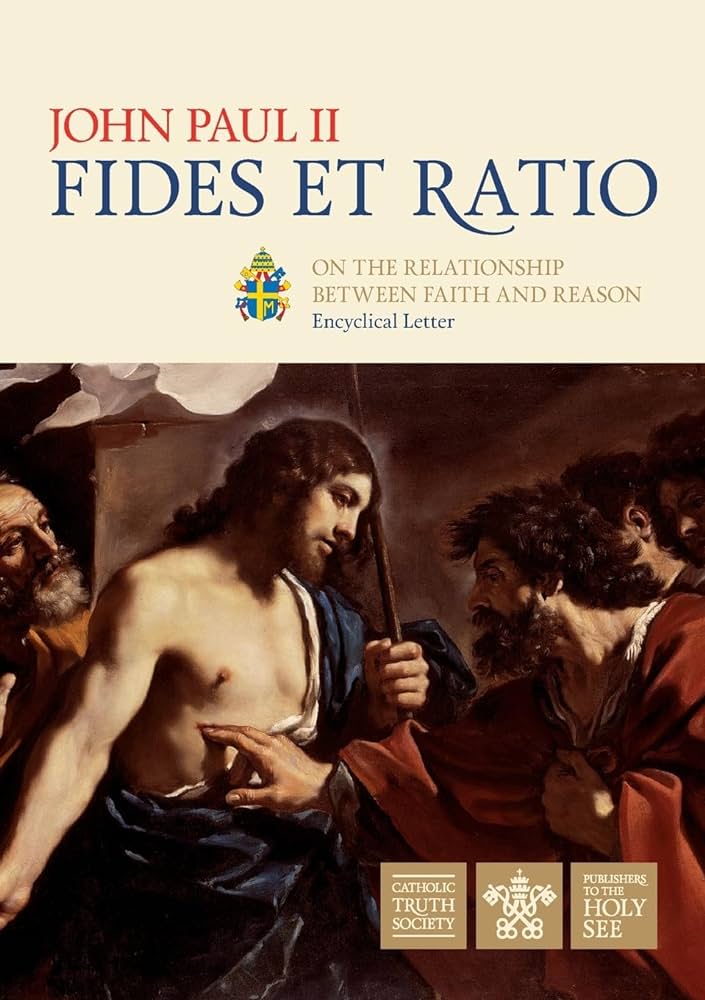
Faith, Reason and Formal Objects
In 1998, 25 years ago, Pope Saint John Paul II published his encyclical, Fides et Ratio, on the relationship between faith and reason, the ‘two wings on which human reason rises to the heights of truth’. Everything we know, we know by these two modes – either we figure it out with our own wits, or we trust someone else who has done so.
Yet, as much as we are rational by nature, and fond of discovering things on our own, almost everything we know we know by faith. There’s not much we could ‘prove’ by ourselves: Take, amongst any number of examples, the following propositions: water is H2O; everything in fact composed of tiny particles called ‘atoms’, connected by electromagnetic forces; New Zealand exists; the Marianas trench is 35,000 feet deep; the Moon is 240,000 miles away and revolving around the Earth at 6000 miles per hour; that our Earth is part of a solar system, within galaxy 100,000 light years across, itself one of billions of other galaxies across a vast universe; that Julius Caesar was assassinated on the Ides of March; and that Jesus Christ, the Son of God, the Second Person of the Blessed Trinity, was born 44 years after that, and died on Good Friday at the age of 33.
We could add to this list ad infinitum, including everything that people tell us about themselves. All these truths, inasmuch as we deem them to be true, we hold them because we trust people, more or less – and we will see about the ‘less’ part, which seems now to be predominating.
My thoughts on these matters were prompted by this recent article on Wikipedia – and by ‘on wikipedia’, I don’t mean it was found on that webpage, but the article is about the on-line encyclopedia, and its own trustworthiness – or lack thereof. It seems there has been a completely fictitious entry on a battle that never happened, and no one noticed for years. Perhaps no one read it; perhaps it was widely cited in undergraduate essays.
We should state, in passing, that the articles on Wikipedia are in the main quite accurate, even if biased and often selective in what it presents, especially on hot-button issues, so what it says should be checked with other sources.
After all, when we trust some impersonal entity – whether a corporation such as Wikipedia, Fox News, CNN, Meta, the Vatican webpage – or the books, newspapers, magazines – our faith is ultimately in the persons behind the scenes, the authors and editors. Faith, and trust, are always, in the end, personal relationships, which is why they are so fraught, and fragile. For, persons are fallible, even duplicitous.
Is there no one we can trust, completely, no infallible source of truth?
We can find answer, along with a helpful distinction from Saint Thomas’ Summa Theologica: In his own first article on faith (II-II.1.1), he states that when we believe something, there are two things in play: There is the material object, what we know, and, more importantly, the formal object, or why we know it. As he puts it:
The object of every cognitive habit includes two things: first, that which is known materially, and is the material object, so to speak, and, secondly, that whereby it is known, which is the formal aspect of the object
In faith, the formal object is the authority we trust, which is primary, for we only trust the material object – what they say – inasmuch as we first trust the formal object, and this trust grows the more the we deem the material object true. If, on the other hand, the formal object is deemed untrustworthy, then what that authority afterwards says will be taken cum grano salis. If the formal object is erroneous or mendacious often enough – even once may be enough – trust may completely break down, and everything the formal object says will be outright rejected.
It need hardly be said that we are living in an age of deception, as the devil – a liar and murderer from the beginning – prowls around the world and his minions, witting and unwitting, are everywhere. We make our way through a veritable blizzard of lies, as one pundit put it. Our once-trusted authorities – news media, government, medical personnel, scientific experts – have been caught in so many errors and falsehoods and errors – whether deliberate or not – that many are turning out, and seeking other ‘formal objects’ – alternate sources – to fill in the vacuum of authority.
For all that, we should not fall into universal skepticism, or the radical doubt of Descartes. Yes, scientists, and physicians, have been grossly and grievously wrong, and there are many deceivers amongst them; but that does mean all of science and medicine is a sham. As Chesterton put it, we should keep an open mind – but not so open that everything falls out. One must use one’s wits to discern chaff from wheat, and the true from the false.
How to do so? Well, we might begin with what is most certain, and, as Thomas rightly points out, the first and foremost formal object is Christ Himself, the Way, the Truth and the Life:
in faith, the formal aspect of the object, it is nothing else than the First Truth. For the faith of which we are speaking, does not assent to anything, except because it is revealed by God.
Christ is the ‘First Truth’, the most perfect of ‘formal objects’, for, as the Thomas sings in a more poetic mode in his hymn, Truth Himself speaks truly, or there’s nothing true. That is why our faith in Christ is not just natural, but supernatural, a gift and grace of God. The truths of our Faith – more certain than all the natural sciences – are so true, we should die rather than deny them.
This is why we say ‘Amen’ – I assent, I affirm – at the end the creed, as well as our prayers.
Even here we must distinguish, for priests and prelates, to say nothing of protestants and pastors, have all claimed to speak in His name, but have failed us – sometimes, sadly, spectacularly so.
Yet we must not abandon the Church, the ‘pillar and bulwark of His truth’, outside of which we are lost. But we must keep firmly in mind that Church teaching is accepted as absolutely true – at least, without error – only if it be taught in a definitive manner, on faith and morals. In that we can have undoubting faith, which is more certain than all human knowledge, as the Catechism puts it. (#157)
So far, so good. But more, from our Faith flows common sense, a trust in reality, in how things have been and will continue to be. To take but a few examples: Men are men, and women, women, and ne’er shall the two transition; marriage is between a man and a woman; children are a blessing; we have rightful autonomy and freedom; the right to life is written in our very nature; wine is given to cheer man’s heart, and goes well with red meat, not crickets, which are not human food. Man is meant to live free, or die trying.
We could go on, but, all in all, if something seems weird, off-base and disconcerting, it’s because it probably is. And if anything goes contrary to any truth of the Faith, well, we know it’s false.
Besides all the absolute truths, we must make up our own minds. For, at the end of the day, we are our own ‘formal object’, accepting what we deem to be true, and rejecting what we deem false. We hold everything in-between with various levels of certainty – opinions abound, and well they should. But don’t trust yourself overmuch – as much as possible, be open to dialogue, debate and other points of view. And always, always, maintaining what friendships we might, in hearty debate and eutrapelia.
As Augustine purportedly put it:
In necesariis, unitas. In dubiis, libertas. In omnibus autem caritas.
In necessary things, unity. In doubtful things, liberty. In all things, charity.
And Amen to that.
Carney’s Amoral Majority
After five defections – euphemistically described as ‘crossing the floor’ – and three by-elections, Mark Carney and his Liberals how have their coveted majority. One wonders what bowls of pottage were offered in back-room deals. In the archaic monarchical system that is the Dominion of Canada, this majority allows the newly-minted Prime Minister to rule[…]Continue reading→
A Closed, Unsustainable, Descending Loop
As a follow-up to my thoughts on Payette’s payout, here be a stark image of where are here in Canada. As the graph shows in, well, graphic terms, since 2025, the public sector has contributed to 95.5% of economic growth. The private sector – which funds the public sector, or is supposed to – has[…]Continue reading→

Remembering Father Alphonse de Valk
(Today marks the sixth anniversary of the death of Father Alphonse de Valk, C.S.B., a faithful, courageous and indefatigable Basilian priest, pro-life-and-family apostle, and the founder of Catholic Insight magazine. Here is what we wrote those on his entering into eternity five years ago, as we continue to remember him in our prayers and thoughts)[…]Continue reading→
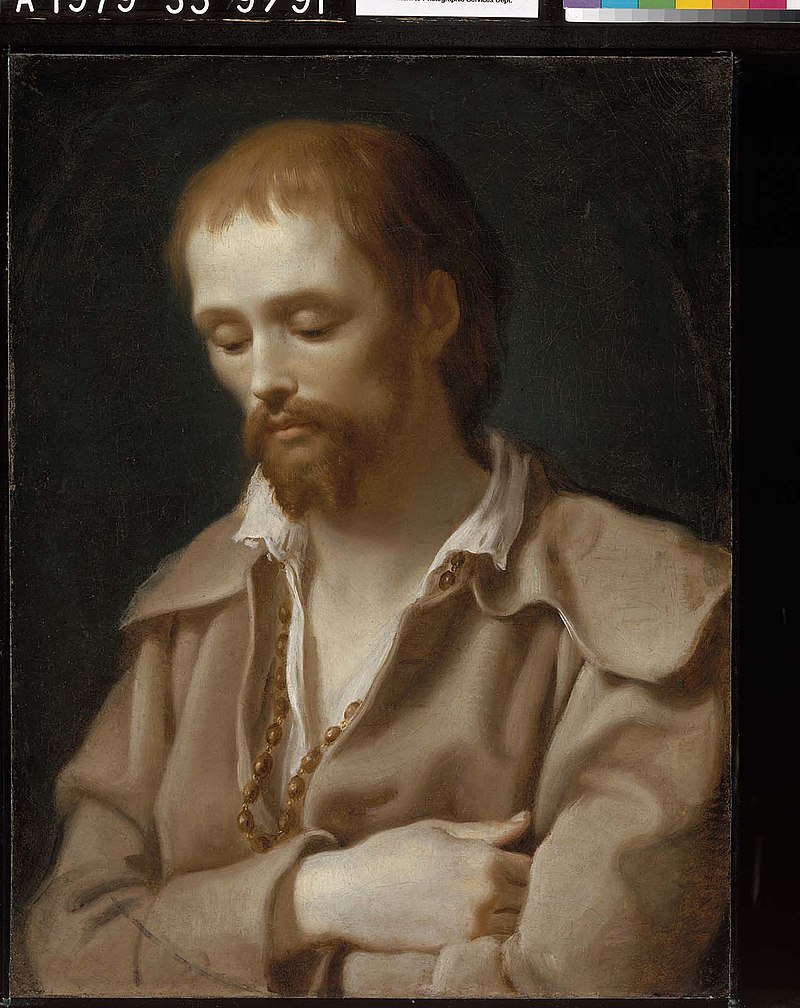
A Tale of Two Benedicts
A grace-filled Holy Week to all our readers! As we await and prepare for the Resurrection about to dawn upon us, we might keep in mind two Benedicts: Pope Emeritus Benedict XVI, requiescat in pace, elected on this day in 2005; and today’s commemoration of the mystic pilgrim, Benedict Joseph Labre, who died on this[…]Continue reading→
Presidential Pardon of Weronika Krawczyk
As a good news, follow-up to our story from Poland, of the persecution of Weronika Krawczyk for her pro-life views, we heard that she has been granted a presidential pardon. One might still wonder why one needs a presidential pardon for simply holding the long-held belief that the child within the womb is a child,[…]Continue reading→
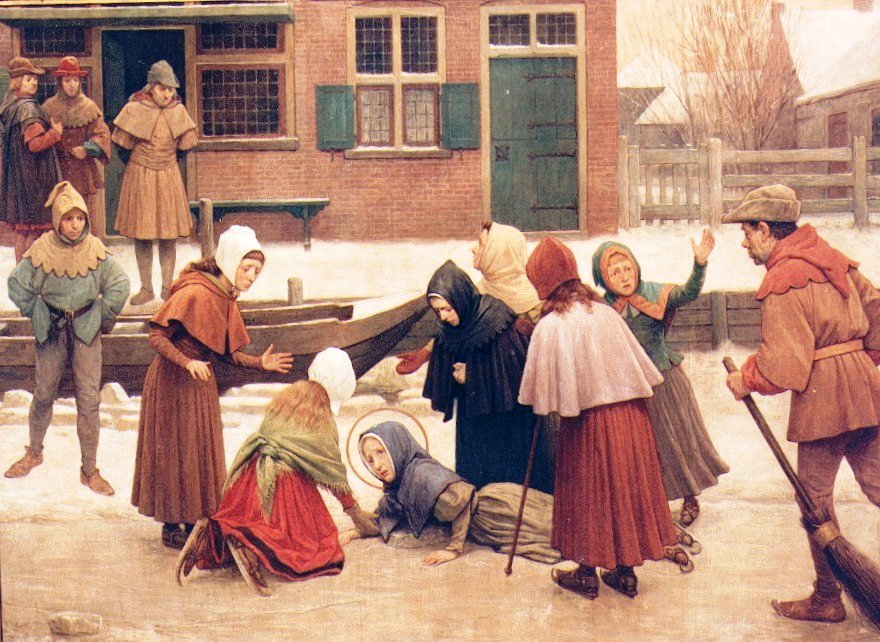
Saint Lydwina of Schiedam and Suffering Joyfully
Saint Lydwina of Schiedam (1380 – 1433) was one of the countless and glorious ‘victim souls’ in the history of the Church, those whose lives are filled with suffering, often of an unimaginable intensity, but who suffer joyfully. She was a fifteen-year old Dutch girl, out skating one day, when she fell and broke one[…]Continue reading→
The Glorious Martyrdoms of Martin and Maximus
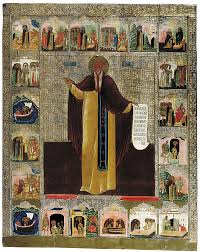
As we enter into Eastertide, we recall on this 13th of April Pope Saint Martin I (+655), one of the noblest, if most tragic, of the successors of Saint Peter. Born in Umbria, Italy, he was of noble lineage, with great intelligence combined with charity and love of the poor and the Church. While still[…]Continue reading→
Pope Leo and a Rosary for Peace
Pope Leo XIV has asked Catholics across the world to join him in a Rosary for peace today, at 18:00 Rome time (6 pm), which would be noon from where I write (EST). If you are able, whether at that time or another, and in whatever way you pray, to join in intercession with the[…]Continue reading→
Payette’s Payout
I was glancing through some headlines, and noticed a mention of Julie Payette – engineer and astronaut and sometime the Queen’s representative in Canada – which brought back vague memories. She was appointed Governor-General by Justin Trudeau in 2017. Ms. Payette resigned in 2021, amidst claims that she created a ‘toxic work environment’, with allegations[…]Continue reading→

Saint Stanislaus of Szczepanów
We celebrate Saint Stanislaus today (+ April 11, 1079), in light of this Easter Octave, a bishop and martyr who accepted the episcopacy only at the direct order of Pope Alexander II. He proved a wise and courageous leader of his flock, put to death by his own king, Boleslaus, for rebuking the monarch’s ‘immoral[…]Continue reading→