
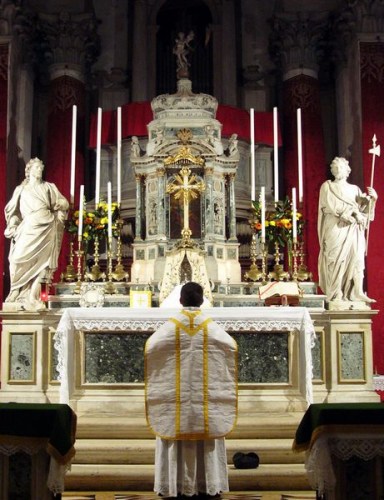
Ignorance of the Mass, New and Old
Ignorance – the state of not knowing what you should know – as opposed to nescience, not knowing what you shouldn’t, or needn’t, know.
Monsignor Richard Antall has a recent column on ‘Priestly Ignorance of the New Mass‘, by which he means the Mass promulgated under the authority of Pope Paul VI.
Much could be said of what so many priests do not seem to know – including what many priests do not know of the glories of the ‘old Mass’ – but the Monsignor Antall’s point is that the ‘new Mass’ is not celebrated the way it was, and is, meant to be celebrated. According to the directives of the Second Vatican Council, particularly Sacrosanctum Concilium, the Constitution the Sacred Liturgy, the ‘new Mass’ was never intended to be ‘new’, but simply the ‘old Mass’ with some reforms – a bit more vernacular, more readings from Scripture, more responses from the faithful. A tweak here and there. They never intended for there to be a whole new ‘rite’ or ‘usus’.
The same could be said of the so-called ‘Mass of Pius V’ from the Council of Trent, which was not really the Pope’s Mass – the Pope can’t make a new Mass, which is given to us by Christ, and handed on by Apostolic succession. Rather, the Pope was simply clarifying and reforming what was needed following the Tridentine Council, to correct anything that had gone a bit awry. Saint Pius V’s intention was to maintain Tradition, not abolish it.
So too, the Constitution from the Vatican Council was quite clear that Latin and chant were not only to be maintained, but to be primary in the Mass, with some concession for the vernacular and other sacred music (especially polyphony). Same with the pipe organ, which was to be given ‘pride of place’ before any other instruments, only permitted if they were consistent with ‘sacred use’.
The Council said nothing about abolishing and forbidding Latin and chant, or ripping out high altars and communion rails, facing the people, ignoring the Roman canon, writing new Eucharistic prayers, receiving the Eucharist in the hand, Eucharistic ministers and lay lectors, in lay clothes, queuing up, altar girls, tawdry chasubles, banal hymns…And this only lists what is now sort-of-in-a way permitted, at least by concession and indult.
Most of the Fathers at the Council – most, but perhaps not all – would have been aghast at what has transpired in the intervening decades. As we’ve written before, it is difficult to argue that the new Mass, at least as we normally see it celebrated, is a fruit of Vatican II.
Ecclesia semper reformanda – The Church is always in need of reform, as is the Liturgy, but with, as Cardinal Ratzinger alluded, with a light and reverential touch, more like a gardener tending a garden, than a wrecker tearing down, and building a whole new Bauhaus structure.
It’s past time to return to the fruitful garden of Tradition, and what we had, and have, been given, from Christ, the Apostles, Irenaeus and onwards.

Carney’s Amoral Majority
After five defections – euphemistically described as ‘crossing the floor’ – and three by-elections, Mark Carney and his Liberals how have their coveted majority. One wonders what bowls of pottage were offered in back-room deals. In the archaic monarchical system that is the Dominion of Canada, this majority allows the newly-minted Prime Minister to rule[…]Continue reading→
A Closed, Unsustainable, Descending Loop
As a follow-up to my thoughts on Payette’s payout, here be a stark image of where are here in Canada. As the graph shows in, well, graphic terms, since 2025, the public sector has contributed to 95.5% of economic growth. The private sector – which funds the public sector, or is supposed to – has[…]Continue reading→

Remembering Father Alphonse de Valk
(Today marks the sixth anniversary of the death of Father Alphonse de Valk, C.S.B., a faithful, courageous and indefatigable Basilian priest, pro-life-and-family apostle, and the founder of Catholic Insight magazine. Here is what we wrote those on his entering into eternity five years ago, as we continue to remember him in our prayers and thoughts)[…]Continue reading→

A Tale of Two Benedicts
A grace-filled Holy Week to all our readers! As we await and prepare for the Resurrection about to dawn upon us, we might keep in mind two Benedicts: Pope Emeritus Benedict XVI, requiescat in pace, elected on this day in 2005; and today’s commemoration of the mystic pilgrim, Benedict Joseph Labre, who died on this[…]Continue reading→
Presidential Pardon of Weronika Krawczyk
As a good news, follow-up to our story from Poland, of the persecution of Weronika Krawczyk for her pro-life views, we heard that she has been granted a presidential pardon. One might still wonder why one needs a presidential pardon for simply holding the long-held belief that the child within the womb is a child,[…]Continue reading→

Saint Lydwina of Schiedam and Suffering Joyfully
Saint Lydwina of Schiedam (1380 – 1433) was one of the countless and glorious ‘victim souls’ in the history of the Church, those whose lives are filled with suffering, often of an unimaginable intensity, but who suffer joyfully. She was a fifteen-year old Dutch girl, out skating one day, when she fell and broke one[…]Continue reading→

The Glorious Martyrdoms of Martin and Maximus
As we enter into Eastertide, we recall on this 13th of April Pope Saint Martin I (+655), one of the noblest, if most tragic, of the successors of Saint Peter. Born in Umbria, Italy, he was of noble lineage, with great intelligence combined with charity and love of the poor and the Church. While still[…]Continue reading→
Pope Leo and a Rosary for Peace
Pope Leo XIV has asked Catholics across the world to join him in a Rosary for peace today, at 18:00 Rome time (6 pm), which would be noon from where I write (EST). If you are able, whether at that time or another, and in whatever way you pray, to join in intercession with the[…]Continue reading→
Payette’s Payout
I was glancing through some headlines, and noticed a mention of Julie Payette – engineer and astronaut and sometime the Queen’s representative in Canada – which brought back vague memories. She was appointed Governor-General by Justin Trudeau in 2017. Ms. Payette resigned in 2021, amidst claims that she created a ‘toxic work environment’, with allegations[…]Continue reading→

Saint Stanislaus of Szczepanów
We celebrate Saint Stanislaus today (+ April 11, 1079), in light of this Easter Octave, a bishop and martyr who accepted the episcopacy only at the direct order of Pope Alexander II. He proved a wise and courageous leader of his flock, put to death by his own king, Boleslaus, for rebuking the monarch’s ‘immoral[…]Continue reading→