
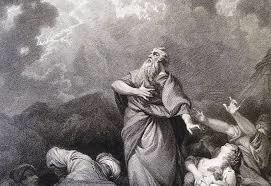
Interpreting the Scriptures Concerning Himself
In the Nicene Creed we find the phrase, “[Jesus] suffered death and was buried, and rose again . . . in accordance with the Scriptures.” These words of the creed echo a statement from Saint Paul: “Christ died for our sins in accordance with the Scriptures, that he was buried, that he was raised on the third day in accordance with the Scriptures.”[1] The words of Jesus in the Gospel for today confirm Saint Paul’s insight:
Was it not necessary that the Christ should suffer these things and enter into his glory?” And beginning with Moses and all the prophets, he interpreted to them in all the Scriptures the things concerning himself.[2]
Such texts, and they could be multiplied, are commonplace throughout the New Testament, in its abundant use of the Old Testament. The general principle was enunciated by Jesus when he read a passage from the Prophet Isaiah in the synagogue at Nazareth: “Today this Scripture has been fulfilled in your hearing.”[3] And yet, when we turn to the pages of the Old Testament, we find very little explicitly about the Messiah’s dying and rising again. There’s Jonah, of course, whose ordeal was invoked by Our Lord himself: “For as Jonah was three days and three nights in the belly of the whale, so will the Son of man be three days and three nights in the heart of the earth.”[4] The mysterious passage about the suffering servant in Isaiah, prominent in the liturgy of Holy Week, adds to his grief a note of triumph: “Behold, my servant shall prosper, he shall prosper and be lifted up, and shall be very high.”[5]
On examination, however, these texts seem somewhat lacking in the precision that Paul and Jesus describe. Even vaguer is this statement from the Prophet Hosea in which the Church has discerned a reference to the resurrection: “After two days he will revive us; on the third day he will raise us up.”[6] Taken literally, the text merely exhibits the prophet’s confidence that God will quickly restore the fortunes of Israel. Another verse from the Old Testament, similarly employed by Saint Peter, is in fact a prayer to be kept alive, not to be brought back from the dead: “For thou wilt not abandon my soul to Hades, nor let thy Holy One see corruption.”[7]
And yet we know that the Old Testament does prophesy the coming of Christ and His saving acts. The mode of prophecy, therefore, must be different from a blueprint or instructions for assembling a model from LEGO blocks. How then are we to regard the Old Testament? We begin by looking for a pattern, for certain characteristics of God’s style (if one may use such a word) in His interventions in history. For instance, consider the text of Hosea cited above. It refers both to the past and to the present, and as such it points to the future, for what God has done once, He can do again. The past event is the Exodus from slavery in Egypt; the current event is a return from exile; a future event is implied because in the Bible every event is a promise. The Lord’s bringing of Israel out of slavery in Egypt reveals what sort of God he is: One who cares for His people. Hence, centuries later Hosea can speak with confidence of a new liberation, this time from exile. On the basis of these two, we confidently look for God to intervene again, freeing mankind from another kind of slavery—Man’s servitude to sin—and effecting return from another sort of exile—from being out of God’s favour. It follows, then, that the passage from Hosea really does refer to the Messiah. Moses himself makes the point when he sees that his own vocation is a pledge on the part of God that there will be in the future a new Moses: “[God said to Moses,] ‘I will raise up for [the people] a prophet like you from among their brethren.”[8]
It follows that when we read the Old Testament—which was the Bible of the apostolic Church—we find the suffering, death and resurrection of Jesus on every page, just as Christ said. Consider the following list that instance a real or symbolic death and resurrection. (It will be a sort of test, to gauge how carefully you have been listening to the passages from the Old Testament that are used as the first reading on most Sundays of the year.)
- After Cain killed his brother, Abel, Eve bore a son, Seth, in whom she saw as a new Abel, restored, as it were, from the dead: “God has appointed for me another child instead of Abel, for Cain slew him.”[9]
- The theme of new life coming forth from death is dramatically realized in the story of the great flood that destroyed all mankind with the exception of Noah and his family. They represent a new life after the destruction wrought by the flood.
- Do you recall the incident in Genesis when Abraham was commanded to sacrifice his only son, Isaac? The boy was spared, given back alive to his father. Significantly, a sheep—“the lamb of God, so to speak”—was offered in his place.
- One of the most significant, paradigmatic passages of the Old Testament is the passage of the Israelites through the Red Sea as they fled Egypt where they had been enslaved. The people emerged as the new people of God, but Pharaoh’s forces were overwhelmed by the waters returning to the seabed: death and destruction on the one hand and a new Jewish nation on the other.
- In the book of Judges the Jews are over and over again threatened with annihilation, only to be restored through the action of a divinely appointed leader; the most famous of them was Samson who gave his life to liberate the people.
- Around the year 700 B.C., the noble King Hezekiah took ill. The prophet Isaiah was sent to inform the King that the illness was fatal, but then something wonderful occurred: Hezekiah’s heartfelt prayer was heard and he was cured. The Lord is a God who can bring his servant back from the grave.
- When the Jewish people were on the brink of extermination first by Assyria and then by Babylon, God gave them hope through the words of the prophets: “I shall gather the remnant of my flock out of all the countries, . . . and I shall bring them back to their fold, and they shall be fruitful and multiply.”[10]
- Similarly, in 587 B.C. all seemed lost. The Babylonians conquered Israel, destroyed the temple and deported the people. It was like a resurrection from the dead when the Jews were later allowed to return to their homeland and rebuild the temple.
- Ezekiel’s famous vision of the dry bones coming to life, like the theme of the remnant, is another prophecy of the marvellous restoration of the nation.
- I have already mentioned the suffering servant and the sign of Jonah.
- Daniel in the lions’ den is another instance of a symbolic resurrection,
- as is Queen Esther’s intervention that saved her people from being massacred.
- Finally, in referring to the resurrection, New Testament writers like to quote Psalm 117/118; “The stone that the builders rejected has become the corner stone. This is the Lord’s doing, and it is marvellous in our eyes.”[11]
The point is that the history of salvation is a story, in which anything can happen, rather than a series of repeatable actions and reactions such as you would find in a science laboratory. We are all actors in the story, for just as the history of Jesus was told in type, prefigured in the history of Israel, so our story is “predicted” (as it were) in the history of Jesus. It follows that Saint Paul could tell the Christians of Galatia—and so also tell us—that they were—as are we—“the Israel of God”;[12] that is why he could say, “It is men of faith who are sons of Abraham.”[13] The basis of such statements, and of this approach to the Bible, is the fact that it speaks to everyone, always and everywhere. Consequently, penetrating the mystery of God’s action is more a sensitivity to symbol than an application of logic. As such it demands a new way of looking at things, that is to say, a conversion.
[1] 1 Cor 15.3-4.
[2] Lk 24.26-27.
[3] Lk 4.21.
[4] Matt 12.40.
[5] Is 52.13.
[6] Hos 6.2.
[7] Act 2.27.
[8] Deut 18.18.
[9] Gen 4.25.
[10] Jer 23.3.
[11] This list comes from Yves M.J. Congar, OP, Tradition and Traditions (London: Macmillan, 1967), p. 72.
[12] Gal 6.16.
[13] Gal 3.7.

Saint Kateri , Canada’s Protectress
This was the title given to Saint Kateri Tekakwitha, by Pope Benedict XVI, when he canonized her on October 28th, 2012, along with six others, in Saint Peter’ Square (she had been beatified by Pope John Paul II back in 1980). With Saint Joseph as our protector, along with the Canadian martyrs, we seem to[…]Continue reading→

Remembering Father Alphonse de Valk
(Today marks the sixth anniversary of the death of Father Alphonse de Valk, C.S.B., a faithful, courageous and indefatigable Basilian priest, pro-life-and-family apostle, and the founder of Catholic Insight magazine. Here is what we wrote those on his entering into eternity five years ago, as we continue to remember him in our prayers and thoughts)[…]Continue reading→

My Name is Bernadette
April 16th is a propitious day, for besides the anniversary of Father de Valk’s death, who founded Catholic Insight in its print form decades ago, and the commemoration of the ‘two Benedicts’, mentioned in accompanying posts, today we also recall Saint Bernadette Soubirous, the young visionary to whom the Virgin Mary appeared numerous times at[…]Continue reading→

Canonizing Sister Faustina and Divine Mercy
HOMILY OF THE HOLY FATHER MASS IN ST PETER’S SQUARE FOR THE CANONIZATION OF SR MARY FAUSTINA KOWALSKA Sunday, 30 April 2000 1. “Confitemini Domino quoniam bonus, quoniam in saeculum misericordia eius”; “Give thanks to the Lord for he is good; his steadfast love endures for ever” (Ps 118: 1). So the Church sings on the Octave of[…]Continue reading→

Divine Mercy Sunday – An Echo of Every Mass
Reach out your hand and put it in my side. Do not doubt but believe’… ‘My Lord and my God!’ (Jn. 20:18)). Today is Divine Mercy Sunday, and as we celebrate the end of the Easter Octave, we contemplate the wounded side of our Saviour, the Church’s source of life. On Good Friday in the[…]Continue reading→

Saint Stanislaus of Szczepanów
We celebrate Saint Stanislaus today (+ April 11, 1079), in light of this Easter Octave, a bishop and martyr who accepted the episcopacy only at the direct order of Pope Alexander II. He proved a wise and courageous leader of his flock, put to death by his own king, Boleslaus, for rebuking the monarch’s ‘immoral[…]Continue reading→

First Holy Communion: Sermon from May 16, 1943
Here is a sermon from the good old days by +Rev. Msgr. Vincent Nicholas Foy (August 14, 1915 – March 13, 2017), from 1943. Readers may recall that Pope Saint Pius X, by the decree Quam Singulari in 1910, lowered the customary age of reception of Holy Communion – after the rigours of the plague[…]Continue reading→

In the Glorious Light of Easter, Alleluia!
Set your minds on things that are above, not on things that are on earth, for you have died, and your life is hidden with Christ in God. When Christ who is your life is revealed, then you also will be revealed with him in glory (Col. 3:3-4). The Resurrection of Our Lord and Saviour[…]Continue reading→

An Ancient Homily for Holy Saturday
The time between Good Friday and Easter Sunday is one of waiting, in silence, as the world wonders – anticipates – what will happen, after the death of Christ. We re-live this time each year in the anamnesis of our liturgy, and in turn look forward to the glorious re-creation of all things at the[…]Continue reading→

Europe’s Long Descent
(As we meditate on this day on Christ’s burial, and His descent into hell, it is fitting to ponder here with contributor Peter Marcus how the world seems to be heading there as well. The difference is that, although God cannot ‘redeem’ hell, nor those therein, He can and did redeem the world. There is[…]Continue reading→