
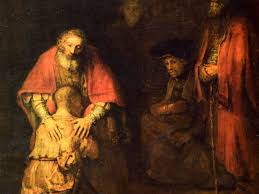
Senses of Scripture in the Prodigal Son
In 1861, John William Burgon, the (Anglican) dean of Chichester cathedral, preached a sermon in Christ Church cathedral, Oxford, that included the following statement:
THE BIBLE is none other than the voice of Him that sitteth upon the Throne! Every Book of it,—every Chapter of it,—every Verse of it,—every word of it,—every syllable of it,— (where are we to stop?),—-every letter of it—is the direct utterance of the Most High! . . . The Bible is none other than the Word of God: not some part of it, more, some part of it, less; but all alike, the utterance of Him who sitteth upon the Throne,—absolute,—faultless,—unerring,—supreme![1]
What are we as Catholics to make of this typically Protestant statement? I, for one, find it extravagant, even naïve, but it is nevertheless essentially defensible as long as we recognize that Scripture has two authors: the human author who produced this or that book of the Bible and God who inspired and guided his writing. The traditional way of describing this theological fact is to say that Scripture has two senses, one which we call “the literal sense” and the other, “the spiritual sense.” The first of these, the literal, is concerned with historical fact, with the time and place of the author, with the ancient languages of the text, and so on. For instance, when David speaks of Jerusalem, he is referring to the actual city, as it was during his time, which was some 900 years before Christ. Biblical scholars are helpful here in investigating the cultural and religious settings of the reign of King David. But the spiritual, i.e., the fuller sense allows us to go more deeply into the text, in various and different ways. For “Jerusalem” can mean more than the historical city; it can also refer to the Church as the place where God meets his people. To push the point, this very building is a sort of Jerusalem where the sacrifice of the new law is offered at Mass, as the fulfilment of the animal sacrifices of the old law that were offered in the temple. But Jerusalem can also refer to the individual Christian as the dwelling place of God: “Do you not know that your body is a temple of the Holy Spirit?”[2] Again, in the Apocalypse Jerusalem stand for heaven: “And I saw the holy city, new Jerusalem coming down from heaven, prepared as a bride adorned for her husband.”[3]
Fathers of the Church, such as Saint Augustine, used this approach to the Bible freely. Suppose we were to imitate them this morning and apply their methods to the parable of the prodigal son, today’s Gospel.[4] First, what is its literal sense? That’s easy: the story is about forgiveness for the repentant sinner, the younger son. This message is exemplified by the father in the story and re-enforced by the passage with the older son.
But now the fun begins, as we investigate the parable with the fuller sense, according to which, as we have seen with “Jerusalem,” the parable can be read in several ways. For we can interpret it with regard to Christ and his Church; but we can also apply it to the individual Christian, to each one of us; or, again, we can treat it as symbolic of the end of time. What happens when we read it, for instance, as symbolic of the Church? Let’s see. The parable opens with the words, “A man had two sons.” The man would be God, and the older son would represent the Jewish people who were “the first to hear the word of God.”[5] The younger son, therefore, must stand for non-Jews, i.e., the gentiles. He receives, we are told, a share of his father’s fortune. In our interpretation, that would correspond to a twofold boon that God has bestowed even on pagans: first a moral instinct, which they identified as conscience, and secondly intelligence, by which they recognized that the world had been created by God. The younger son dissipated this noble inheritance; that would indicate the decline in antiquity of religion into superstition, idolatry and sensuality. The famine in the land suggests a sterility of thought that became more and more incapable of directing and encouraging man to practise virtue. The parable states that the young man would have gladly eaten with the pigs, for the fact is that without God the rational human descends to the level of the irrational beast. His coming to his senses is the gradual recognition that something has gone horribly wrong with the human condition and that the remedy for it is to be found in his father’s house. As the younger son limps towards home, the father sees him from afar, indicative of the decision of the early Church to reach out to the gentiles by offering them access to the one true God, the God of Abraham, Isaac and Jacob. How appropriate, then, is the son’s speech: “Father, I have sinned against heaven and against you. I am no longer worthy to be called your son.” These words express a fact that all Christians accept, whether they are Protestant, Orthodox or Catholic, namely, that the grace of conversion is a gift that comes freely from God and which we could do nothing to deserve.
I hope your recollection of the parable is allowing you to follow this admittedly complicated interpretation of it, for every detail and be applied to some aspect of the Church. The fine robe brought out for the son, for instance, is a symbol of the beauty of the Church, “without spot or wrinkle,” as Saint Paul says,[6] and the ring placed on his finger is a sign of authority. The fatted calf slaughtered for the feast points to the riches of the Church’s tradition, now made available to the new convert, and the feast itself surely is a reference to the Eucharist, the Mass that we are celebrating here and now. Then there’s that mean older son—for whom, I suspect we all have a certain sympathy. His refusal to join in the festivities reminds us that many Jews refused the proclamation of the good news that Jesus has died and risen for us. The father’s gentle rebuke and invitation highlight a common these from the Old Testament, namely, that when the Messiah has come all the nations of the world will be invited to worship the one true God who revealed himself to Abraham, Isaac and Jacob:
It shall come to pass in the latter days that . . . all the nations shall flow to [the house of the Lord] . . . and say: “Come, let us go up . . . to the house of the God of Jacob; that he may teach us his way. . . .”[7]
This parable stops at this point, although we would all like to know something about their subsequent history. What would these sons have been like twenty or thirty years later? Well, the story is open-ended because we must complete it in our lives by thinking about it and by acting upon its message.
As I mentioned earlier, this symbolic reading of this parable, like the city of Jerusalem, could be applied to the individual Christian and also final state of things, when Christ will have come again. Perhaps in three years, when this reading recurs, I shall take the opportunity to explore one of other interpretations of the prodigal son.
[1] J.W. Burgon, Inspiration and Interpretation (Oxford, 1861), p. 9.
[2] 1 Cor 6.19.
[3] Rev 21.2.
[4] Augustine’s interpretation of the parable of the prodigal son can be found in his treatise Quæstionum evangeliorum libri duo, II.33 (PL XXXV, 1344-48).
[5] Intercessions for Good Friday.
[6] Eph 5.27.
[7] Is 2.2-3.

Saint Kateri , Canada’s Protectress
This was the title given to Saint Kateri Tekakwitha, by Pope Benedict XVI, when he canonized her on October 28th, 2012, along with six others, in Saint Peter’ Square (she had been beatified by Pope John Paul II back in 1980). With Saint Joseph as our protector, along with the Canadian martyrs, we seem to[…]Continue reading→

Remembering Father Alphonse de Valk
(Today marks the sixth anniversary of the death of Father Alphonse de Valk, C.S.B., a faithful, courageous and indefatigable Basilian priest, pro-life-and-family apostle, and the founder of Catholic Insight magazine. Here is what we wrote those on his entering into eternity five years ago, as we continue to remember him in our prayers and thoughts)[…]Continue reading→

My Name is Bernadette
April 16th is a propitious day, for besides the anniversary of Father de Valk’s death, who founded Catholic Insight in its print form decades ago, and the commemoration of the ‘two Benedicts’, mentioned in accompanying posts, today we also recall Saint Bernadette Soubirous, the young visionary to whom the Virgin Mary appeared numerous times at[…]Continue reading→

Canonizing Sister Faustina and Divine Mercy
HOMILY OF THE HOLY FATHER MASS IN ST PETER’S SQUARE FOR THE CANONIZATION OF SR MARY FAUSTINA KOWALSKA Sunday, 30 April 2000 1. “Confitemini Domino quoniam bonus, quoniam in saeculum misericordia eius”; “Give thanks to the Lord for he is good; his steadfast love endures for ever” (Ps 118: 1). So the Church sings on the Octave of[…]Continue reading→

Divine Mercy Sunday – An Echo of Every Mass
Reach out your hand and put it in my side. Do not doubt but believe’… ‘My Lord and my God!’ (Jn. 20:18)). Today is Divine Mercy Sunday, and as we celebrate the end of the Easter Octave, we contemplate the wounded side of our Saviour, the Church’s source of life. On Good Friday in the[…]Continue reading→

Saint Stanislaus of Szczepanów
We celebrate Saint Stanislaus today (+ April 11, 1079), in light of this Easter Octave, a bishop and martyr who accepted the episcopacy only at the direct order of Pope Alexander II. He proved a wise and courageous leader of his flock, put to death by his own king, Boleslaus, for rebuking the monarch’s ‘immoral[…]Continue reading→

First Holy Communion: Sermon from May 16, 1943
Here is a sermon from the good old days by +Rev. Msgr. Vincent Nicholas Foy (August 14, 1915 – March 13, 2017), from 1943. Readers may recall that Pope Saint Pius X, by the decree Quam Singulari in 1910, lowered the customary age of reception of Holy Communion – after the rigours of the plague[…]Continue reading→

In the Glorious Light of Easter, Alleluia!
Set your minds on things that are above, not on things that are on earth, for you have died, and your life is hidden with Christ in God. When Christ who is your life is revealed, then you also will be revealed with him in glory (Col. 3:3-4). The Resurrection of Our Lord and Saviour[…]Continue reading→

An Ancient Homily for Holy Saturday
The time between Good Friday and Easter Sunday is one of waiting, in silence, as the world wonders – anticipates – what will happen, after the death of Christ. We re-live this time each year in the anamnesis of our liturgy, and in turn look forward to the glorious re-creation of all things at the[…]Continue reading→

Europe’s Long Descent
(As we meditate on this day on Christ’s burial, and His descent into hell, it is fitting to ponder here with contributor Peter Marcus how the world seems to be heading there as well. The difference is that, although God cannot ‘redeem’ hell, nor those therein, He can and did redeem the world. There is[…]Continue reading→