
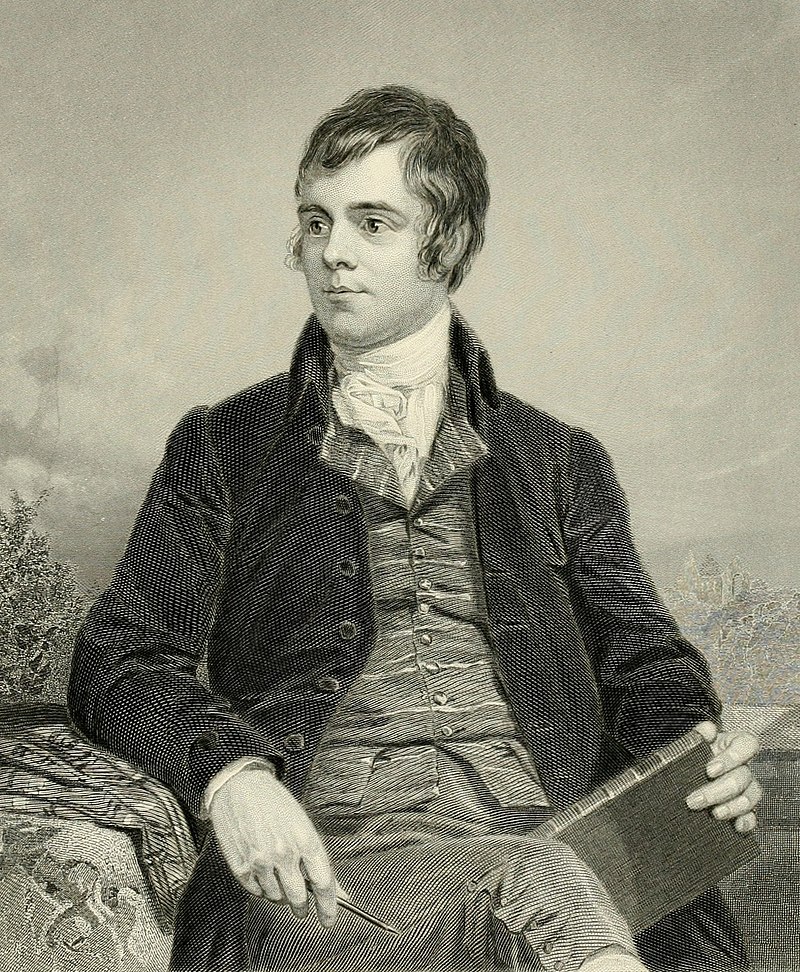
A Man’s A Man For A’ That
(On this birthday of Scotland’s national poet, ’tis fitting that we received this submission from Magda Vanderburg, including a brief analysis of Rabbie Burns’ poem, ‘A Man’s a Man’. We begin with a recorded recital, if ye like. Editor).
Robert Burns, in his song “For a’ that and a’ that” argues that it is not wealth, rank, or lifestyle that makes a man great. Throughout his lines, Burns uses the phrase “an’ a’ that” - as well as similar phrases like “for a’ that” and “For a’ that, an’ a’ that”- but uses these phrases with different effects. The words themselves as well as their contextual meanings form a repetitive pattern used by Burns to manifest, demonstrate and define the egalitarian position the song presents.
In a purely textual sense, the repeated phrases, written with a Scottish accent, are contrasted with the use of plain English throughout most of the song. The speaker begins by asking, “Is there, for honest poverty, That hings his head, an’ a’ that?” (lines 1-2). While the word “hings” and the final phrase both indicate a Scottish lilt, the rest of the line is written in British English. This combination can also be seen in the final stanza, where the speaker expresses his wish: “Then let us pray that come it may, / As come it will for a’ that, /That sense and worth, o’er a’ the earth, / May bear the gree, an’ a’ that” (lines 33-36). The marriage of the plain English and the Scottish work to manifest the egalitarian message of the song. Thus, though some might speak proper English (or what is deemed to be so, Editor), and another might speak with an accent, “A man’s a man for a’ that” (line 12).
Similarly, the phrase itself contains within it a common and unadorned sentiment that echoes the sentiment of the song as a whole. The speaker refers to a young lord and states that he “struts, an’ stares, an’ a’ that” (lines 18). In this, the speaker describes the characteristics of noblemen, then flippantly lumps together all the characteristics with “an’ a’ that.” This same flippancy is expressed for the titles, decorations and “dignities a’ a’ that” (line 30). The speaker, with these phrases, demonstrates through his or her repeated words their honest viewpoint of and disregard for the meaningless ornaments they see in the class system. Instead of “a’ that” (line 34), the speaker exults the “hamely” (line 9) man whose “pith o’ sense, an’ pride o’ worth” (line 31), as well as his honesty (line 15 and 27), make him king-like (line 16). Thus, the ordinariness and dismissiveness of the phrase, “an’ a’ that,” in itself describes the attitude of the song.
Finally, the phrase is utilized to mean different things. The speaker names the highborn attitudes of “yon birkie” (line 17) and that “He’s but a coof for a’ that” (line 20) and this use could be translated to mean “despite all that.” The phrase is used referentially as well, such as when the speaker states that sense and worth “Are higher rank than a’ that” (line 32) in reference to the previous titles and flaunting displays of the lords, princes, marquis and dukes. Finally, the phrase is used to indicate to a continuation of similar ideas, just as the Latin et cetera is used in modern English. For example, the speaker refers to his previous description of the strutting and staring lord and implies a logical continuation of thought as he explains “For a’ that, an’ a’ that, / His riband, star, an’ a’ that” (lines 21-22). All three meanings utilize a similar set of repeating phrases which contextually mean very different things. Just as the speaker hopes “That man to man, the warld o’er, / Shall brothers be for a’ that” (lines 39-40), so to the repeating the phrase, though carrying different meanings, is assembled by the same words. Thus, Burns’ repetition of the phrase “an’ a’ that” highlights the speaker’s argument that men are essentially the same by nature, no matter societal circumstances or accidental qualities.
Burns therefore uses and repeats this iconic phrase throughout his song and in doing so highlights the egalitarian message of the song by contrasting class accents, by echoing the speaker’s sentiment in the phrase itself, and by using the phrase in multiple ways to express different things while using the same words.
Works Cited:
Burns, Robert. “For a’ That and a’ That.” Poetry Foundation, Poetry Foundation, 2022, https://www.poetryfoundation.org/poems/43805/for-a-that-and-a-that.

Saint Kateri , Canada’s Protectress
This was the title given to Saint Kateri Tekakwitha, by Pope Benedict XVI, when he canonized her on October 28th, 2012, along with six others, in Saint Peter’ Square (she had been beatified by Pope John Paul II back in 1980). With Saint Joseph as our protector, along with the Canadian martyrs, we seem to[…]Continue reading→

Remembering Father Alphonse de Valk
(Today marks the sixth anniversary of the death of Father Alphonse de Valk, C.S.B., a faithful, courageous and indefatigable Basilian priest, pro-life-and-family apostle, and the founder of Catholic Insight magazine. Here is what we wrote those on his entering into eternity five years ago, as we continue to remember him in our prayers and thoughts)[…]Continue reading→

My Name is Bernadette
April 16th is a propitious day, for besides the anniversary of Father de Valk’s death, who founded Catholic Insight in its print form decades ago, and the commemoration of the ‘two Benedicts’, mentioned in accompanying posts, today we also recall Saint Bernadette Soubirous, the young visionary to whom the Virgin Mary appeared numerous times at[…]Continue reading→

Canonizing Sister Faustina and Divine Mercy
HOMILY OF THE HOLY FATHER MASS IN ST PETER’S SQUARE FOR THE CANONIZATION OF SR MARY FAUSTINA KOWALSKA Sunday, 30 April 2000 1. “Confitemini Domino quoniam bonus, quoniam in saeculum misericordia eius”; “Give thanks to the Lord for he is good; his steadfast love endures for ever” (Ps 118: 1). So the Church sings on the Octave of[…]Continue reading→

Divine Mercy Sunday – An Echo of Every Mass
Reach out your hand and put it in my side. Do not doubt but believe’… ‘My Lord and my God!’ (Jn. 20:18)). Today is Divine Mercy Sunday, and as we celebrate the end of the Easter Octave, we contemplate the wounded side of our Saviour, the Church’s source of life. On Good Friday in the[…]Continue reading→

Saint Stanislaus of Szczepanów
We celebrate Saint Stanislaus today (+ April 11, 1079), in light of this Easter Octave, a bishop and martyr who accepted the episcopacy only at the direct order of Pope Alexander II. He proved a wise and courageous leader of his flock, put to death by his own king, Boleslaus, for rebuking the monarch’s ‘immoral[…]Continue reading→

First Holy Communion: Sermon from May 16, 1943
Here is a sermon from the good old days by +Rev. Msgr. Vincent Nicholas Foy (August 14, 1915 – March 13, 2017), from 1943. Readers may recall that Pope Saint Pius X, by the decree Quam Singulari in 1910, lowered the customary age of reception of Holy Communion – after the rigours of the plague[…]Continue reading→

In the Glorious Light of Easter, Alleluia!
Set your minds on things that are above, not on things that are on earth, for you have died, and your life is hidden with Christ in God. When Christ who is your life is revealed, then you also will be revealed with him in glory (Col. 3:3-4). The Resurrection of Our Lord and Saviour[…]Continue reading→

An Ancient Homily for Holy Saturday
The time between Good Friday and Easter Sunday is one of waiting, in silence, as the world wonders – anticipates – what will happen, after the death of Christ. We re-live this time each year in the anamnesis of our liturgy, and in turn look forward to the glorious re-creation of all things at the[…]Continue reading→

Europe’s Long Descent
(As we meditate on this day on Christ’s burial, and His descent into hell, it is fitting to ponder here with contributor Peter Marcus how the world seems to be heading there as well. The difference is that, although God cannot ‘redeem’ hell, nor those therein, He can and did redeem the world. There is[…]Continue reading→