
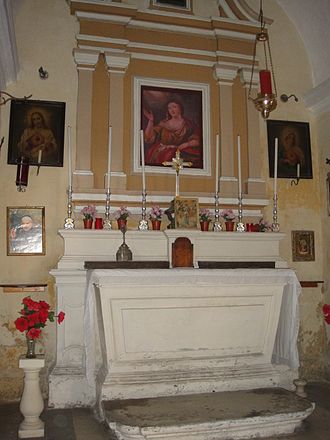
Saint Agatha and Malta
February 5th is the liturgical memorial of St Agatha, a Sicilian virgin, martyred at Catania in the island of Sicily.
Even if little is known about her life, however Agatha is certainly one of the most highly venerated virgin martyrs the early Church has ever witnessed. Hers is a story deeply marked by the boldest profession of Christian faith. It is generally believed that she was martyred during the persecution of the Emperor Decius (250-253).
Malta has been blessed by the cult of St Agatha. In fact, according to the report of the Apostolic Delegate Pietro Dusina, which bears the date of 1575, he managed to list some ten chapels that were all dedicated to St Agatha. These chapels were located at Mdina, Rabat, Naxxar, Birkirkara, Lija, Hax-Xluq, Zabbar, Safi, inside the Borgo (after 1530 re-dedicated as one of the Greek-rite parishes of St. Nicholas) as well as at Zurrieq. There were two other churches of St Agatha in the Maltese Islands. The first one was at Birkirkara. This was a tiny chapel connected to the old parish church whereas the Naxxar chapel was demolished to make space for the extended parish church.
One would also find altars dedicated to St Agatha in Naxxar together with Zabbar. Up to the 16 century devotion to St Agatha was very much diffused on the Island. However, in 1593, in the aftermath of the plague the devotion to this saint began to dwindle up to the point that at the kick off of the 18th century solely the chapels in Mdina and Rabat were used for the public veneration of this Sicilian saint. History tells us that the chapel in Mdina was erected by Francesco Gatto in 1410. Its actual structure is simply a re-construction on the design arranged by Lorenzo Gafà following the terrible earthquake of 1694. At the Mdina Cathedral Museum one can find the old titular painting which goes back to 1554.
Concerning Gozo, Malta’s sister island, one can say that although there is no church or chapel dedicated to St Agatha, nonetheless a transcription of the last will of Antonio de Naso, which bears the date of 10, 1465 quite frankly expresses the testator desire to build a chapel dedicated specifically to St Agatha which is detailed as pennaculum ad arces (a belfry with arches), with the designation to employ “squaredstones” that appears to suggest that newly hewn stone-blocks to be made use of.
In the Dusina report we also encounter the Church and Crypt of St Agatha which are situated “within the limits of Rabat”. The church, which is dedicated to St Agatha, was erected in 1504. Then, in 1670 another larger church was built on the very same site. Probably in 1504 the church was partly demolished and the section kept was included in the 1670 construction.
The church’s principal altar was restored in 1894 whilst the marble statue of St Agatha was put up on a high pedestal above the altar. In 1912-13 other work was carried out to adorn the church, including, of course, the bell tower on the right hand side of the façade together with the two lateral rooms which were used as a sacristy.
In the 1957-61 period we see further structural modifications that were built. Along with restoration of the entire side walls of the aisle we also find the building of two small side chapels. These 1957 architectural innovations included a chapel dedicated to the Immaculate Heart of Mary as well as a smaller one dedicated to St Paul the Apostle in 1960 so as to commemorate the 19th Centenary of the Apostle’s Shipwreck on the Island.
Subsequently, an underground crypt was hewn in the chamber on the right hand side of the principal altar. Here one finds the remains of the Servant of God Joseph De Piro, founder of the Missionary Society of St Paul together with the deceased MSSP members.
A strong local tradition has it that during the persecution of the Roman Emperor Trajanus Decius (AD 249-251), Agatha and some of her friends, managed to escape from native island of Sicily and hid in Malta. Certain historians further comment that her stay in Malta was brief. It is believed that Agatha spent her time in the crypt at Rabat. There she prayed and taught the Christian Faith to the local children. As time went on Agatha discerned that it would be appropriate for her to return to Sicily to bear witness for her Christian faith, even if she were to be martyred. As soon as she landed in Sicily she was arrested, brought before Quintanus, praetor of Catania, who condemned her to be tortured and imprisoned. Agatha died on February 5, 251, in prison as a martyr.
The Maltese lovingly dedicated to her the very same crypt in which she used to spend hours and days praying. They also named after her the neighbouring catacombs as well as a Church which now stand over the crypt. St Agatha crypt is an underground basilica, hewn in live rock. The locals paid homage to this place from early years. When St Agatha lived the crypt was just a tiny natural cave. It was precisely during the 4th or probably the 5th century when this place was finally expanded and decorated.
The main altar, which is to be found at the further end of the crypt, is dedicated to St Agatha. However, we know that up till 1647 this altar was made use of for worship. It was erected over another rock altar, in 1666. This altar was built to hold the alabaster statue of St Agatha. At the episcopal appointment of Mgr Lucas Buenos as bishop of Malta (1664-1668), he not only paid a visit to the place but presented to the crypt an alabaster statue of St Agatha experiencing her martyrdom. This work of art is really a fine work, sculptured in Trapani, and portrays St Agatha tied to a tree trunk and a small puttino is holding a crown of roses above her head. The statue is put on a baroque pedestal within which, there is a small statue of the Saint put on fire. Presently, this statue could be appreciated in the Museum.
The crypt is embellished by many frescoes. Certain frescoes go back to the 12th century. They are executed in Byzantine style. The rest, which are in Greek style, go back to the 15th century (1480). There are 30 images of saints, among which 13 show St Agatha. The others display bishop saints, virgin and martyr saints. The 15th century frescoes are credited to the Sicilian painter Salvatore D’Antonio. These were given to the crypt by different devotees, donated as thanksgiving for a grace obtained. Other paintings can still be visible in the ceiling at the vestibule on the right hand. George Farrugia restored these frescoes between the years 1984-1989. Restoration was financed by the Lions Club, Sliema (Malta.)
St Agatha is one of the patron saints of Malta because, in 1551, she appeared to a Benedictine nun who prayed to her, and saved our Island from a clear Turkish invasion.
Almighty God, among the many marvels of Your power, you granted to St Agatha, the victory of martyrdom. Now in your mercy, as we celebrate the life of St Agatha and seek her help… (Name request…) grant to us the joy of being drawn closer to You. This I ask through Jesus Christ, Thy Son, who lives and reigns, world without end. Amen.
… St Agatha, Pray for Us …
A Closed, Unsustainable, Descending Loop
As a follow-up to my thoughts on Payette’s payout, here be a stark image of where are here in Canada. As the graph shows in, well, graphic terms, since 2025, the public sector has contributed to 95.5% of economic growth. The private sector – which funds the public sector, or is supposed to – has[…]Continue reading→
Presidential Pardon of Weronika Krawczyk
As a good news, follow-up to our story from Poland, of the persecution of Weronika Krawczyk for her pro-life views, we heard that she has been granted a presidential pardon. One might still wonder why one needs a presidential pardon for simply holding the long-held belief that the child within the womb is a child,[…]Continue reading→
Pope Leo and a Rosary for Peace
Pope Leo XIV has asked Catholics across the world to join him in a Rosary for peace today, at 18:00 Rome time (6 pm), which would be noon from where I write (EST). If you are able, whether at that time or another, and in whatever way you pray, to join in intercession with the[…]Continue reading→
Payette’s Payout
I was glancing through some headlines, and noticed a mention of Julie Payette – engineer and astronaut and sometime the Queen’s representative in Canada – which brought back vague memories. She was appointed Governor-General by Justin Trudeau in 2017. Ms. Payette resigned in 2021, amidst claims that she created a ‘toxic work environment’, with allegations[…]Continue reading→
Weronika Krawczyk and Injustice in Poland
Catholic Action in Poland has issued a formal statement appealing to the President of the Republic of Poland to pardon Weronika Krawczyk—convicted for warning other women against an abortion-performing gynaecologist. Catholic Action (AK) emphasizes that no apology is owed to a doctor who has performed numerous abortions and proposed others; furthermore, the organization considers the[…]Continue reading→
Saint Isidore of Seville, the Internet and Industriousness
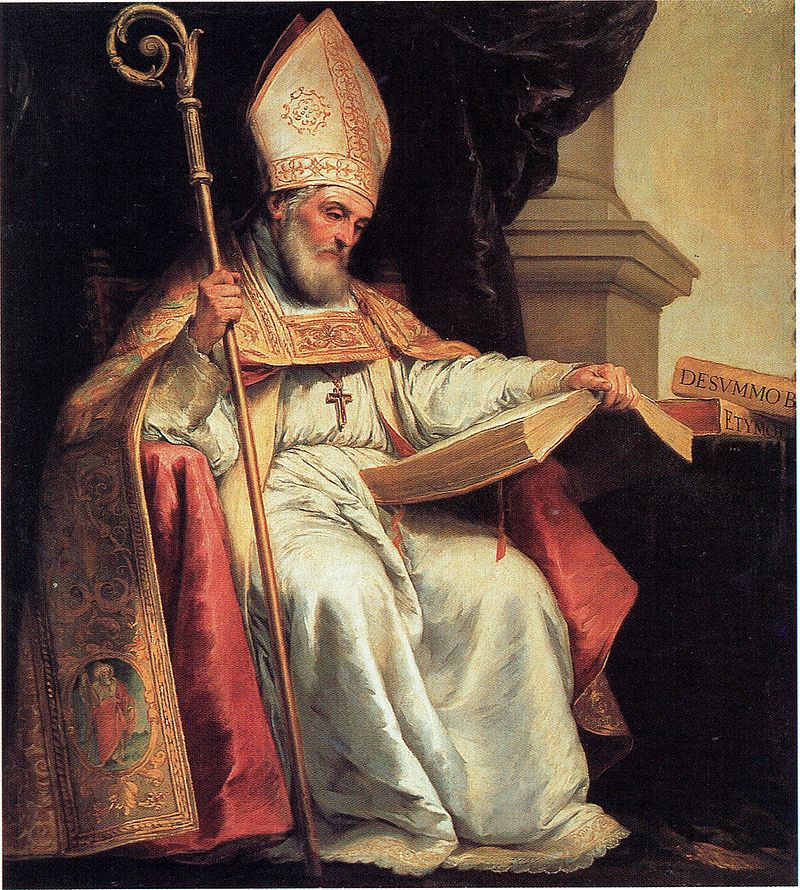
Today, April 4th, muted this year by Holy Saturday, is the commemoration of Saint Isidore of Seville (560-636) a bishop and doctor of the Church during a tumultuous age, when civilization was crumbling, coming apart at its very seams, which may sound sort of au courant. Then again, the form of this world has always[…]Continue reading→
Bishop Fulton Sheen’s 58th Good Friday Reflection
Incredible, at the beginning of this reflection, that the Venerable Bishop Sheen declares that he has given nearly 58 Good Friday reflections – this, as far as I can gather, was his final one, and he seems in full vigour in mind and body. The good bishop and evangelist died in his 84th year on[…]Continue reading→
A Minimal Friar and the Death of a Great Pope
This April the second- overshadowed by Holy Thursday this year – marks the memorial of Saint Francis of Paola (1417-1507), founder of the ‘Minim’ friars, so called for their humility and poverty, who interpreted the rule of Saint Francis of Assisi in quite a literal sense: extreme poverty, trust in God, foregoing all animal and[…]Continue reading→
Woven versus Seamless Garments
The reflection on the worthy project by Magie Dominic was intriguing, and I thought I would offer a brief follow-up commentary. The garment woven out of many pieces is a poignant symbol, even a ‘sacramental’, inspired by prayer and grace. We are all united in some way, and should strive for such unity, wherever we[…]Continue reading→
Bill C-9: Prelude to Persecution?
Well, it happened, as I suppose was inevitable, at least in a secular sense (from God’ perspective, there’s always hope). Bill C-9, the ironically named ‘Combatting Hate Act’ passed the House of Commons with a 186-137 vote. Look on the good side – there’s still over a hundred sane people in parliament who believe in[…]Continue reading→