
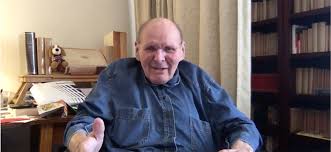
Father Reginald Foster, The Vatican’s Latinist: Requiescat in Pace
Father Reginald Foster, O.C.D, died on Christmas Eve from complications arising from Covid-19. (Yes, I know – people across America are dying with bullet wounds and head trauma, falls, heart attacks, and what not else from ‘Covid’, but we might trust this one, for now).
But whatever it was that took his soul to God, his death marks the end of an era, and I thought I would squeak in a little Ave atque Vale for Father Foster before this year came to a close. He was one of the foremost Latinists of the 20th century. A brilliant student, the young priest was appointed the Pope’s chief Latinist in 1969, responsible for composing and translating pontifical and Magisterial documents of all sorts, as well as teaching generations of students at the Gregorian. I suppose for those outside the Church’s fold – and, sadly, even for many within – a ‘Latinist’ might signify expertise in Spanish-Hispanic-Mexican-Argentinian culture – like, say, Hilaria Baldwin – but no. Father Foster was a peritus in the linguam Latinam of the ancient Romans, and before them the Etruscans, which was in turn adopted by the Catholic Church in the late fourth century, and then by the Christian culture and civilization that the Church formed and founded.
I’ve often thought that Father Foster had a near-ideal job: Living at the Vatican, immersed in the Church’s teaching, precise translations – with one’s days off hiking in the Dolomites or plunging into the Mediterranean, or wandering the streets and monuments of the Eternal City. I have dreamt that one day, perhaps…But I am a victim of our cultural loss of Latin, and any British schoolboy of 1910 or so would mop the floor with my smattering.
Even that ‘small Latin’, as Johson wrote of Shakespeare, is being lost. Up until rather recently – say a generation or two – everyone had a smattering of Latin, enough to muddle through a bit of Caesar and Aquinas, perhaps even a bit less of Cicero and Augustine; and they could certainly have made it through the ‘Latin’ Mass. A myth to be sure that people did not understand the words at Mass. I have been castigated for singing the Sanctus, because people in the parish don’t know Latin’. I don’t think one needs any Latin at all to grasp the significance of the Sanctus, which would be comprehensible in Chinese.
Just back in the sixties, the Fathers at the Second Vatican Council were scandalized that some bishops needed simultaneous translation for the discussions and speeches, conducted, of course, in Latin. One of the last things Pope Saint John XXIII wrote – and he was no liberal, contrary to myth – in 1962, was the Apostolic Constitution Veterum Sapientia (the highest level of authority of Church documents, and, yes, the link is in English) exhorting the reinvigoration of Latin, and ordering that all seminary instruction be conducted in the language. The professors went on strike rather than obey, which showed where things were headed. But by that time, poor Pope John in June of 1963 had already gone to his own eternal reward.
Go a bit further back, and those with a modicum of education were quite fluent in the ancient language, not just translating, but also composing. Cardinal Newman was fluent, as was Thomas Jefferson, who would pen Latin and Greek epigrams in his spare time. Isaac Newton wrote his Principia – with all the complex calculus – in Latin.
It was the lifelong mission of Father Reginald Foster to bring some of this back, to ‘instaurare‘, to reinstate, the perennial Latin language, in which so much of our culture is written, and the greatest minds expressed their thoughts. After all, is not something always lost in translation? To Father Foster, ignorance of Latin is, well, ignorance.
Father Reggie was a controversial figure – zealous, hard-working (teaching ten courses a semester at times), diligent, solicitous of his students, ascetical – he was scandalized by the lifestyle of some of his fellow ecclesiastics when he was first in Rome – and a brilliant teacher and translator. But he could also be rather contrary, and did not suffer fools nor dilettantes gladly. I was always a bit puzzled when I read years ago of his decision to adopt a ‘modified’ habit of blue overalls – I heard them described as a ‘jumpsuit’ – rather than his proper Carmelite habit, as called for by the Council itself, but which Father Reginald claimed no longer corresponded with the ‘dress of the poor’. Hmm. What would Sanctus Johannes Crucis have to say about that?
Perhaps I quibble, as is my wont. Father Reginald certainly left his mark, and legions of loyal students attest to his unique pedagogical method, emphasizing the military and precise nature of Latin, so given to clear, oral, as well as written, expression. There are no exceptions to the rules of Latin, unlike English, where the exception is the rule. He would have them read, cajole, shout, sing, in Latin, feeling the flow of the words. Eamus – Let’s go! Manducemus et bibamus! – Let us eat and drink!
And how much more devotional prayer is in the ancient and official language of the Church herself – of her saints, fathers, doctors, priests, bishops, missionaries and martyrs through the ages. (Of course, we would, and should, include Greek here, for the same panoply of greats in ‘other lung’ of the Church, in the East, but that is food for another reflection. I would recommend the recent Climbing Parnassus, an exhortation to immerse oneself on both languages of our culture).
Father Foster kept his pedagogical zeal right up to the very end, teaching ‘by remote’ a few days before his going to eternity in a nursing home in his native Milwaukee. May he hear the words of our Saviour:
Euge, serve bone, et fidelis: quia super pauca fuisti fidelis, super multa te constituam; intra in gaudium domini tui.
And may learn to love the mellifluous and melodic language of our Holy Mother Church, of all those who came before us, so that we may pray and sing with them.
As one of the foremost Latinists of any age once exhorted, Qui cantat, bis orat. And he who ‘cantats’ in Latin, ‘oras’ even more well. Yes, I must work on my Latin, and English.
Requiescat in pace, Pater Reginaldus Foster, et lux perpetua luceat tui.
Carney’s Amoral Majority
After five defections – euphemistically described as ‘crossing the floor’ – and three by-elections, Mark Carney and his Liberals how have their coveted majority. One wonders what bowls of pottage were offered in back-room deals. In the archaic monarchical system that is the Dominion of Canada, this majority allows the newly-minted Prime Minister to rule[…]Continue reading→
A Closed, Unsustainable, Descending Loop
As a follow-up to my thoughts on Payette’s payout, here be a stark image of where are here in Canada. As the graph shows in, well, graphic terms, since 2025, the public sector has contributed to 95.5% of economic growth. The private sector – which funds the public sector, or is supposed to – has[…]Continue reading→

Remembering Father Alphonse de Valk
(Today marks the sixth anniversary of the death of Father Alphonse de Valk, C.S.B., a faithful, courageous and indefatigable Basilian priest, pro-life-and-family apostle, and the founder of Catholic Insight magazine. Here is what we wrote those on his entering into eternity five years ago, as we continue to remember him in our prayers and thoughts)[…]Continue reading→

A Tale of Two Benedicts
A grace-filled Holy Week to all our readers! As we await and prepare for the Resurrection about to dawn upon us, we might keep in mind two Benedicts: Pope Emeritus Benedict XVI, requiescat in pace, elected on this day in 2005; and today’s commemoration of the mystic pilgrim, Benedict Joseph Labre, who died on this[…]Continue reading→
Presidential Pardon of Weronika Krawczyk
As a good news, follow-up to our story from Poland, of the persecution of Weronika Krawczyk for her pro-life views, we heard that she has been granted a presidential pardon. One might still wonder why one needs a presidential pardon for simply holding the long-held belief that the child within the womb is a child,[…]Continue reading→

Saint Lydwina of Schiedam and Suffering Joyfully
Saint Lydwina of Schiedam (1380 – 1433) was one of the countless and glorious ‘victim souls’ in the history of the Church, those whose lives are filled with suffering, often of an unimaginable intensity, but who suffer joyfully. She was a fifteen-year old Dutch girl, out skating one day, when she fell and broke one[…]Continue reading→

The Glorious Martyrdoms of Martin and Maximus
As we enter into Eastertide, we recall on this 13th of April Pope Saint Martin I (+655), one of the noblest, if most tragic, of the successors of Saint Peter. Born in Umbria, Italy, he was of noble lineage, with great intelligence combined with charity and love of the poor and the Church. While still[…]Continue reading→
Pope Leo and a Rosary for Peace
Pope Leo XIV has asked Catholics across the world to join him in a Rosary for peace today, at 18:00 Rome time (6 pm), which would be noon from where I write (EST). If you are able, whether at that time or another, and in whatever way you pray, to join in intercession with the[…]Continue reading→
Payette’s Payout
I was glancing through some headlines, and noticed a mention of Julie Payette – engineer and astronaut and sometime the Queen’s representative in Canada – which brought back vague memories. She was appointed Governor-General by Justin Trudeau in 2017. Ms. Payette resigned in 2021, amidst claims that she created a ‘toxic work environment’, with allegations[…]Continue reading→

Saint Stanislaus of Szczepanów
We celebrate Saint Stanislaus today (+ April 11, 1079), in light of this Easter Octave, a bishop and martyr who accepted the episcopacy only at the direct order of Pope Alexander II. He proved a wise and courageous leader of his flock, put to death by his own king, Boleslaus, for rebuking the monarch’s ‘immoral[…]Continue reading→