
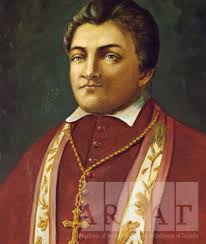
The Courage of Bishop Michael Power: Crucial For Our Times
In 1842, when Father Michael Power, a Haligonian born of Irish parents, was consecrated as the first bishop of the newly formed Diocese of Toronto, he faced an enormous challenge. The Toronto Diocese, largely forgotten by Rome at that time, covered a vast area. Spanning the western area of Upper Canada, the diocese included Manitoulin Island to the north, London to the west, Niagara to the south and Toronto as the home base. He was the spiritual Father to fifty thousand Catholics with three thousand of them living in Toronto. The diocese was lacking in key areas. In a 1842 letter to Bishop Kinsella of Ireland, he wrote, “I have but twenty clergymen throughout the whole county…. I have neither colleges, nor schools, nor men.” One of his first actions was to gather the clergy at St. Paul’s Church in Toronto for a retreat and synod at which he issued strict rules for the conduct of his unruly priests and governance of the diocese. At this time, he consecrated Toronto Diocese to the Sacred Heart of Jesus.
Bishop Power travelled extensively throughout the expansive region. Realizing the need for a nucleus – a central point – for the diocese, he set about the work of building a cathedral and bishop’s palace. Construction of St. Michael’s Cathedral began in April, 1845. He did not live to see its dedication on September 29, 1848.
In the 1840s the famine in Ireland caused mass immigration to Canada. Ninety thousand immigrants landed at Quebec City in 1847 and many of them continued the journey to a new life in Toronto. Overcrowded and unsanitary condition on the ships as well as spoiled, inadequate food resulted in outbreaks of typhus en route to Canada.
Typhus raged in Toronto at this time, the large infected Irish population spreading the disease as they arrived in Hogtown. By 1847, eight hundred sixty-three people had died from the infection, their bodies buried in deep trenches near St. Paul’s Church.
Bishop Power led a courageous group of Catholic clergy and laymen, and assisted by Anglican Bishop J. Strachan, they went out to tend to the sick and the dying confined to fever sheds built along the wharves. Far from hiding behind locked church doors, they worked tirelessly on the forefront of the devastation. Bishop Power contracted the disease and died on October 1, 1847. He was 42 years old.
The newspaper in his hometown of Halifax, The Cross, paid tribute to Bishop Power:
“The loss to the Diocese of Toronto which Dr. Power distinguished by the value of his sacred offices, and the virtues of his life – is at this moment heavy and severe. It is said that neither night nor day witnessed his absence from depositaries of disease, until at length, kneeling over the bed of infection, and listening to the sorrows of some poor penitent, he inhaled the miasmata of death.”
In the one hundred seventy-eight years since the establishment of Toronto Diocese, much has changed. Canada’s largest Archdiocese has a Catholic population of almost two million people served by two hundred twenty-six parishes within an area that is smaller than the original boundaries. One wonders what Bishop Power would say if he were to walk our streets today. One also wonders what he would say about the lockdowns that have been mandated during this time of covid infections.
On November 20, 2020, the Ontario Government, in an attempt to curb the increase in covid infections, misguidedly mandated that all places of worship must limit attendance to ten people. Note that the government did not demand the suspension of public worship. In response, the Archdiocese of Toronto decreed that as of November 23, 2020, all parishes in the city of Toronto and Peel region must stop all public Masses until further notice. No Holy Sacrifice of the Mass despite the fact that churches have been following strict sanitation, social distancing and masking guidelines and to date, have not been a source of outbreaks. The faithful have been encouraged to rely on livestreamed Masses, a poor and increasingly demoralizing substitute for being in the presence of the Lord in His Holy House.
In Toronto, Peel and everywhere that churches have prohibited public Mass, what would Bishop Power say? How would he lead during the current crisis? Would he pour himself out in leadership and service to an increasingly dispirited flock or would he surpass the ten-person government mandate and take away the public celebration of the Holy Sacrifice, removing public, in-person worship from Catholics badly in need of hope, badly in need of Christ?
We will never know his answer but we have the example of his life. In a time of fear and contagion, the good Bishop neither prohibited the celebration of Holy Mass nor hid from his people. In a Catholic Register staff editorial from June 8, 2017, Cardinal Thomas Collins lauded Bishop Power’s “sacrifice and service.” According to the editorial, Bishop Power assuaged the sick and dying with “the experience of Heaven to those who were suffering that hell.” In our present situation, we need the authority, sacrifice, service and courage of Bishop Michael Power.
Sacred Heart of Jesus, have mercy on us.
Sources:
Michael Power: First Bishop of Toronto. http://www.umanitoba.ca/colleges/st_pauls/ccha/Back%20Issues/CCHA1987/Nicolson.pdf
Wise, L. & Gould, A. Toronto Street Names: An Illustrated Guide To Their Origins. Richmond Hill: Firefly Books, 2011.
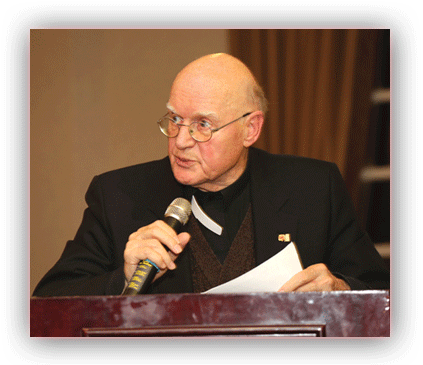
Remembering Father Alphonse de Valk
(Today marks the sixth anniversary of the death of Father Alphonse de Valk, C.S.B., a faithful, courageous and indefatigable Basilian priest, pro-life-and-family apostle, and the founder of Catholic Insight magazine. Here is what we wrote those on his entering into eternity five years ago, as we continue to remember him in our prayers and thoughts)[…]Continue reading→
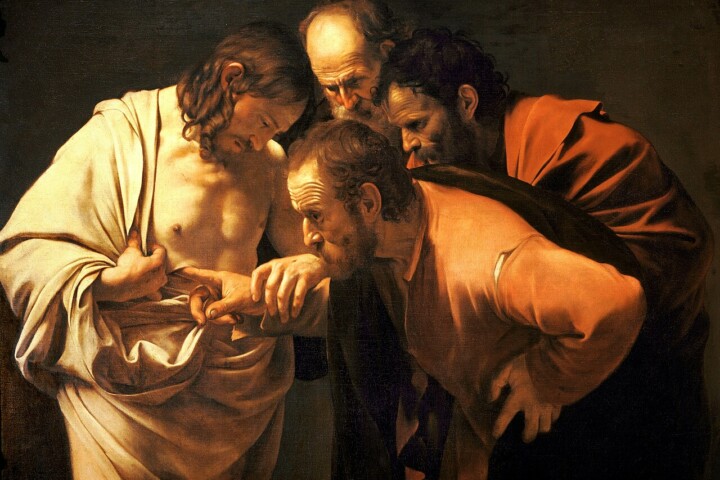
Divine Mercy Sunday – An Echo of Every Mass
Reach out your hand and put it in my side. Do not doubt but believe’… ‘My Lord and my God!’ (Jn. 20:18)). Today is Divine Mercy Sunday, and as we celebrate the end of the Easter Octave, we contemplate the wounded side of our Saviour, the Church’s source of life. On Good Friday in the[…]Continue reading→

Saint Stanislaus of Szczepanów
We celebrate Saint Stanislaus today (+ April 11, 1079), in light of this Easter Octave, a bishop and martyr who accepted the episcopacy only at the direct order of Pope Alexander II. He proved a wise and courageous leader of his flock, put to death by his own king, Boleslaus, for rebuking the monarch’s ‘immoral[…]Continue reading→
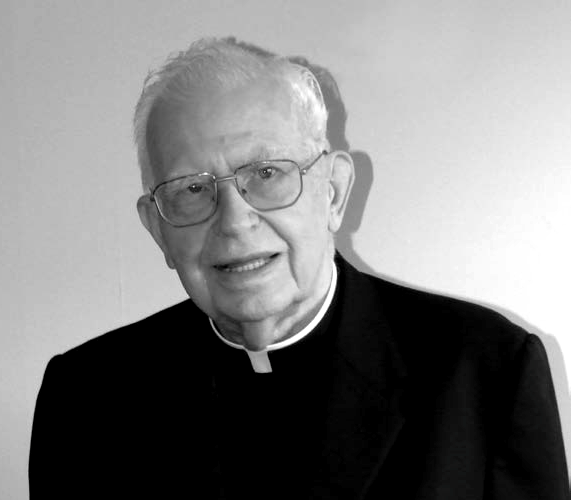
First Holy Communion: Sermon from May 16, 1943
Here is a sermon from the good old days by +Rev. Msgr. Vincent Nicholas Foy (August 14, 1915 – March 13, 2017), from 1943. Readers may recall that Pope Saint Pius X, by the decree Quam Singulari in 1910, lowered the customary age of reception of Holy Communion – after the rigours of the plague[…]Continue reading→
In the Glorious Light of Easter, Alleluia!
Set your minds on things that are above, not on things that are on earth, for you have died, and your life is hidden with Christ in God. When Christ who is your life is revealed, then you also will be revealed with him in glory (Col. 3:3-4). The Resurrection of Our Lord and Saviour[…]Continue reading→
An Ancient Homily for Holy Saturday
The time between Good Friday and Easter Sunday is one of waiting, in silence, as the world wonders – anticipates – what will happen, after the death of Christ. We re-live this time each year in the anamnesis of our liturgy, and in turn look forward to the glorious re-creation of all things at the[…]Continue reading→
Europe’s Long Descent
(As we meditate on this day on Christ’s burial, and His descent into hell, it is fitting to ponder here with contributor Peter Marcus how the world seems to be heading there as well. The difference is that, although God cannot ‘redeem’ hell, nor those therein, He can and did redeem the world. There is[…]Continue reading→
Pope Saint John Paul II’s First Good Friday Homily
ADDRESS OF HIS HOLINESS JOHN PAUL II AT THE CONCLUSION OF THE STATIONS OF THE CROSS AT THE COLOSSEUM Good Friday, 13 April 1979 When we make the Way of the Cross from one station to the next, in spirit we are always at the spot wherethis journey had its “historical” place: where it[…]Continue reading→
A Meditation for Good Friday: How To Undo the Effects of Sin?
Cardinal Newman, now Saint John Henry Newman, was a towering figure of nineteenth-century Catholicism who is almost universally admired. I say “almost” because not everyone likes him. I knew a priest once, Arthur Caulkins, who has become disenchanted with Newman. As an undergraduate Arthur had been enamoured of Newman, and this interest continued when he[…]Continue reading→
Pope Benedict’s Last Holy Thursday Homily
MASS OF THE LORD’S SUPPER HOMILY OF HIS HOLINESS BENEDICT XVI Basilica of St John Lateran Holy Thursday, 5 April 2012 Photo Gallery (Video) Dear Brothers and Sisters! Holy Thursday is not only the day of the institution of the Most Holy Eucharist, whose splendour bathes all else and in some ways draws it to[…]Continue reading→