
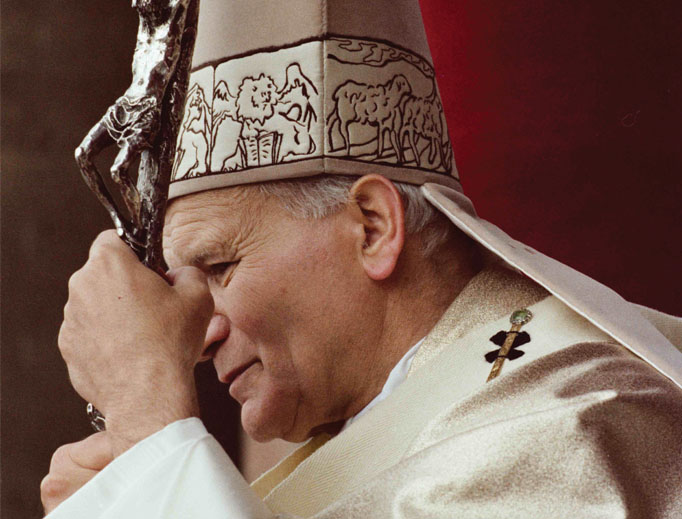
JP II’s Homily Proclaiming Saint Therese A Doctor of the Church
PROCLAMATION OF ST THÉRÈSE OF THE CHILD JESUS
AND THE HOLY FACE
AS A “DOCTOR OF THE CHURCH”
HOMILY OF POPE JOHN PAUL II
Sunday, 19 October 1997
- “Nations shall come to your light” (Is 60: 3). The echo of Epiphany already resounds in the words of the prophet Isaiah as a fervent expectation and luminous hope. It is precisely the connection with this solemnity that enables us to perceive more clearlythis Sunday’s missionary character. Isaiah’s prophecy, in fact, broadens the perspective of salvation to all humanity, and thus anticipates the prophetic act of the Magi who, coming from the East to adore the divine Child born in Bethlehem (cf. Mt 2: 1-12), proclaim and inaugurate the adherence of the nations to Christ’s message.
All men are called to accept in faith the saving Gospel. The Church is sent to all peoples, all lands and cultures: “Go … and make disciples of all nations, baptizing them in the name of the Father and of the Son and of the Holy Spirit, teaching them to observe all that I have commanded you” (Mt 28: 19-20). These words, spoken by Christ before ascending into heaven, together with the promise he made to the Apostles and their successors that he would be with them until the end of the world (cf. Mt 28: 20), are the essence of the missionary mandate: in the person of his ministers, it is Christ himself who goes ad gentes, to those who have not yet received the proclamation of the faith.
- Thérèse Martin, a discalced Carmelite of Lisieux, ardently desired to be a missionary. She was one, to the point that she could be proclaimedpatroness of the missions. Jesus himself showed her how she could live this vocation: by fully practising the commandment of love, she would be immersed in the very heart of the Church’s mission, supporting those who proclaim the Gospel with the mysterious power of prayer and communion. Thus she achieved what the Second Vatican Council emphasized in teaching that the Church is missionary by nature (cf.Ad gentes, n. 2). Not only those who choose the missionary life but all the baptized are in some way sent ad gentes.
This is why I chose this missionary Sunday to proclaim St Thérèse of the Child Jesus and the Holy Face a doctor of the universal Church: a woman, a young person, a contemplative.
- Everyone thus realizes that today something surprising is happening. St Thérèse of Lisieux was unable to attend a university or engage in systematic study. She died young: nevertheless, from this day forward she will be honoured as a doctor of the Church, an outstanding recognition which raises her in the esteem of the entire Christian community far beyond any academic title.
Indeed, when the Magisterium proclaims someone a doctor of the Church, it intends to point out to all the faithful, particularly to those who perform in the Church the fundamental service of preaching or who undertake the delicate task of theological teaching and research, that the doctrine professed and proclaimed by a certain person can be a reference point, not only because it conforms to revealed truth, but also because it sheds new light on the mysteries of the faith, a deeper understanding of Christ’s mystery. The Council reminded us that, with the help of the Holy Spirit, understanding of the “depositum fidei” continually grows in the Church, and not only does the richly contemplative study to which theologians are called, not only does the Magisterium of pastors, endowed with the “sure charism of truth”, contribute to this growth process, but also that “profound understanding of spiritual things” which is given through experience, with the wealth and diversity of gifts, to all those who let themselves be docilely led by God’s Spirit (cf. Dei Verbum, n. 8). Lumen gentium, for its part, teaches that God himself “speaks to us” (n. 50) in his saints. It is for this reason that the spiritual experience of the saints has a special value for deepening our knowledge of the divine mysteries, which remain ever greater than our thoughts, and not by chance does the Church choose only saints to be distinguished with the title of “doctor”.
(To continue reading, please see here…)

Saint Kateri , Canada’s Protectress
This was the title given to Saint Kateri Tekakwitha, by Pope Benedict XVI, when he canonized her on October 28th, 2012, along with six others, in Saint Peter’ Square (she had been beatified by Pope John Paul II back in 1980). With Saint Joseph as our protector, along with the Canadian martyrs, we seem to[…]Continue reading→

Remembering Father Alphonse de Valk
(Today marks the sixth anniversary of the death of Father Alphonse de Valk, C.S.B., a faithful, courageous and indefatigable Basilian priest, pro-life-and-family apostle, and the founder of Catholic Insight magazine. Here is what we wrote those on his entering into eternity five years ago, as we continue to remember him in our prayers and thoughts)[…]Continue reading→

My Name is Bernadette
April 16th is a propitious day, for besides the anniversary of Father de Valk’s death, who founded Catholic Insight in its print form decades ago, and the commemoration of the ‘two Benedicts’, mentioned in accompanying posts, today we also recall Saint Bernadette Soubirous, the young visionary to whom the Virgin Mary appeared numerous times at[…]Continue reading→

Canonizing Sister Faustina and Divine Mercy
HOMILY OF THE HOLY FATHER MASS IN ST PETER’S SQUARE FOR THE CANONIZATION OF SR MARY FAUSTINA KOWALSKA Sunday, 30 April 2000 1. “Confitemini Domino quoniam bonus, quoniam in saeculum misericordia eius”; “Give thanks to the Lord for he is good; his steadfast love endures for ever” (Ps 118: 1). So the Church sings on the Octave of[…]Continue reading→

Divine Mercy Sunday – An Echo of Every Mass
Reach out your hand and put it in my side. Do not doubt but believe’… ‘My Lord and my God!’ (Jn. 20:18)). Today is Divine Mercy Sunday, and as we celebrate the end of the Easter Octave, we contemplate the wounded side of our Saviour, the Church’s source of life. On Good Friday in the[…]Continue reading→

Saint Stanislaus of Szczepanów
We celebrate Saint Stanislaus today (+ April 11, 1079), in light of this Easter Octave, a bishop and martyr who accepted the episcopacy only at the direct order of Pope Alexander II. He proved a wise and courageous leader of his flock, put to death by his own king, Boleslaus, for rebuking the monarch’s ‘immoral[…]Continue reading→

First Holy Communion: Sermon from May 16, 1943
Here is a sermon from the good old days by +Rev. Msgr. Vincent Nicholas Foy (August 14, 1915 – March 13, 2017), from 1943. Readers may recall that Pope Saint Pius X, by the decree Quam Singulari in 1910, lowered the customary age of reception of Holy Communion – after the rigours of the plague[…]Continue reading→

In the Glorious Light of Easter, Alleluia!
Set your minds on things that are above, not on things that are on earth, for you have died, and your life is hidden with Christ in God. When Christ who is your life is revealed, then you also will be revealed with him in glory (Col. 3:3-4). The Resurrection of Our Lord and Saviour[…]Continue reading→

An Ancient Homily for Holy Saturday
The time between Good Friday and Easter Sunday is one of waiting, in silence, as the world wonders – anticipates – what will happen, after the death of Christ. We re-live this time each year in the anamnesis of our liturgy, and in turn look forward to the glorious re-creation of all things at the[…]Continue reading→

Europe’s Long Descent
(As we meditate on this day on Christ’s burial, and His descent into hell, it is fitting to ponder here with contributor Peter Marcus how the world seems to be heading there as well. The difference is that, although God cannot ‘redeem’ hell, nor those therein, He can and did redeem the world. There is[…]Continue reading→