
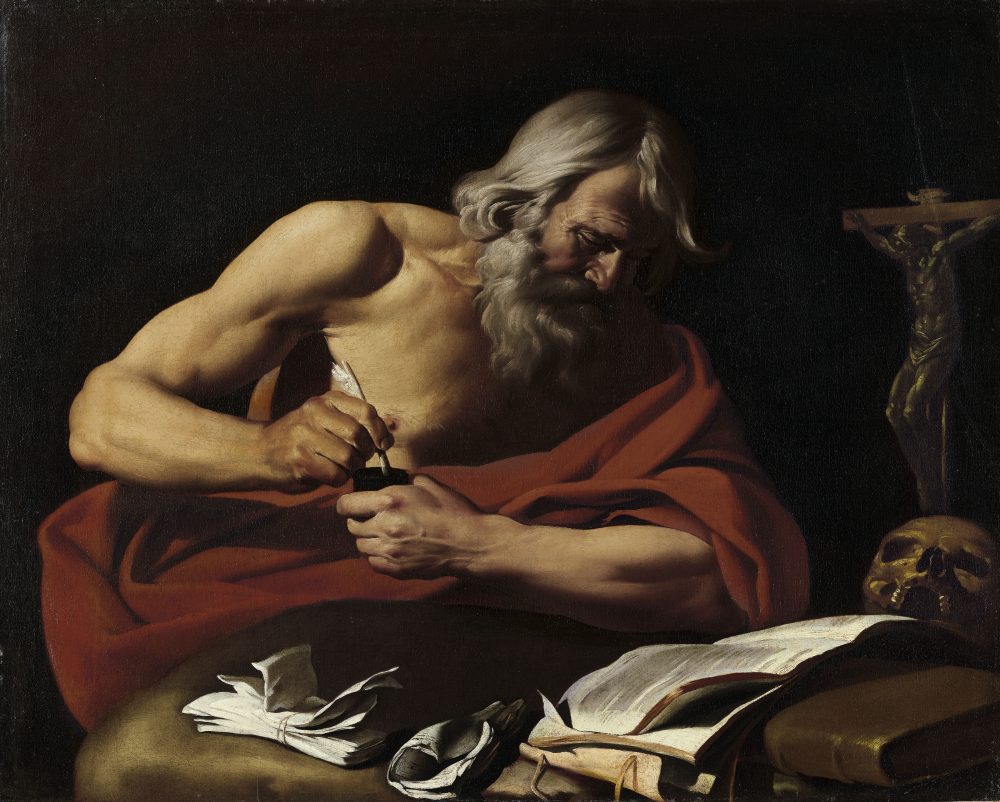
Pope Benedict and Saint Jerome
BENEDICT XVI
GENERAL AUDIENCE
Saint Peter’s Square
Wednesday, 7 November 2007
Saint Jerome (1)
Dear Brothers and Sisters,
Today, we turn our attention to St Jerome, a Church Father who centred his life on the Bible: he translated it into Latin, commented on it in his works, and above all, strove to live it in practice throughout his long earthly life, despite the well-known difficult, hot-tempered character with which nature had endowed him.
Jerome was born into a Christian family in about 347 A.D. in Stridon. He was given a good education and was even sent to Rome to fine-tune his studies. As a young man he was attracted by the worldly life (cf. Ep 22, 7), but his desire for and interest in the Christian religion prevailed.
He received Baptism in about 366 and opted for the ascetic life. He went to Aquileia and joined a group of fervent Christians that had formed around Bishop Valerian and which he described as almost “a choir of blesseds” (Chron. ad ann. 374). He then left for the East and lived as a hermit in the Desert of Chalcis, south of Aleppo (Ep 14, 10), devoting himself assiduously to study. He perfected his knowledge of Greek, began learning Hebrew (cf. Ep 125, 12), and transcribed codices and Patristic writings (cf. Ep 5, 2). Meditation, solitude and contact with the Word of God helped his Christian sensibility to mature. He bitterly regretted the indiscretions of his youth (cf. Ep. 22, 7) and was keenly aware of the contrast between the pagan mentality and the Christian life: a contrast made famous by the dramatic and lively “vision” – of which he has left us an account – in which it seemed to him that he was being scourged before God because he was “Ciceronian rather than Christian” (cf. Ep. 22, 30).
In 382 he moved to Rome: here, acquainted with his fame as an ascetic and his ability as a scholar, Pope Damasus engaged him as secretary and counsellor; the Pope encouraged him, for pastoral and cultural reasons, to embark on a new Latin translation of the Biblical texts. Several members of the Roman aristocracy, especially noblewomen such as Paula, Marcella, Asella, Lea and others, desirous of committing themselves to the way of Christian perfection and of deepening their knowledge of the Word of God, chose him as their spiritual guide and teacher in the methodical approach to the sacred texts. These noblewomen also learned Greek and Hebrew.
After the death of Pope Damasus, Jerome left Rome in 385 and went on pilgrimage, first to the Holy Land, a silent witness of Christ’s earthly life, and then to Egypt, the favourite country of numerous monks (cf. Contra Rufinum, 3, 22; Ep. 108, 6-14). In 386 he stopped in Bethlehem, where male and female monasteries were built through the generosity of the noblewoman, Paula, as well as a hospice for pilgrims bound for the Holy Land, “remembering Mary and Joseph who had found no room there” (Ep. 108, 14). He stayed in Bethlehem until he died, continuing to do a prodigious amount of work: he commented on the Word of God; he defended the faith, vigorously opposing various heresies; he urged the monks on to perfection; he taught classical and Christian culture to young students; he welcomed with a pastor’s heart pilgrims who were visiting the Holy Land. He died in his cell close to the Grotto of the Nativity on 30 September 419-420.
Jerome’s literary studies and vast erudition enabled him to revise and translate many biblical texts: an invaluable undertaking for the Latin Church and for Western culture. On the basis of the original Greek and Hebrew texts, and thanks to the comparison with previous versions, he revised the four Gospels in Latin, then the Psalter and a large part of the Old Testament. Taking into account the original Hebrew and Greek texts of the Septuagint, the classical Greek version of the Old Testament that dates back to pre-Christian times, as well as the earlier Latin versions, Jerome was able, with the assistance later of other collaborators, to produce a better translation: this constitutes the so-called “Vulgate”, the “official” text of the Latin Church which was recognized as such by the Council of Trent and which, after the recent revision, continues to be the “official” Latin text of the Church. It is interesting to point out the criteria which the great biblicist abided by in his work as a translator. He himself reveals them when he says that he respects even the order of the words of the Sacred Scriptures, for in them, he says, “the order of the words is also a mystery” (Ep. 57, 5), that is, a revelation. Furthermore, he reaffirms the need to refer to the original texts: “Should an argument on the New Testament arise between Latins because of interpretations of the manuscripts that fail to agree, let us turn to the original, that is, to the Greek text in which the New Testament was written. “Likewise, with regard to the Old Testament, if there are divergences between the Greek and Latin texts we should have recourse to the original Hebrew text; thus, we shall be able to find in the streams all that flows from the source” (Ep. 106, 2). Jerome also commented on many biblical texts. For him the commentaries had to offer multiple opinions “so that the shrewd reader, after reading the different explanations and hearing many opinions – to be accepted or rejected – may judge which is the most reliable, and, like an expert moneychanger, may reject the false coin” (Contra Rufinum 1, 16).
(To continue reading, please see here…)
(For the second part to the Pope’s reflections on Saint Jerome, see here)

Remembering Father Alphonse de Valk
(Today marks the sixth anniversary of the death of Father Alphonse de Valk, C.S.B., a faithful, courageous and indefatigable Basilian priest, pro-life-and-family apostle, and the founder of Catholic Insight magazine. Here is what we wrote those on his entering into eternity five years ago, as we continue to remember him in our prayers and thoughts)[…]Continue reading→

Divine Mercy Sunday – An Echo of Every Mass
Reach out your hand and put it in my side. Do not doubt but believe’… ‘My Lord and my God!’ (Jn. 20:18)). Today is Divine Mercy Sunday, and as we celebrate the end of the Easter Octave, we contemplate the wounded side of our Saviour, the Church’s source of life. On Good Friday in the[…]Continue reading→

Saint Stanislaus of Szczepanów
We celebrate Saint Stanislaus today (+ April 11, 1079), in light of this Easter Octave, a bishop and martyr who accepted the episcopacy only at the direct order of Pope Alexander II. He proved a wise and courageous leader of his flock, put to death by his own king, Boleslaus, for rebuking the monarch’s ‘immoral[…]Continue reading→

First Holy Communion: Sermon from May 16, 1943
Here is a sermon from the good old days by +Rev. Msgr. Vincent Nicholas Foy (August 14, 1915 – March 13, 2017), from 1943. Readers may recall that Pope Saint Pius X, by the decree Quam Singulari in 1910, lowered the customary age of reception of Holy Communion – after the rigours of the plague[…]Continue reading→

In the Glorious Light of Easter, Alleluia!
Set your minds on things that are above, not on things that are on earth, for you have died, and your life is hidden with Christ in God. When Christ who is your life is revealed, then you also will be revealed with him in glory (Col. 3:3-4). The Resurrection of Our Lord and Saviour[…]Continue reading→

An Ancient Homily for Holy Saturday
The time between Good Friday and Easter Sunday is one of waiting, in silence, as the world wonders – anticipates – what will happen, after the death of Christ. We re-live this time each year in the anamnesis of our liturgy, and in turn look forward to the glorious re-creation of all things at the[…]Continue reading→

Europe’s Long Descent
(As we meditate on this day on Christ’s burial, and His descent into hell, it is fitting to ponder here with contributor Peter Marcus how the world seems to be heading there as well. The difference is that, although God cannot ‘redeem’ hell, nor those therein, He can and did redeem the world. There is[…]Continue reading→
Pope Saint John Paul II’s First Good Friday Homily
ADDRESS OF HIS HOLINESS JOHN PAUL II AT THE CONCLUSION OF THE STATIONS OF THE CROSS AT THE COLOSSEUM Good Friday, 13 April 1979 When we make the Way of the Cross from one station to the next, in spirit we are always at the spot wherethis journey had its “historical” place: where it[…]Continue reading→
A Meditation for Good Friday: How To Undo the Effects of Sin?
Cardinal Newman, now Saint John Henry Newman, was a towering figure of nineteenth-century Catholicism who is almost universally admired. I say “almost” because not everyone likes him. I knew a priest once, Arthur Caulkins, who has become disenchanted with Newman. As an undergraduate Arthur had been enamoured of Newman, and this interest continued when he[…]Continue reading→
Pope Benedict’s Last Holy Thursday Homily
MASS OF THE LORD’S SUPPER HOMILY OF HIS HOLINESS BENEDICT XVI Basilica of St John Lateran Holy Thursday, 5 April 2012 Photo Gallery (Video) Dear Brothers and Sisters! Holy Thursday is not only the day of the institution of the Most Holy Eucharist, whose splendour bathes all else and in some ways draws it to[…]Continue reading→