
Finding Our Way: Mass Ad Orientem, Towards Our Saviour
Have you ever been really lost? Lost to the point of having no clue which direction you needed to go? What would you do without your phone and Google maps?
A few years ago, a friend of my parents was out for a hike in the British Columbia back-country with her boyfriend. The two of them weren’t experienced hikers, but they were bold. They left the trail to improve their experience, but after a few hours of hiking they realized they were lost. They didn’t have a map, they didn’t have a compass and they didn’t have a clue how to get back to the trail or a road. Not only were they lost, they were also without food and a means of making fire. It was a bleak situation. What did they do? They found a small creek, so they would have fresh water, they built a small shelter to protect themselves from the elements, and they waited. One day passed, then two, then they started hearing and seeing rescue helicopters, but Search and Rescue couldn’t see them. Three, four, five, six days passed and they weren’t found. After seven days they finally accepted that they would not be found; however, in that time they realized that the helicopters were always coming from the same general direction and returning in the same general direction, so they decided to walk in that direction. At the end of the seventh day, just as the search was being called off and the last helicopter was returning, the couple walked out into the clearing where Search and Rescue had set up their base camp. The lost were found.
For those of you who are accustomed to spending time in the woods or out on the water, you’re probably shaking your head at this poor couple. How could they be so unprepared and get so lost? Their situation, however, is a powerful image of where our world is today. We live in a world that is unprepared and without direction.
You’re familiar with the terms orienteering and orientation. The root of both words, of course, is orientem, east. In order to navigate properly, you need to first have one direction of which you are certain. The sun always rises in the east and sets in the west, so those are easy. The needle of a compass points north. If it’s night and you can see the stars, then you can always know north by the North Star. And there are many other ways that you can orient yourself in the wilderness. You just need to find something that you know always points in the same direction.
We live in a disoriented world because there are no longer fixed points to guide people. Religion, of course, has always been a guiding principle. Religions have fixed dogmas and practices that must be followed. These dogmas and practices give meaning and direction to people’s lives. The modern world, however, rejects religion. We often hear the phrase, “I’m spiritual but not religious.” In other words, “I determine my own direction. I decide what’s good and evil, and I do what I think is right.” Spirituality without religion, is spirituality with no guiding principle. It has no sure direction.
For many people in the modern era science is the guiding principle, but more and more we see that scientific facts can be manipulated and interpreted in many different ways. One person interprets the facts one way to support his beliefs and someone else interprets them another way. Fr. Raymond de Souza’s recent article, It’s time to stop pretending our politicians ‘follow the science’, speaks well to how this problem is manifesting itself in the midst of the present crisis. The physical sciences are lost without the higher sciences. They need a guiding principle beyond themselves.
The point of this article, however, is not to explain the many ways in which the waywardness of our society are manifested. Rather, it is a reflection on a simple way that my own waywardness is manifested. As a parish priest and as a Christian, what is my guiding principle? What is my orientem? Christ, of course. He is the beginning and the end. Christ, present in Scripture, guides us with His teachings; the Ten Commandments, the beatitudes, all of which teach us the path to heaven. Christ, present in His Church, sustains us in this world with the grace of the Sacraments and the guidance of the Magisterium. Christ, present within the faithful, through the grace of the Holy Spirit, provides an interior compass, an interior law, to guide us. Christ is the one true guiding principle.
Of course, we all know this. We know as Christians that Christ must be our guiding principle, our ‘east’, but do we always live that way? In the midst of a crisis where do we turn for direction? Do we pray to Christ, do we open the Bible and seek His wisdom, do we bring our struggles to confession and ask the priest for guidance? Or, do we look to news sources, Facebook, politicians, and whoever else for our guidance? The reality is that a situation only really becomes a crisis, we’re only really lost, when our focus is taken off Christ. Like St. Peter, who was walking on water but became distracted by the wind and waves, we only sink when our eyes leave Christ.
When we spend our time worrying about things that are out of our control, then our eyes are not on Christ. We can’t control what the Pope says. We can’t control the next fixation of the news cycle. We can’t control other people. We can barely control ourselves, so we must start by controlling ourselves as best we can and then we see where Christ leads us.
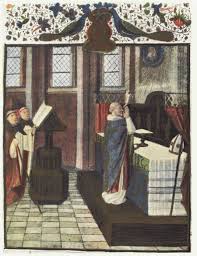
One practical application of this principle is how we enter into the Sacrifice of the Mass. The various aspects of the Mass should focus our attention on Christ. He is the orientem of the Mass. Ideally, everything (architecture, music, art, words, gestures, etc.) should point to Him. Clearly, not all parishes are made equal in these respects, but that doesn’t absolve individuals from doing their best to remain focused on Christ at every Mass. Maybe you have the power to help orient one or more of those aspects of liturgy more toward Christ or maybe you don’t. The goal isn’t parish reform through activism. The goal is personal reform letting Christ lead the way.
I know this isn’t easy. I will admit that when I was a layman, I was quite capable of spending an entire Mass pondering all the things I hated about the church I was in. Thankfully, as a priest the duties of the moment prevent me from spending so much time pondering. But now that I am a priest, I have more responsibility in making sure every aspect of the liturgy is pointing to Christ, and yet certain things are even beyond the control of the priest. Priests aren’t free to tear down and rebuild churches at their leisure. Priests can’t simply will their congregations into being proficient at Gregorian chant or polyphony. There are, indeed, many other limiting factors to what priests can do; however, that doesn’t absolve us from continually striving toward the perfect ad orientem, et ad Christum Mass.

Remembering Father Alphonse de Valk
(Today marks the sixth anniversary of the death of Father Alphonse de Valk, C.S.B., a faithful, courageous and indefatigable Basilian priest, pro-life-and-family apostle, and the founder of Catholic Insight magazine. Here is what we wrote those on his entering into eternity five years ago, as we continue to remember him in our prayers and thoughts)[…]Continue reading→

Divine Mercy Sunday – An Echo of Every Mass
Reach out your hand and put it in my side. Do not doubt but believe’… ‘My Lord and my God!’ (Jn. 20:18)). Today is Divine Mercy Sunday, and as we celebrate the end of the Easter Octave, we contemplate the wounded side of our Saviour, the Church’s source of life. On Good Friday in the[…]Continue reading→

Saint Stanislaus of Szczepanów
We celebrate Saint Stanislaus today (+ April 11, 1079), in light of this Easter Octave, a bishop and martyr who accepted the episcopacy only at the direct order of Pope Alexander II. He proved a wise and courageous leader of his flock, put to death by his own king, Boleslaus, for rebuking the monarch’s ‘immoral[…]Continue reading→
First Holy Communion: Sermon from May 16, 1943
Here is a sermon from the good old days by +Rev. Msgr. Vincent Nicholas Foy (August 14, 1915 – March 13, 2017), from 1943. Readers may recall that Pope Saint Pius X, by the decree Quam Singulari in 1910, lowered the customary age of reception of Holy Communion – after the rigours of the plague[…]Continue reading→
In the Glorious Light of Easter, Alleluia!
Set your minds on things that are above, not on things that are on earth, for you have died, and your life is hidden with Christ in God. When Christ who is your life is revealed, then you also will be revealed with him in glory (Col. 3:3-4). The Resurrection of Our Lord and Saviour[…]Continue reading→
An Ancient Homily for Holy Saturday
The time between Good Friday and Easter Sunday is one of waiting, in silence, as the world wonders – anticipates – what will happen, after the death of Christ. We re-live this time each year in the anamnesis of our liturgy, and in turn look forward to the glorious re-creation of all things at the[…]Continue reading→
Europe’s Long Descent
(As we meditate on this day on Christ’s burial, and His descent into hell, it is fitting to ponder here with contributor Peter Marcus how the world seems to be heading there as well. The difference is that, although God cannot ‘redeem’ hell, nor those therein, He can and did redeem the world. There is[…]Continue reading→
Pope Saint John Paul II’s First Good Friday Homily
ADDRESS OF HIS HOLINESS JOHN PAUL II AT THE CONCLUSION OF THE STATIONS OF THE CROSS AT THE COLOSSEUM Good Friday, 13 April 1979 When we make the Way of the Cross from one station to the next, in spirit we are always at the spot wherethis journey had its “historical” place: where it[…]Continue reading→
A Meditation for Good Friday: How To Undo the Effects of Sin?
Cardinal Newman, now Saint John Henry Newman, was a towering figure of nineteenth-century Catholicism who is almost universally admired. I say “almost” because not everyone likes him. I knew a priest once, Arthur Caulkins, who has become disenchanted with Newman. As an undergraduate Arthur had been enamoured of Newman, and this interest continued when he[…]Continue reading→
Pope Benedict’s Last Holy Thursday Homily
MASS OF THE LORD’S SUPPER HOMILY OF HIS HOLINESS BENEDICT XVI Basilica of St John Lateran Holy Thursday, 5 April 2012 Photo Gallery (Video) Dear Brothers and Sisters! Holy Thursday is not only the day of the institution of the Most Holy Eucharist, whose splendour bathes all else and in some ways draws it to[…]Continue reading→