
Are Fairies Catholic?
Are fairies good Christians?
Many say they are not; that they are actually shrunken idols, worshipped into later ages by the people of the fens, the “heathen” or “pagan.” This, after all, is where fairies are met: in the woods, on the margins of human settlement. Max Muller, the 19th century scholar of religions, advanced this opinion. W.B. Yeats cites “Irish antiquarians” to say fairies are “The gods of pagan Ireland … who, when no longer worshipped and fed with offerings, dwindled away in the popular imagination, and now are only a few spans high.”
Plausible; yet this fancy runs afoul of the fact that there are already such creatures in pre-Christian cultures, and they are not gods: the nymphs and dryads of Greece; the yakshas and apsaras of India; Korea’s dokkaebi; the engkanto of the ante-Christian Philippines. The Quran has its djinn, who function like fairies in the Thousand and One Arabian Nights.
The 17th century Anglican bishop of Oxford actually saw fairies as Catholic:
By which we note, the fairies
Were of the old profession,
Their songs were Ave Marias,
Their dances were procession.
But now, alas! They all are dead,
Or gone beyond the seas;
Or farther for religion fled;
Or else they take their ease.
Most by now perhaps have taken passage for Canada. My Irish-Canadian grandmother would agree. They were always hiding items in her pantry.
Yeats too believes that fairies are loyal to Rome, and notes that they remained a stronger tradition in Ireland than in Protestant England. If they were sometimes declared pagan, other aspects of Catholicism were also declared pagan, in an England gone Puritan: Christmas, icons, shrines, relics, saints. Fairies love beauty, and music, and dance. Puritans do not.
Fairies do seem to find enduring habitation in the Catholic imagination; among such Catholic or “high church” authors as Chesterton, C.S. Lewis, Conan Doyle, Oscar Wilde, J.R.R. Tolkien.
Among church fathers, Origen seems to argue for their existence:
“We indeed … maintain with regard not only to the fruits of the earth, but to every flowing stream and every breath of air that the ground brings forth those things which are said to grow up naturally,—that the water springs in fountains, and refreshes the earth with running streams,—that the air is kept pure, and supports the life of those who breathe it, only in consequence of the agency and control of certain beings whom we may call invisible husbandmen and guardians; but we deny that those invisible agents are demons. (Origen, Contra Celsus, Book 8, ch. 3).”
The simple, obvious interpretation is that “fairy” is a class of angel. This, indeed, follows from St. Augustine’s definition: “’Angel’ is the name of their office, not of their nature. If you seek the name of their nature, it is ‘spirit’; if you seek the name of their office, it is ‘angel’: from what they are, ‘spirit,’ from what they do, ‘angel.’’’ “Fairy” is simply a generic term for a spiritual being.
The “fairy godmother,” most familiar fairy in the tales, is functionally equivalent to a guardian angel. In some of Grimms’ collected tales, like “The Maiden without Hands,” she is identified expressly as an angel.
Why do fairy tales not make this clear? Perhaps because seraphim in their true spiritual form are too intimidating to young, and many adult, minds.
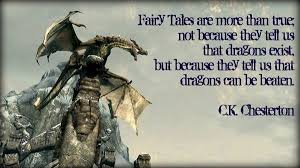
There is an informal belief, it is true, that fairies are amoral, and mischievous. Yet this is not borne out in the actual legends. As Chesterton has observed, fairyland is actually resolutely moral at all times. But rather than lead with ethics, which many find disturbing, it follows Bishop Barron’s advice, and lures at first with beauty.
For there are also fallen angels: the trolls. A Danish legend implies their real identity:
One night as a priest was going from Hiorlunde to Rolskilde, he passed by a mound in which there were music, dancing and other merriment.
At this moment some trolls sprang forth from the mound, stopped the coach, and said, “Where are you going?”
“To Landemode,” answered the priest.
They then asked him whether he thought they could be saved. He replied that he could not tell them. They then asked him to return with an answer in a year.
In the meantime the coachman, the next time he passed by the mound, was overturned and killed on the spot.
When the priest came again at the end of a year, they again asked him the same question, to which he answered, “No! You are all damned!”
Scarcely had he uttered the words before the whole mound was ablaze.
“A fairy tale,” says Laura Cready, in her 1916 Study of Fairy Tales, “is a poetic presentation of a spiritual truth.”

Saint Kateri , Canada’s Protectress
This was the title given to Saint Kateri Tekakwitha, by Pope Benedict XVI, when he canonized her on October 28th, 2012, along with six others, in Saint Peter’ Square (she had been beatified by Pope John Paul II back in 1980). With Saint Joseph as our protector, along with the Canadian martyrs, we seem to[…]Continue reading→

Remembering Father Alphonse de Valk
(Today marks the sixth anniversary of the death of Father Alphonse de Valk, C.S.B., a faithful, courageous and indefatigable Basilian priest, pro-life-and-family apostle, and the founder of Catholic Insight magazine. Here is what we wrote those on his entering into eternity five years ago, as we continue to remember him in our prayers and thoughts)[…]Continue reading→

My Name is Bernadette
April 16th is a propitious day, for besides the anniversary of Father de Valk’s death, who founded Catholic Insight in its print form decades ago, and the commemoration of the ‘two Benedicts’, mentioned in accompanying posts, today we also recall Saint Bernadette Soubirous, the young visionary to whom the Virgin Mary appeared numerous times at[…]Continue reading→

Canonizing Sister Faustina and Divine Mercy
HOMILY OF THE HOLY FATHER MASS IN ST PETER’S SQUARE FOR THE CANONIZATION OF SR MARY FAUSTINA KOWALSKA Sunday, 30 April 2000 1. “Confitemini Domino quoniam bonus, quoniam in saeculum misericordia eius”; “Give thanks to the Lord for he is good; his steadfast love endures for ever” (Ps 118: 1). So the Church sings on the Octave of[…]Continue reading→

Divine Mercy Sunday – An Echo of Every Mass
Reach out your hand and put it in my side. Do not doubt but believe’… ‘My Lord and my God!’ (Jn. 20:18)). Today is Divine Mercy Sunday, and as we celebrate the end of the Easter Octave, we contemplate the wounded side of our Saviour, the Church’s source of life. On Good Friday in the[…]Continue reading→

Saint Stanislaus of Szczepanów
We celebrate Saint Stanislaus today (+ April 11, 1079), in light of this Easter Octave, a bishop and martyr who accepted the episcopacy only at the direct order of Pope Alexander II. He proved a wise and courageous leader of his flock, put to death by his own king, Boleslaus, for rebuking the monarch’s ‘immoral[…]Continue reading→
First Holy Communion: Sermon from May 16, 1943
Here is a sermon from the good old days by +Rev. Msgr. Vincent Nicholas Foy (August 14, 1915 – March 13, 2017), from 1943. Readers may recall that Pope Saint Pius X, by the decree Quam Singulari in 1910, lowered the customary age of reception of Holy Communion – after the rigours of the plague[…]Continue reading→
In the Glorious Light of Easter, Alleluia!
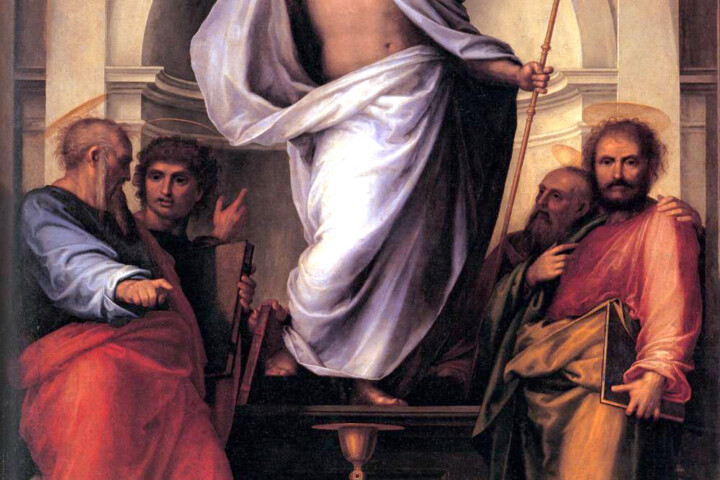
Set your minds on things that are above, not on things that are on earth, for you have died, and your life is hidden with Christ in God. When Christ who is your life is revealed, then you also will be revealed with him in glory (Col. 3:3-4). The Resurrection of Our Lord and Saviour[…]Continue reading→
An Ancient Homily for Holy Saturday
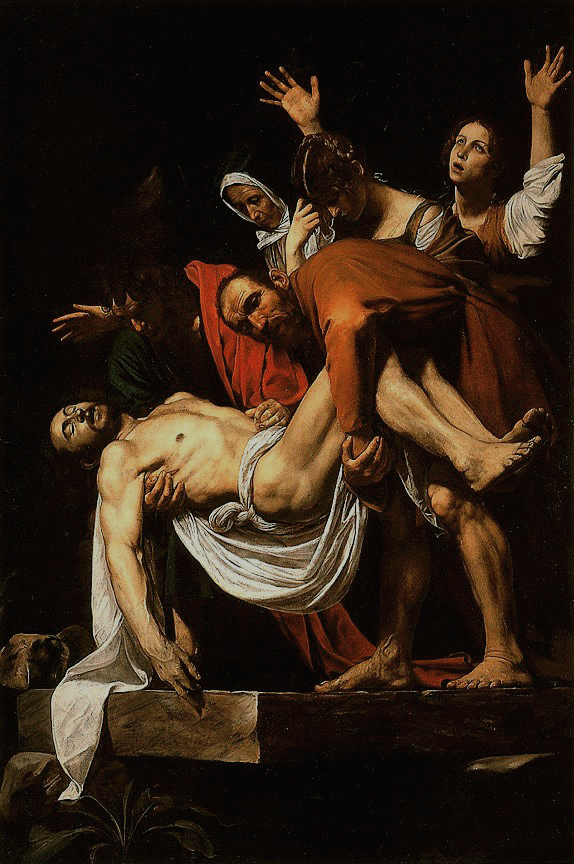
The time between Good Friday and Easter Sunday is one of waiting, in silence, as the world wonders – anticipates – what will happen, after the death of Christ. We re-live this time each year in the anamnesis of our liturgy, and in turn look forward to the glorious re-creation of all things at the[…]Continue reading→
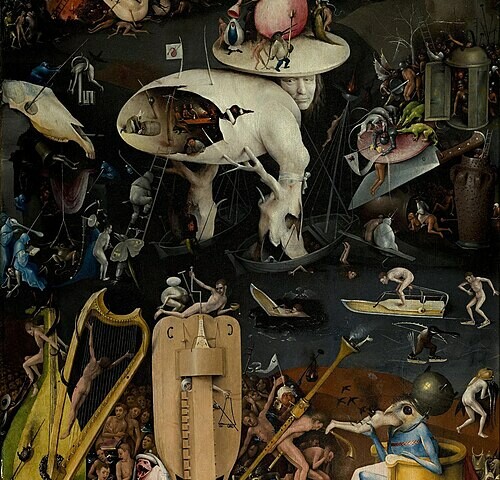
Europe’s Long Descent
(As we meditate on this day on Christ’s burial, and His descent into hell, it is fitting to ponder here with contributor Peter Marcus how the world seems to be heading there as well. The difference is that, although God cannot ‘redeem’ hell, nor those therein, He can and did redeem the world. There is[…]Continue reading→