
Lynn’s Resurrection
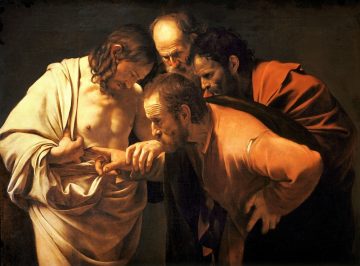
The significance of today’s Gospel, about doubting Thomas—came home to me in a special way on 1 January 1975 when I was informed of the death of a good friend. His name was Lynn Edwards, and he had died in his sleep the preceding night. His death was not completely unexpected for, although he was only thirty years old, he was a severe spastic. Fluid would collect in his lungs because of the contortions of his body, and that is what caused his death that New Year’s Eve. If I can claim to have known a saint, it would be Lynn. Consider his situation. For his entire life he had been strapped arms and legs to a wheelchair. At night he had to have the sheets tucked tightly around his body and to have heavy woolen socks placed on his hands to prevent him from hurting himself by the violent and uncontrollable spasms of his body. Despite these serious handicaps, he was the most even-tempered, agreeable and witty person I have ever known. Because of his condition he could not speak above a whisper, but whenever I presented my ear to his mouth, I heard an amusing comment about something odd or a grateful response to some simple kindness. He was a Catholic, and his strong faith had much to do with his acceptance of his plight.
As a friend, I was asked by the family to preside at his funeral Mass, which I accepted as an honour. In pondering what to say in my sermon, I thought of today’s Gospel, and specifically of the fact that the body of the risen Lord bore the marks of his passion. On his hands and feet, as well as his side, were the wounds he had received in being crucified; but surely there were also the lacerations caused by the scourging, the marks on his head from the crown of thorns, and the bruises and scrapes from his having fallen and been beaten by the soldiers. Things that should have been too horrible merely to look at were rendered beautiful, even glorious, as tokens of the great love that had inspired Jesus to undergo these torments for the sake of our redemption. The disciples were enabled to regard the body of the risen Jesus, not with physical sight but with a moral vision, and this insight into the perfection of Jesus’s action made his mangled body supremely beautiful. A weak comparison would be the winkled and emaciated face of Mother Teresa. It was highly attractive because we knew that every crease on her visage had been put there by an act of love.
Hence, when the time for my homily arrived at Lynn’s funeral I was prepared. I said that, at the resurrection of the body, he would appear with his twisted body and distorted features, strapped to his wheelchair[i], but also that we would recognize his true worth because we would look on him and see through his body to the perfection of his soul. What I mean to say is that we should perceive in his disabled body the grace-filled means by which he had mirrored in his life the perfect sacrifice of Jesus. It’s as if a body could become transparent, so that the soul of the person would be manifest in its corporeal envelope. In contrast, mere physical perfection—an ideal specimen of humanity—would be hideous if a sinful way of life had corrupted that person’s inner being.
The fact is that our behaviour during our time on earth will determine our eternal destiny. We should, therefore, prepare ourselves for glory by honouring that mysterious union of spirit and flesh that we call a human being. Thus, when the resurrection occurs, the body will shine like the sun, as having been a vehicle of divine grace. It’s as if each act of virtue were an opening through which the radiance of God’s love can shine; and, correspondingly, every sin is a sort of closing off that will leave the sinner in a horrible and repulsive darkness. Well, God’s grace is ever abundant; he does his part. Our response to grace is what we contribute to, or subtract from, the final stage of our existence.a
[i][i] Saint Thomas might demur at this, for in his formulation, when we receive our bodies in the resurrection, they will be as God had originally intended them, without any of their imperfections – which are, after all, an effect of sin, in the broad sense. (Editor)

Saint Kateri , Canada’s Protectress
This was the title given to Saint Kateri Tekakwitha, by Pope Benedict XVI, when he canonized her on October 28th, 2012, along with six others, in Saint Peter’ Square (she had been beatified by Pope John Paul II back in 1980). With Saint Joseph as our protector, along with the Canadian martyrs, we seem to[…]Continue reading→

Remembering Father Alphonse de Valk
(Today marks the sixth anniversary of the death of Father Alphonse de Valk, C.S.B., a faithful, courageous and indefatigable Basilian priest, pro-life-and-family apostle, and the founder of Catholic Insight magazine. Here is what we wrote those on his entering into eternity five years ago, as we continue to remember him in our prayers and thoughts)[…]Continue reading→

My Name is Bernadette
April 16th is a propitious day, for besides the anniversary of Father de Valk’s death, who founded Catholic Insight in its print form decades ago, and the commemoration of the ‘two Benedicts’, mentioned in accompanying posts, today we also recall Saint Bernadette Soubirous, the young visionary to whom the Virgin Mary appeared numerous times at[…]Continue reading→

Canonizing Sister Faustina and Divine Mercy
HOMILY OF THE HOLY FATHER MASS IN ST PETER’S SQUARE FOR THE CANONIZATION OF SR MARY FAUSTINA KOWALSKA Sunday, 30 April 2000 1. “Confitemini Domino quoniam bonus, quoniam in saeculum misericordia eius”; “Give thanks to the Lord for he is good; his steadfast love endures for ever” (Ps 118: 1). So the Church sings on the Octave of[…]Continue reading→

Divine Mercy Sunday – An Echo of Every Mass
Reach out your hand and put it in my side. Do not doubt but believe’… ‘My Lord and my God!’ (Jn. 20:18)). Today is Divine Mercy Sunday, and as we celebrate the end of the Easter Octave, we contemplate the wounded side of our Saviour, the Church’s source of life. On Good Friday in the[…]Continue reading→

Saint Stanislaus of Szczepanów
We celebrate Saint Stanislaus today (+ April 11, 1079), in light of this Easter Octave, a bishop and martyr who accepted the episcopacy only at the direct order of Pope Alexander II. He proved a wise and courageous leader of his flock, put to death by his own king, Boleslaus, for rebuking the monarch’s ‘immoral[…]Continue reading→

First Holy Communion: Sermon from May 16, 1943
Here is a sermon from the good old days by +Rev. Msgr. Vincent Nicholas Foy (August 14, 1915 – March 13, 2017), from 1943. Readers may recall that Pope Saint Pius X, by the decree Quam Singulari in 1910, lowered the customary age of reception of Holy Communion – after the rigours of the plague[…]Continue reading→

In the Glorious Light of Easter, Alleluia!
Set your minds on things that are above, not on things that are on earth, for you have died, and your life is hidden with Christ in God. When Christ who is your life is revealed, then you also will be revealed with him in glory (Col. 3:3-4). The Resurrection of Our Lord and Saviour[…]Continue reading→

An Ancient Homily for Holy Saturday
The time between Good Friday and Easter Sunday is one of waiting, in silence, as the world wonders – anticipates – what will happen, after the death of Christ. We re-live this time each year in the anamnesis of our liturgy, and in turn look forward to the glorious re-creation of all things at the[…]Continue reading→

Europe’s Long Descent
(As we meditate on this day on Christ’s burial, and His descent into hell, it is fitting to ponder here with contributor Peter Marcus how the world seems to be heading there as well. The difference is that, although God cannot ‘redeem’ hell, nor those therein, He can and did redeem the world. There is[…]Continue reading→