
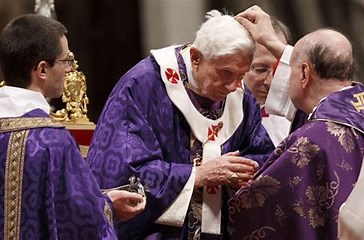
Remember Man, That Thou Art Dust
HOMILY OF HIS HOLINESS BENEDICT XVI
Vatican Basilica
Ash Wednesday, 13 February 2013
Venerable Brethren,
Dear Brothers and Sisters,
Today, Ash Wednesday, we begin a new Lenten journey, a journey that lasts forty days and leads us towards the joy of Easter, the victory of life over death. Following the ancient Roman tradition of the Lenten stations, we are gathered today for the celebration of the Eucharist. Traditionally the first station is held in the Basilica of Santa Sabina on the Aventine Hill. Circumstances have suggested that we gather in the Vatican Basilica. This evening we meet in great numbers around the tomb of the Apostle Peter, also to beg his intercession for the Church’s path forward at this particular moment, renewing our faith in the Chief Pastor, Christ the Lord. For me it is a fitting occasion to thank everyone, especially the faithful of the Diocese of Rome, as I prepare to conclude my Petrine ministry, and to ask for a special remembrance in your prayers.
The readings just proclaimed offer us several points of reflection which during this Lent, with God’s grace, we are called to translate into concrete ways of thinking and acting. First, the Church repeats to us the powerful appeal which the prophet Joel addressed to the people of Israel: “Even now, says the Lord, return to me with all your heart, with fasting, with weeping and with mourning” (2:12). The expression “with all your heart” is important: it means from the core of our thoughts and feelings, from the wellspring of our free decisions, choices and actions, in an act of complete and radical freedom. But is such a return to God possible? Yes, because there is a power which does not reside in our own hearts, but springs from God’s own heart. It is the power of his mercy. The prophet goes on to say: “Return to the Lord, your God, for he is gracious and merciful, slow to anger and abounding in steadfast love, and relents from punishing” (v. 13). To return to the Lord is possible as a “grace”, for it is God’s own work and the fruit of our faith in his mercy. This return to God becomes a concrete reality in our lives only when the Lord’s grace penetrates and deeply shakes us, enabling us to “rend our hearts”. Again, the prophet has God proclaim these words: “Rend your hearts and not your clothing” (v. 13). In our own day, lots of people are ready to “rend their clothing” in the face of scandals and acts of injustice – the fault naturally of others – but few seem prepared to do something about their own “hearts”, their own consciences and their own intentions, allowing the Lord to transform, renew and convert them.
The words, “Return to me with all your heart”, are an appeal directed not only to individuals, but to the whole community. Again, in the first reading we heard the words: “Blow the trumpet in Zion; sanctify a fast; call a solemn assembly; gather the people. Sanctify the congregation; assemble the aged; gather the children, even infants at the breast. Let the bridegroom leave his room, and the bride her canopy” (vv. 15-16). The dimension of community is an essential part of Christian faith and life. Christ came “to gather into one the dispersed children of God” (cf. Jn 11:52). The “we” of the Church is a community in which Jesus draws us together to himself (cf. Jn 12:32): faith is necessarily ecclesial. It is important to keep this in mind and to experience it throughout this Lenten season: everyone should realize that we do not take up the path of repentance alone, but together with our many brothers and sisters in the Church.
Finally, the prophet considers the prayer of the priests, who turn to God with tears, saying: “Do not make your heritage a mockery, a byword among the nations. Why should it be said among the peoples, ‘Where is their God?’” (v. 17). This prayer makes us think of the importance of the witness of Christian faith and life given by each of us and our communities for showing the face of the Church, and how that face is sometimes disfigured. I think in particular of sins against the unity of the Church, and divisions within the body of the Church. To experience Lent in a more intense and manifest ecclesial communion, overcoming individualism and rivalry, is a humble and valuable sign for those who are distant from the faith or indifferent.
“See, now is the acceptable time; see, now is the day of salvation!” (2 Cor 6:2). These words of the Apostle Paul to the Christians of Corinth also echo in our hearts with an urgency which leaves no room for absence or inertia. The frequent repetition of the word “now” tells us that we cannot let this moment pass: it is given to us as a unique and unrepeatable opportunity. The Apostle fixes his gaze on on the “sharing” which Christ wanted to characterize his life, by taking upon himself all that is human, even our sin. Saint Paul’s words are forceful: God “made him to be sin” for our sake. Jesus, the innocent one, the holy one, “he who knew no sin” (2 Cor 5:21), took upon himself the burden of sin by sharing with humanity its wages of death, even death on a cross. The reconciliation offered us had a high price, that of the cross raised on Golgotha on which the Son of God made man hung. In this, God’s immersion in human suffering and the abyss of evil, is the root of our justification. To “return to God with all your heart” on this Lenten journey means embracing the cross, following Christ along the path which leads to Calvary, unto complete self-giving. It is a journey which teaches us each day to abandon our selfishness and self-absorption in order to make room for God, who opens and transforms our hearts. Saint Paul reminds us that the preaching of the cross resonates within us as a result of the preaching of the word, of which the Apostle himself is an ambassador; it is an appeal to make this Lenten journey a time when we listen more attentively and regularly to the word of God, the light for our path.
In the page of Matthew’s Gospel, which is part of the Sermon on the Mount, Jesus mentions three basic practices found in the law of Moses: almsgiving, prayer and fasting; these are also traditional signposts along the journey of Lent, pointing out how to respond to the call to “return to God with all your heart”. But Jesus makes it clear that is the quality and the truthfulness of our relationship with God which reveals the authenticity of any religious practice. Consequently, he denounces religious hypocrisy, ways of acting meant to impress others and to garner applause and approval. The true disciple serves not himself or the “public”, but his Lord, simply and generously: “and your Father who sees in secret will reward you” (Mt 6:4,6,18). Our witness, then, will always be more effective the less we seek our own glory and the more we realize that the reward of the just is God himself: being one with him here below on the journey of faith, and, at life’s end, in the luminous peace of seeing him face to face for ever (cf. 1 Cor 13:12).
Dear brothers and sisters, let us begin our Lenten journey with joyful confidence. May we feel deep within us the call to conversion, to “return to God with all our heart”, accepting his grace which makes us new men and women, with that astonishing newness which is a share in the very life of Jesus. May none of us be deaf to this appeal, which also comes to us in the austere rite, at once so simple and so evocative, of the imposition of ashes, which we are about to celebrate. May the Blessed Virgin Mary, Mother of the Church and the model of all authentic disciples of the Lord, accompany us throughout this Lenten season. Amen!
© Copyright 2013 – Libreria Editrice Vaticana

Remembering Father Alphonse de Valk
(Today marks the sixth anniversary of the death of Father Alphonse de Valk, C.S.B., a faithful, courageous and indefatigable Basilian priest, pro-life-and-family apostle, and the founder of Catholic Insight magazine. Here is what we wrote those on his entering into eternity five years ago, as we continue to remember him in our prayers and thoughts)[…]Continue reading→

Divine Mercy Sunday – An Echo of Every Mass
Reach out your hand and put it in my side. Do not doubt but believe’… ‘My Lord and my God!’ (Jn. 20:18)). Today is Divine Mercy Sunday, and as we celebrate the end of the Easter Octave, we contemplate the wounded side of our Saviour, the Church’s source of life. On Good Friday in the[…]Continue reading→

Saint Stanislaus of Szczepanów
We celebrate Saint Stanislaus today (+ April 11, 1079), in light of this Easter Octave, a bishop and martyr who accepted the episcopacy only at the direct order of Pope Alexander II. He proved a wise and courageous leader of his flock, put to death by his own king, Boleslaus, for rebuking the monarch’s ‘immoral[…]Continue reading→

First Holy Communion: Sermon from May 16, 1943
Here is a sermon from the good old days by +Rev. Msgr. Vincent Nicholas Foy (August 14, 1915 – March 13, 2017), from 1943. Readers may recall that Pope Saint Pius X, by the decree Quam Singulari in 1910, lowered the customary age of reception of Holy Communion – after the rigours of the plague[…]Continue reading→

In the Glorious Light of Easter, Alleluia!
Set your minds on things that are above, not on things that are on earth, for you have died, and your life is hidden with Christ in God. When Christ who is your life is revealed, then you also will be revealed with him in glory (Col. 3:3-4). The Resurrection of Our Lord and Saviour[…]Continue reading→

An Ancient Homily for Holy Saturday
The time between Good Friday and Easter Sunday is one of waiting, in silence, as the world wonders – anticipates – what will happen, after the death of Christ. We re-live this time each year in the anamnesis of our liturgy, and in turn look forward to the glorious re-creation of all things at the[…]Continue reading→

Europe’s Long Descent
(As we meditate on this day on Christ’s burial, and His descent into hell, it is fitting to ponder here with contributor Peter Marcus how the world seems to be heading there as well. The difference is that, although God cannot ‘redeem’ hell, nor those therein, He can and did redeem the world. There is[…]Continue reading→
Pope Saint John Paul II’s First Good Friday Homily
ADDRESS OF HIS HOLINESS JOHN PAUL II AT THE CONCLUSION OF THE STATIONS OF THE CROSS AT THE COLOSSEUM Good Friday, 13 April 1979 When we make the Way of the Cross from one station to the next, in spirit we are always at the spot wherethis journey had its “historical” place: where it[…]Continue reading→
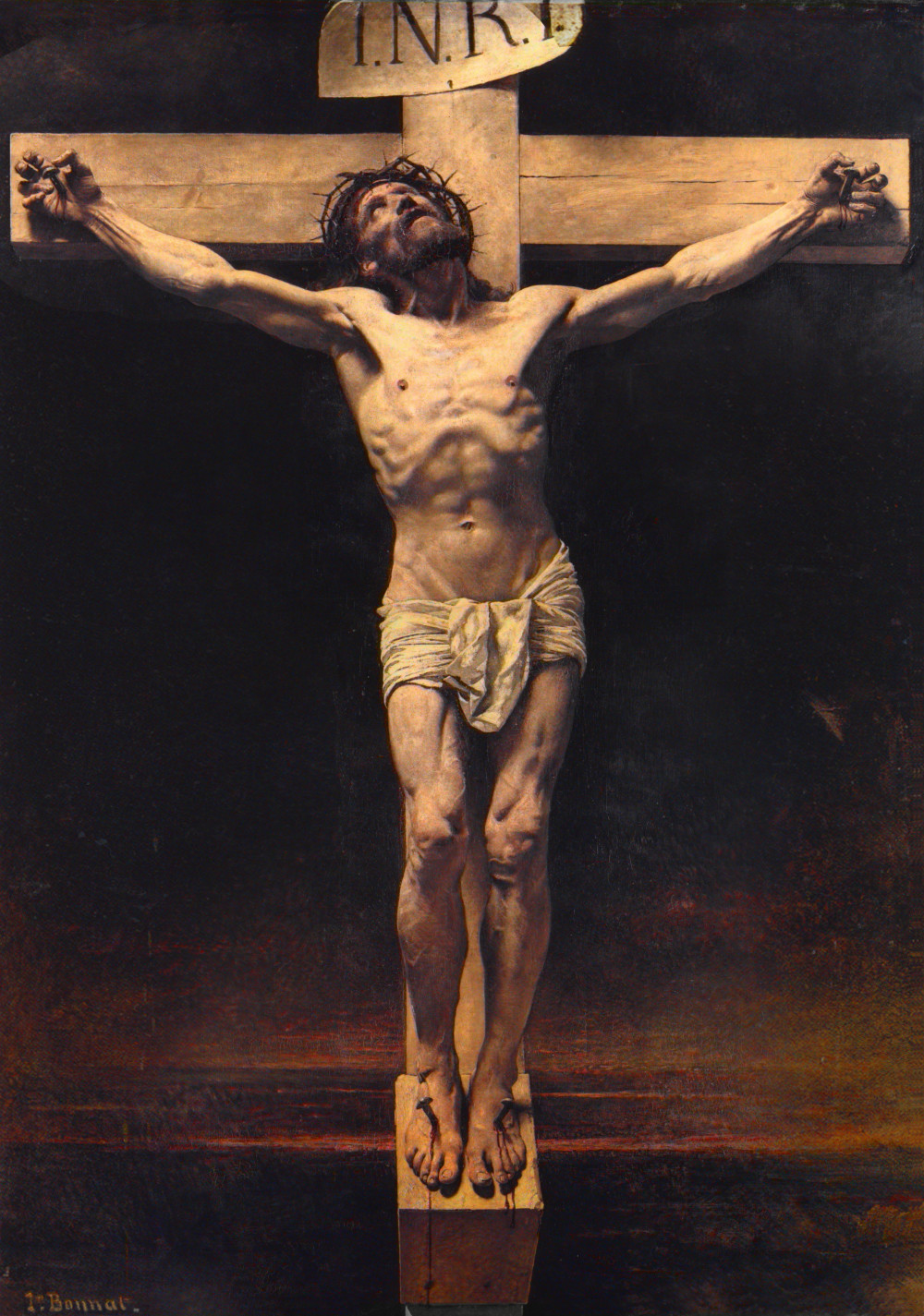
A Meditation for Good Friday: How To Undo the Effects of Sin?
Cardinal Newman, now Saint John Henry Newman, was a towering figure of nineteenth-century Catholicism who is almost universally admired. I say “almost” because not everyone likes him. I knew a priest once, Arthur Caulkins, who has become disenchanted with Newman. As an undergraduate Arthur had been enamoured of Newman, and this interest continued when he[…]Continue reading→
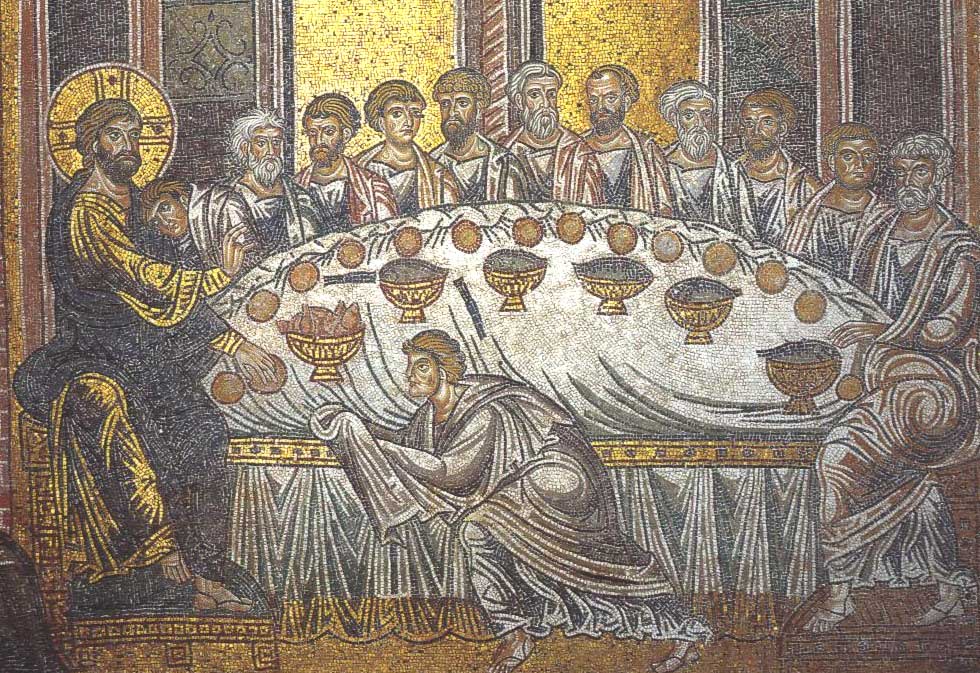
Pope Benedict’s Last Holy Thursday Homily
MASS OF THE LORD’S SUPPER HOMILY OF HIS HOLINESS BENEDICT XVI Basilica of St John Lateran Holy Thursday, 5 April 2012 Photo Gallery (Video) Dear Brothers and Sisters! Holy Thursday is not only the day of the institution of the Most Holy Eucharist, whose splendour bathes all else and in some ways draws it to[…]Continue reading→