
The Faith is All or None
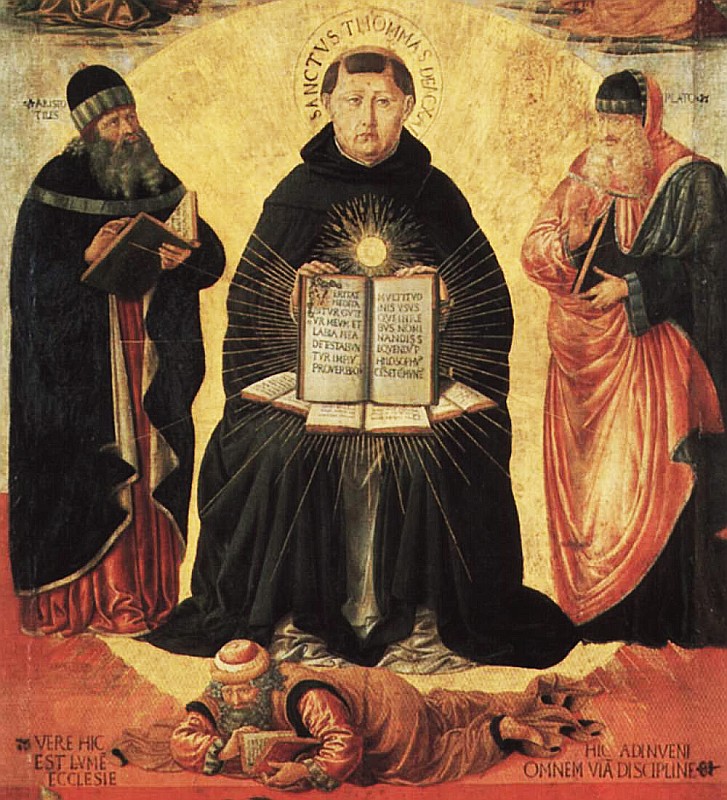
(I may write more on the recent headline, which comes not as a surprise, that most ‘Catholics’ – and one must use that term widely nowadays – reject the Church’s teaching on ‘cohabitation’, companionate marriage or, in more technical terms, fornicatio simplex. For now, ponder these words from the great Saint Thomas Aquinas Summa Theologica, II-II, question 5, article 3, whose principles apply to all who take and pick what they themselves ‘agree with’ on divinely revealed truth. Editor)
Whether a man who disbelieves one article of faith, can have lifeless faith in the other articles?
Objection 1. It would seem that a heretic who disbelieves one article of faith, can have lifeless faith in the other articles. For the natural intellect of a heretic is not more able than that of a catholic. Now a catholic’s intellect needs the aid of the gift of faith in order to believe any article whatever of faith. Therefore it seems that heretics cannot believe any articles of faith without the gift of lifeless faith.
Objection 2. Further, just as faith contains many articles, so does one science, viz. geometry, contain many conclusions. Now a man may possess the science of geometry as to some geometrical conclusions, and yet be ignorant of other conclusions. Therefore a man can believe some articles of faith without believing the others.
Objection 3. Further, just as man obeys God in believing the articles of faith, so does he also in keeping the commandments of the Law. Now a man can obey some commandments, and disobey others. Therefore he can believe some articles, and disbelieve others.
On the contrary, Just as mortal sin is contrary to charity, so is disbelief in one article of faith contrary to faith. Now charity does not remain in a man after one mortal sin. Therefore neither does faith, after a man disbelieves one article.
I answer that, Neither living nor lifeless faith remains in a heretic who disbelieves one article of faith.
The reason of this is that the species of every habit depends on the formal aspect of the object, without which the species of the habit cannot remain. Now the formal object of faith is the First Truth, as manifested in Holy Writ and the teaching of the Church, which proceeds from the First Truth. Consequently whoever does not adhere, as to an infallible and Divine rule, to the teaching of the Church, which proceeds from the First Truth manifested in Holy Writ, has not the habit of faith, but holds that which is of faith otherwise than by faith. Even so, it is evident that a man whose mind holds a conclusion without knowing how it is proved, has not scientific knowledge, but merely an opinion about it. Now it is manifest that he who adheres to the teaching of the Church, as to an infallible rule, assents to whatever the Church teaches; otherwise, if, of the things taught by the Church, he holds what he chooses to hold, and rejects what he chooses to reject, he no longer adheres to the teaching of the Church as to an infallible rule, but to his own will.
Hence it is evident that a heretic who obstinately disbelieves one article of faith, is not prepared to follow the teaching of the Church in all things; but if he is not obstinate, he is no longer in heresy but only in error. Therefore it is clear that such a heretic with regard to one article has no faith in the other articles, but only a kind of opinion in accordance with his own will.
Reply to Objection 1. A heretic does not hold the other articles of faith, about which he does not err, in the same way as one of the faithful does, namely by adhering simply to the Divine Truth, because in order to do so, a man needs the help of the habit of faith; but he holds the things that are of faith, by his own will and judgment.
Reply to Objection 2. The various conclusions of a science have their respective means of demonstration, one of which may be known without another, so that we may know some conclusions of a science without knowing the others. On the other hand faith adheres to all the articles of faith by reason of one mean, viz. on account of the First Truth proposed to us in Scriptures, according to the teaching of the Church who has the right understanding of them. Hence whoever abandons this mean is altogether lacking in faith.
Reply to Objection 3. The various precepts of the Law may be referred either to their respective proximate motives, and thus one can be kept without another; or to their primary motive, which is perfect obedience to God, in which a man fails whenever he breaks one commandment, according to James 2:10: “Whosoever shall . . . offend in one point is become guilty of all.”

Saint Kateri , Canada’s Protectress
This was the title given to Saint Kateri Tekakwitha, by Pope Benedict XVI, when he canonized her on October 28th, 2012, along with six others, in Saint Peter’ Square (she had been beatified by Pope John Paul II back in 1980). With Saint Joseph as our protector, along with the Canadian martyrs, we seem to[…]Continue reading→

Remembering Father Alphonse de Valk
(Today marks the sixth anniversary of the death of Father Alphonse de Valk, C.S.B., a faithful, courageous and indefatigable Basilian priest, pro-life-and-family apostle, and the founder of Catholic Insight magazine. Here is what we wrote those on his entering into eternity five years ago, as we continue to remember him in our prayers and thoughts)[…]Continue reading→

My Name is Bernadette
April 16th is a propitious day, for besides the anniversary of Father de Valk’s death, who founded Catholic Insight in its print form decades ago, and the commemoration of the ‘two Benedicts’, mentioned in accompanying posts, today we also recall Saint Bernadette Soubirous, the young visionary to whom the Virgin Mary appeared numerous times at[…]Continue reading→

Canonizing Sister Faustina and Divine Mercy
HOMILY OF THE HOLY FATHER MASS IN ST PETER’S SQUARE FOR THE CANONIZATION OF SR MARY FAUSTINA KOWALSKA Sunday, 30 April 2000 1. “Confitemini Domino quoniam bonus, quoniam in saeculum misericordia eius”; “Give thanks to the Lord for he is good; his steadfast love endures for ever” (Ps 118: 1). So the Church sings on the Octave of[…]Continue reading→

Divine Mercy Sunday – An Echo of Every Mass
Reach out your hand and put it in my side. Do not doubt but believe’… ‘My Lord and my God!’ (Jn. 20:18)). Today is Divine Mercy Sunday, and as we celebrate the end of the Easter Octave, we contemplate the wounded side of our Saviour, the Church’s source of life. On Good Friday in the[…]Continue reading→

Saint Stanislaus of Szczepanów
We celebrate Saint Stanislaus today (+ April 11, 1079), in light of this Easter Octave, a bishop and martyr who accepted the episcopacy only at the direct order of Pope Alexander II. He proved a wise and courageous leader of his flock, put to death by his own king, Boleslaus, for rebuking the monarch’s ‘immoral[…]Continue reading→

First Holy Communion: Sermon from May 16, 1943
Here is a sermon from the good old days by +Rev. Msgr. Vincent Nicholas Foy (August 14, 1915 – March 13, 2017), from 1943. Readers may recall that Pope Saint Pius X, by the decree Quam Singulari in 1910, lowered the customary age of reception of Holy Communion – after the rigours of the plague[…]Continue reading→

In the Glorious Light of Easter, Alleluia!
Set your minds on things that are above, not on things that are on earth, for you have died, and your life is hidden with Christ in God. When Christ who is your life is revealed, then you also will be revealed with him in glory (Col. 3:3-4). The Resurrection of Our Lord and Saviour[…]Continue reading→

An Ancient Homily for Holy Saturday
The time between Good Friday and Easter Sunday is one of waiting, in silence, as the world wonders – anticipates – what will happen, after the death of Christ. We re-live this time each year in the anamnesis of our liturgy, and in turn look forward to the glorious re-creation of all things at the[…]Continue reading→

Europe’s Long Descent
(As we meditate on this day on Christ’s burial, and His descent into hell, it is fitting to ponder here with contributor Peter Marcus how the world seems to be heading there as well. The difference is that, although God cannot ‘redeem’ hell, nor those therein, He can and did redeem the world. There is[…]Continue reading→