
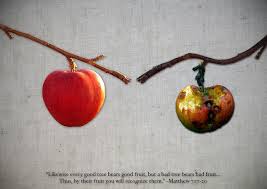
Good and Bad Fruit
Eighth Sunday Per Annum (C) March 3, 2019.
No good tree bears bad fruit, nor again does a bad tree bear good fruit; for each tree is known by its own fruit (Lk. 6:43-44). ⧾
Our Gospel reading today is a continuation of last Sunday’s reading and again by means of concrete examples Our Lord explains the importance of a pure heart. In Psalm 51, one of the Seven Penitential Psalms, the Psalmist prays: A pure heart create for me, O God, put a steadfast spirit within me…a humbled contrite heart you will not spurn. Our Lord teaches us: Out of the good treasure of the heart, the good person produces good, and out of evil treasure, the evil person produces evil; for it is out the abundance of the heart that the mouth speaks (Lk. 6:45). What is implied of course and elsewhere explicitly expressed by Our Lord is the danger of possessing an impure heart, a proud and cold heart. He warns us: From within, out of the heart of man, come evil thoughts, fornication, theft, murder, adultery, coveting, wickedness, deceit, licentiousness, envy, slander, pride, foolishness. All these evil things come from within, and they defile a man (Mk. 7:22-23).
Again, the Psalmist gives voice to those who seek the grace of a humbled contrite heart: Show me, Lord, your way so that I may walk in your truth. Guide my heart to fear your name (86:11). On Wednesday of this week we will begin the holy season of Lent and in keeping with a Biblical tradition, we will be marked with blessed ashes; a sign of our sorrow for sin and our resolve to undertake the traditional Lenten discipline of prayer, fasting, penance and almsgiving so that we might be renewed and sanctified by the grace of repentance and conversion and experience the joy of salvation. We do well to heed the words that Our Lord addressed to the Pharisees: ‘Bear fruit that befits repentance’ (Mt. 3:8). This implies acts penance, conversion of manners and most importantly, a deeper and more intense awareness on our part of God’s holiness. St. Maximus the Confessor wisely admonishes us: For Jeremiah warns us: Do not say: ‘We are the Lord’s temple.’ Neither say, ‘Faith alone in our Lord Jesus Christ can save me.’ By itself faith accomplishes nothing. For even the devils believe and shudder. No, faith must be joined by an active love of God which is expressed in good works. The charitable man is distinguished by sincere and long-suffering service to his fellow man: it also means using things aright [rightly]. (From the chapters on Charity, Liturgy of the Hours, Vol. III, p. 230).
One of the many benefits of fasting and abstinence not only from food and drink but also from the many conveniences that we enjoy at least in our part of the world, is a renewed and purified appreciation of their value and goodness. Using things rightly helps us to live with greater integrity; always returning to the quiet unassuming Christian sacrificial life defined by love, humility and hard work. Using things rightly also entails appreciating and valuing the life of prayer which for Catholics always entails our attitude towards the Church’s greatest treasure – the Holy Sacrifice of the Mass. What has been done to the Mass and what have we done to the Mass? What dispositions do we bring to its celebration? Are we in need of reassessing our approach and use of the sacred order bequeathed to us by Our Lord?
Some of you may have heard of a recent survey conducted in the United States by a Catholic priest that has highlighted some interesting data from an underrepresented group of Catholics: those who attend the traditional Latin Mass. The findings indicate that these communities comprising in total an estimated 100,000 faithful, are a fertile ground for Catholic orthodoxy, large families, and an authentic practice of the faith and will continue to provide growth and nourishment to the Church for the foreseeable future (Ibid.). Allow me to share just one of the findings of this survey: 99% of Catholics who attend the Traditional Latin Mass attend Mass weekly versus 22% of those who attend what is known as the Novus Ordo Mass promulgated by Pope Saint Paul VI, what we are now celebrating. What happened? To pose this question is not an act of defiance nor is it reactionary. For the sake of clarity I was obviously ordained to celebrate the Novus Ordo though I also celebrate the Traditional Latin Mass weekly. I have no ulterior motive. I make mention of this simply as a point of reflection, both personal and communal as we enter into the holy season of Lent. Conversion implies a change of heart and of direction or course of action.
More importantly, what is the Holy Spirit telling us?
Some fifty years ago, when most of us here were much younger, there emerged what may be aptly defined as an attitude of arrogance towards the sacred and towards Catholic tradition (Cf. H. J. A. Sire, Phoenix from the Ashes: The Making, Unmaking, and Restoration of Catholic Tradition). The time has come for us individually and as a Catholic community to examine our attitude towards Sacred Tradition and to restore the sacred. Sadly, the refusal to admit errors has become a feature of the Church’s life as it is a feature of the secular realm or political order as we are seeing in our nation at this time. Why can we not say that we were or are wrong and apply a corrective? Man’s pride is always his downfall.
Let the Church today, so weakened and wounded, be a light to the nations, an example to follow in our humble submission to the discipline of the Lord. Let our humility be manifest first and foremost in the holy presence of God; in our worship and let this humility be the foundation for our life for as we worship so we become.
No prayer expresses our humility before God and our willingness to change than the Seven Penitential Psalms. Again today, I propose them to you as a Lenten discipline of prayer. Let us be generous with our spirit of prayer, penance and sacrifice; that through Lenten grace the promise of our Heavenly Father may be fulfilled in each one of us: A new heart I will give you, and a new spirit I will put within you; and I will take out of your flesh the heart of stone and give you a heart of flesh (Ezek. 36:26). ⧾

Saint Kateri , Canada’s Protectress
This was the title given to Saint Kateri Tekakwitha, by Pope Benedict XVI, when he canonized her on October 28th, 2012, along with six others, in Saint Peter’ Square (she had been beatified by Pope John Paul II back in 1980). With Saint Joseph as our protector, along with the Canadian martyrs, we seem to[…]Continue reading→

Remembering Father Alphonse de Valk
(Today marks the sixth anniversary of the death of Father Alphonse de Valk, C.S.B., a faithful, courageous and indefatigable Basilian priest, pro-life-and-family apostle, and the founder of Catholic Insight magazine. Here is what we wrote those on his entering into eternity five years ago, as we continue to remember him in our prayers and thoughts)[…]Continue reading→

My Name is Bernadette
April 16th is a propitious day, for besides the anniversary of Father de Valk’s death, who founded Catholic Insight in its print form decades ago, and the commemoration of the ‘two Benedicts’, mentioned in accompanying posts, today we also recall Saint Bernadette Soubirous, the young visionary to whom the Virgin Mary appeared numerous times at[…]Continue reading→

Canonizing Sister Faustina and Divine Mercy
HOMILY OF THE HOLY FATHER MASS IN ST PETER’S SQUARE FOR THE CANONIZATION OF SR MARY FAUSTINA KOWALSKA Sunday, 30 April 2000 1. “Confitemini Domino quoniam bonus, quoniam in saeculum misericordia eius”; “Give thanks to the Lord for he is good; his steadfast love endures for ever” (Ps 118: 1). So the Church sings on the Octave of[…]Continue reading→

Divine Mercy Sunday – An Echo of Every Mass
Reach out your hand and put it in my side. Do not doubt but believe’… ‘My Lord and my God!’ (Jn. 20:18)). Today is Divine Mercy Sunday, and as we celebrate the end of the Easter Octave, we contemplate the wounded side of our Saviour, the Church’s source of life. On Good Friday in the[…]Continue reading→

Saint Stanislaus of Szczepanów
We celebrate Saint Stanislaus today (+ April 11, 1079), in light of this Easter Octave, a bishop and martyr who accepted the episcopacy only at the direct order of Pope Alexander II. He proved a wise and courageous leader of his flock, put to death by his own king, Boleslaus, for rebuking the monarch’s ‘immoral[…]Continue reading→

First Holy Communion: Sermon from May 16, 1943
Here is a sermon from the good old days by +Rev. Msgr. Vincent Nicholas Foy (August 14, 1915 – March 13, 2017), from 1943. Readers may recall that Pope Saint Pius X, by the decree Quam Singulari in 1910, lowered the customary age of reception of Holy Communion – after the rigours of the plague[…]Continue reading→

In the Glorious Light of Easter, Alleluia!
Set your minds on things that are above, not on things that are on earth, for you have died, and your life is hidden with Christ in God. When Christ who is your life is revealed, then you also will be revealed with him in glory (Col. 3:3-4). The Resurrection of Our Lord and Saviour[…]Continue reading→

An Ancient Homily for Holy Saturday
The time between Good Friday and Easter Sunday is one of waiting, in silence, as the world wonders – anticipates – what will happen, after the death of Christ. We re-live this time each year in the anamnesis of our liturgy, and in turn look forward to the glorious re-creation of all things at the[…]Continue reading→

Europe’s Long Descent
(As we meditate on this day on Christ’s burial, and His descent into hell, it is fitting to ponder here with contributor Peter Marcus how the world seems to be heading there as well. The difference is that, although God cannot ‘redeem’ hell, nor those therein, He can and did redeem the world. There is[…]Continue reading→