
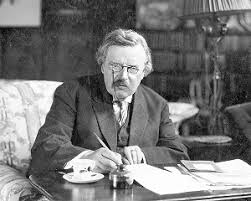
G.K. Chesterton as Catholic Apologist
G.K. Chesterton is known as the most often quoted of any writer . . . and the least often read. It’s easy to see why that is so; merely consider these clever statements:
- A dead thing can go with the stream, but only a living thing can go against it.[1]
- It is terrible to contemplate how few politicians are hanged.[2]
- The whole pleasure of marriage is that it is a perpetual crisis.[3]
- “My country, right or wrong”’ is a thing that no patriot would think of saying. It is like saying, “My mother, drunk or sober.”[4]
- These are the days when the Christian is expected to praise every creed except his own.[5]
The last of these, I may note, was written in 1928.
There are hundreds of such statements, all equally amusing and arresting. He is quotable, delightfully so. Why, then, is he not read? The answer is that he was too Catholic, and more specifically, he was a Catholic apologist. I am using the word “apologist” here in its proper meaning, which has nothing to do with apologizing in the sense of asking that an error or a fault be overlooked or forgiven. Rather apology here means a defence of some thing or some one. For instance, Cardinal Newman wrote a book entitled Apologia pro vita sua—Apology for my life—which is a defence of his decision to leave the Anglican Church and become a Catholic. But Chesterton had his own, peculiar approach to apologetics. For the most part he did not refer directly to religion, and when he did so he said very little about specific doctrines, such as the Trinity or sanctifying grace. After all, he was a journalist, and his audience was ordinary people, the man in the street. You have first to attract his attention before you proceed with your “apology.”
Chesterton did, however, share one principle with earlier apologists, such as Blaise Pascal in the seventeenth century and Cardinal Newman in the nineteenth: all three of them recognized that logical argumentation in religious controversy was useless. No one is ever convinced by being browbeaten or even by losing an argument. Cardinal Newman expressed this fact vividly: “It is as absurd to argue as to torture [a man] into believing.”[6] But why? After all, we argue all the time about one thing or another: whether or not it’s my turn to load the dishwasher or time to buy a new van. The fact is that that logic alone is ineffective in that a person’s world view is made up of a thousand elements, many of which he will hardly be conscious of, such as family background, childhood experiences, friendships, reading, national culture and emotional ties. Reason has its role to play, but in a secondary way, as an affirmation of positions already accepted. After all, if you limit yourself to strict logic, you could defend almost any world view including, for instance, atheism. Cardinal Newman said as much: “It is indeed a great question whether Atheism is not as philosophically consistent with the phenomena of the physical world, taken by themselves, as the doctrine of a creative and governing Power.”[7] It follows that a radical change of view, as with Chesterton, who in 1922 at the age of forty-eight became a Catholic, is an extensive reconfiguring of one’s entire way of life.
Consider what may well be Chesterton’s greatest work: Orthodoxy. Although it was published in1908, fourteen years before he joined the Church, it is thoroughly Catholic in its tone and argument. There’s one chapter that presents and then resolves the issue of logic’s role in persuading someone to change his mind. The title of the chapter contains in a nutshell its entire contents: “The Maniac.” And what is a maniac? In replying to the question, Chesterton is at his most paradoxical and most profound: “The madman is not the man who has lost his reason. The madman is the man who has lost everything except his reason.”[8] This remark is typically Chestertonian, in that he says something that seems at first against common sense but which, on further thought, turns out to be quite correct.[9] In this case, he uses the example of someone who is paranoid: “Everyone is out to get me,” he says. And when you point out, “Be sensible; no one is even looking at you,” he has a perfectly logical response: “Aren’t they clever!” And, indeed, if people were really out to get him, they would act as if they were oblivious to his presence. There’s no logical way you can prove that he’s wrong. You see, he spends all his time thinking about his monomania, so that he has an answer ready and waiting for any casual, rational observation you may make. You all probably know people who are into conspiracy theories, such as that the American government was responsible for destroying the twin towers of the New York Trade Center, what we have come to call simply “9/11,” or that Neil Armstrong’s moon walk was faked, the whole thing having been filmed in Hollywood. You’ll never convince such a person otherwise. As Chesterton noted, “If you argue with a madman it is extremely probable that you will get the worst of it.”[10]
What, in fact, is the flaw, the fatal weakness in the logically irrefutable position of such people, from conspiracy nuts to nuts, plain and simple. Chesterton can tell you: “He’s in the clean and well-lit prison of one idea.”[11] It’s not a lack of logic; it’s a lack of imagination. For instance, to cure, or at least to challenge the paranoid, ask him why the entire population of Toronto or even Canada would have the least interest in an ordinary person such as he. His position is not illogical, it’s implausible. Chesterton used the same approach to, e.g., an atheist. He may be able to describe the entire universe, but it’s a very small universe. I refuse to accept it not because it’s illogical but because it’s boring. In such a cosmos all the interesting things are eliminated, such as free will, virtue and vice, love and self-sacrifice, even, when you think of it, beauty and purpose. It really is surprising that anyone would want to view man as a puppet controlled by the mindless forces of matter when the glorious vision of freedom, responsibility and virtue is open to him as a real—and logically defensible—alternative.
We may illustrate Chesterton’s method by examining one of his Father Brown stories: “The Invisible Man.”[12] The starting point is the love of two men—the dwarfish Isidore Smythe and the lanky James Welkin—for the same woman, Laura Hope. She eventually rids herself of them by insisting that she would never marry anyone who had not made his fortune by his own efforts. Nothing happens for several years, until Laura, now being courted by John Angus, is accosted by Smythe who reappears to claim her hand. He has become wealthy from the invention and marketing of robots that can perform simple household tasks: “Smythe’s Silent Service.” Welkin, somehow present but never seen, is consumed by jealousy and, with a note that no one has delivered, threatens Smythe: “If you have been to see her today, I shall kill you.”[13] The murder occurs, but in a mysterious, even “supernatural”[14] manner. Smythe has disappeared from his flat, leaving behind only a blood-stained carpet with the robots, silent and sinister, positioned about the room. There is only one entrance to the block of flats, and everyone—a chestnut seller, a policeman, the doorman, the janitor—swears that no one entered or left the building, even though footprints in the snow demonstrate that someone must have come and gone. “‘God,’ cried Angus involuntarily, ‘the Invisible Man.’”[15] Father Brown, however, knows that men and women can be invisible by being overlooked, what he terms “mentally invisible”:[16]
Suppose one lady says to another in a country house, ‘Is anybody staying with you?’ the lady doesn’t answer, “Yes; the butler, the three footmen, the parlourmaid, and so on,’ though the parlourmaid may be in the room, or the butler behind her chair. Instead, she says ‘There’s nobody staying with us.’[17]
Who, then, is similarly unremarked in this case? The answer is, the postman, who entered, killed Smythe and then left with his bulky mailbag stuffed with Smythe’s conveniently dwarfish body, seen and yet “mentally invisible” to four witnesses. The story ends with a confession, but not to the police: “Father Brown walked those snow-covered hills under the stars for many hours with a murderer, and what they said to one another will never be known.”[18]
Chesterton’s Method
How did Father Brown solve the crime? Well, he knew that you need more than mere logic because there are always several logically consistent explanations of any event, from a simple remark to the origins and purpose of the universe. In “The Wrong Shape,”[19] for instance, what seems to be a suicide note turns out to be a quotation from a piece of fiction. Father Brown has three qualities that allow him to penetrate the mind of the criminal and thus to identify him. First, he is a priest, and “a man who does next to nothing but hear men’s real sins is not likely to be wholly unaware of human evil.”[20] It follows, then, that Father Brown has an interest in the case that goes beyond solving the crime and bringing the culprit to justice: he wants to reconcile the sinner to God, as at the end of “The Invisible Man,” when he hears the confession of the murderer James Welkin. And thirdly, most significantly, Father Brown has sympathy for the criminal because he recognizes that he himself is a sinner and as such would be capable of every enormity, including the crime under investigation:
I try to be inside the murderer. . . . Indeed, it’s much more than that, don’t you see? I am inside a man, moving his arms and legs; […] thinking his thoughts, wrestling with his passions, […] [t]ill I really am a murderer.[21]
[1] G.K. Chesterton, “The Five Deaths of the Faith,” The Everlasting Man (New York: Doubleday Image Books, 1955), pp. 261-262.
[2] G.K. Chesterton, The Cleveland Press, March 1, 1921.
[3] G.K. Chesterton, “David Copperfield,” Chesterton on Dickens. The Collected Works of G. K. Chesterton, vol. 15 (San Francisco|: Ignatius Press, 1990), p. 333.
[4] G.K. Chesterton, “A Defence of Patriotism,” The Defendant (London: Dodd, Mead & Company,1901), p. 125.
[5] G.K. Chesterton, Illustrated London News, August 11, 1928.
[6] John Henry Newman, “The Usurpations of Reason,” University Sermons, no. 4 (London: Longmans, Green, and Co, 1896), p. 63.
[7] John Henry Newman, “Faith and Reason Contrasted as Habits of Mind,” University Sermons, no. 10 (London: Longmans, Green, and Co, 1896), p. 194.
[8] G.K. Chesterton, Orthodoxy: A Centenary Edition (South Orange [NJ]: Chesterton Institute Press, 2008), p. 90.
[9] Chesterton had a genius for inventing such paradoxes; e.g.: “All roads lead to Rome, which is one reason why many people never get there.” Orthodoxy, p. 195.
[10] Orthodoxy, pp. 89-90.
[11] Orthodoxy, 95.
[12] G. K. Chesterton, “The Invisible Man,” The Father Brown Omnibus (New York: Dodd, Mead & Company, 1951), pp.82-100; cf. H.G. Wells, The Invisible Man (London: C. Arthur Pearson, 1897).
[13] “Invisible Man,” p. 92.
[14] “Father” said Flambeau, . . . “no friend or foe has entered the house, but Smythe is gone, as if stolen by the fairies. If that is not supernatural, I—.” “Invisible Man,” p. 97.
[15] “Invisible Man,” p. 95.
[16] “Invisible Man,” p. 98.
[17] “Invisible Man,” p. 98.
[18] “Invisible Man,” p. 100.
[19] G.K. Chesterton, “The Wrong Shape,” The Father Brown Omnibus (New York: Dodd, Mead & Company, 1951), pp. 117-36.
[20] G.K. Chesterton, “The Blue Cross,” The Father Brown Omnibus (New York: Dodd, Mead & Company, 1951), p. 23.
[21] G.K. Chesterton, “The Secret of Father Brown, The Father Brown Omnibus (New York: Dodd, Mead & Company, 1951), p. 639.

Saint Kateri , Canada’s Protectress
This was the title given to Saint Kateri Tekakwitha, by Pope Benedict XVI, when he canonized her on October 28th, 2012, along with six others, in Saint Peter’ Square (she had been beatified by Pope John Paul II back in 1980). With Saint Joseph as our protector, along with the Canadian martyrs, we seem to[…]Continue reading→

Remembering Father Alphonse de Valk
(Today marks the sixth anniversary of the death of Father Alphonse de Valk, C.S.B., a faithful, courageous and indefatigable Basilian priest, pro-life-and-family apostle, and the founder of Catholic Insight magazine. Here is what we wrote those on his entering into eternity five years ago, as we continue to remember him in our prayers and thoughts)[…]Continue reading→

My Name is Bernadette
April 16th is a propitious day, for besides the anniversary of Father de Valk’s death, who founded Catholic Insight in its print form decades ago, and the commemoration of the ‘two Benedicts’, mentioned in accompanying posts, today we also recall Saint Bernadette Soubirous, the young visionary to whom the Virgin Mary appeared numerous times at[…]Continue reading→

Canonizing Sister Faustina and Divine Mercy
HOMILY OF THE HOLY FATHER MASS IN ST PETER’S SQUARE FOR THE CANONIZATION OF SR MARY FAUSTINA KOWALSKA Sunday, 30 April 2000 1. “Confitemini Domino quoniam bonus, quoniam in saeculum misericordia eius”; “Give thanks to the Lord for he is good; his steadfast love endures for ever” (Ps 118: 1). So the Church sings on the Octave of[…]Continue reading→

Divine Mercy Sunday – An Echo of Every Mass
Reach out your hand and put it in my side. Do not doubt but believe’… ‘My Lord and my God!’ (Jn. 20:18)). Today is Divine Mercy Sunday, and as we celebrate the end of the Easter Octave, we contemplate the wounded side of our Saviour, the Church’s source of life. On Good Friday in the[…]Continue reading→

Saint Stanislaus of Szczepanów
We celebrate Saint Stanislaus today (+ April 11, 1079), in light of this Easter Octave, a bishop and martyr who accepted the episcopacy only at the direct order of Pope Alexander II. He proved a wise and courageous leader of his flock, put to death by his own king, Boleslaus, for rebuking the monarch’s ‘immoral[…]Continue reading→

First Holy Communion: Sermon from May 16, 1943
Here is a sermon from the good old days by +Rev. Msgr. Vincent Nicholas Foy (August 14, 1915 – March 13, 2017), from 1943. Readers may recall that Pope Saint Pius X, by the decree Quam Singulari in 1910, lowered the customary age of reception of Holy Communion – after the rigours of the plague[…]Continue reading→

In the Glorious Light of Easter, Alleluia!
Set your minds on things that are above, not on things that are on earth, for you have died, and your life is hidden with Christ in God. When Christ who is your life is revealed, then you also will be revealed with him in glory (Col. 3:3-4). The Resurrection of Our Lord and Saviour[…]Continue reading→

An Ancient Homily for Holy Saturday
The time between Good Friday and Easter Sunday is one of waiting, in silence, as the world wonders – anticipates – what will happen, after the death of Christ. We re-live this time each year in the anamnesis of our liturgy, and in turn look forward to the glorious re-creation of all things at the[…]Continue reading→

Europe’s Long Descent
(As we meditate on this day on Christ’s burial, and His descent into hell, it is fitting to ponder here with contributor Peter Marcus how the world seems to be heading there as well. The difference is that, although God cannot ‘redeem’ hell, nor those therein, He can and did redeem the world. There is[…]Continue reading→