
Cobra Kai: A Nostalgic Adventure
Cobra Kai is the latest addition to the epic Karate Kid saga. It takes place 34 years (!!) after the 1984 All Valley Karate Tournament of the original Karate Kid movie. The series can be found on YouTube Red. The first two episodes are free and episodes 3 to 10 are $2.99 USD each – well worth the cost if you are an avid fan of the original Karate Kid trilogy. Throughout the ten episodes there are many twists and turns that make the show into a sort of karate style drama. There are plenty of similarities between this series and the Rocky Saga, which is to be expected since the late director, John G. Avildsen, directed all three Karate Kid movies and Rocky I and V. Continuing in this tradition, producers Josh Heald, Jon Hurwitz and Hayden Schlossberg have paid a tremendous homage to the original three movies. The series is without a doubt a nostalgic throwback for those who grew up in the 1980s. There are also plenty of references which make it a gem for lifelong fans but there’s also enough new material and young actors to captivate the next generation. In my opinion Cobra Kai is one of the best shows in recent memory. The high ratings on the website Rotten Tomatoes is a testament to this. Without revealing too much, I’ll discuss features of the series that would be of interest to Catholic readers (but not limited to).
Synopsis
There is a significant shift in dynamic between the original characters of Johnny Lawrence (William Zabka) and Daniel LaRusso (Ralph Macchio). Johnny is now the underdog, while Daniel enjoys a comfortable life with a very successful auto-business, a beautiful wife and family. Johnny, on the other hand, who enjoyed a posh life in his younger days and popularity in high school, is now down on his luck. He can barely hang onto lower end jobs and has become a heavy drinker. However, after receiving some money from his step father who intends on “buying” him out, he opens up his own dojo with the intention to resurrect the Cobra Kai. There are a series of new characters, many of whom are misfits and outcasts within high school life.
The show has a great cast of actors. The most prominent characters aside from Johnny and Daniel throughout the series include Daniel’s daughter, Amanda; Miguel Diaz, one of Johnny’s neighbors who desperately seeks a father figure in Johnny; and Johnny’s son, Robby, who feels dejected and abandoned by Johnny, but finds solace in Daniel’s attentiveness and mentorship. The characters in this series are developed with greater depth than the original three, more realistic and nuanced – television series give more time and space than movies for this. Johnny and Daniel are not stuck in a simplistic good and evil type dualism. The depth of both their characters reveal a complexity of many inner struggles and demons that have followed them from their youth. They both undergo their own positive transformation throughout the series.
The Search for a Father Figure
Young men are bailing out of college in unprecedented rates. Boys are underperforming throughout elementary and high school education. Girls are outperforming boys in most educational domains (in terms of sheer numbers, except very few such as STEM, philosophy and theology). Boys are increasingly told they are tyrants in the making. This is not at all helpful for the future of Western civilization. Our society is increasingly attacking the traditional notion of the family including basic and natural roles such as fatherhood; roles that have been tried and tested throughout human history for millennia. The social constructionist perspectives that ignore biological facts, if allowed to persist, will have fatal consequences for the future of human civilization.
Public intellectuals such as Peterson are labeled as misogynistic for stating there should be culturally, not institutionally, “enforced monogamy,” and that young men (women as well) need encouraging words but rarely receive it (see here , here and here). Young men and women are seeking hope in a father figure they’ve never met since for whatever reason their own fathers are absent or do not exist. Say what you will about Peterson and his shortcomings, when it comes to the Christian faith, we must be grateful for the advent of someone like him. Not many have assumed this important role nor have the competency, courage or articulation to do so. If those that are so critical of him think they can do a better job, let them step forward.
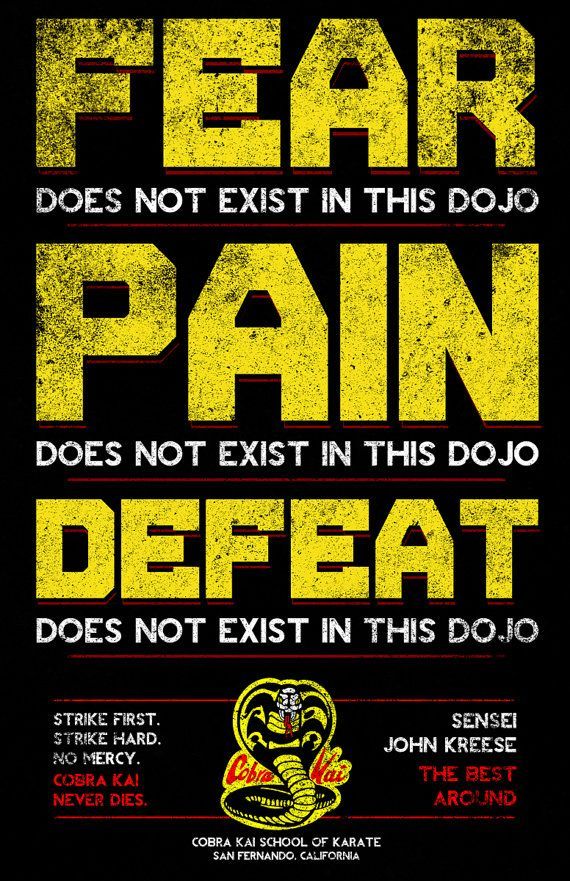
One of the most positive elements of Cobra Kai is its focus on fatherhood. This is something that runs contrary to the contemporary narrative which is increasingly attacking the family, gender roles and the importance of males. Every child yearns for a relationship with his father. Unfortunately, many fathers, for various reasons, are absent from their children’s lives. This is precisely why Professor Peterson’s message of responsibility and traditional values is resonating so deeply with many of his listeners, especially young men. We witness this yearning throughout Cobra Kai, in not only the teenage boy characters of Miguel and Robby, but also in Johnny and Daniel. Daniel lost his father at a young age and found a father figure in his Karate mentor, Mr. Miyagi (Pat Morita). Johnny searched for the father figure, just like Daniel, in his karate mentor Sensei John Kreese – the main antagonist of the original series. Unfortunately, unlike Daniel’s father figure, Johnny’s mentor was a very bad influence on him. This negative influence has impacted the rest of his life. Interestingly, Johnny begins to mentor Miguel and teaches him Karate in order to be able to defend himself from bullies but unfortunately, he teaches him the corrupt mantra of Cobra Kai: “strike first, strike hard and show no mercy.” Miguel resembles a young Daniel in many ways but learns a pernicious philosophy to karate. On the other hand, Robby, Johnny’s son, first out of spite towards Johnny, seeks Daniel but then finds a fatherly figure in him. He begins to learn the foundational roots of what Miyagi taught Daniel, which involves defending one’s self with honour and integrity but without fear and in the style of kata. Johnny begins to show a transformation and realization in the wrongs of his previous ways, especially when his own method and teaching of fighting begins to hurt his son.
Despite now being in their 50’s, Daniel still searches for that “balance” in his life, still in his now deceased mentor/father figure. One episode, dedicated in loving memory to Morita, emphasizes this. Likewise, Johnny struggles throughout the series with alcoholism and from the broken bond between him and his son. In episode one it is revealed that his biological father was absent and that his stepfather never had anything to offer him aside from money.
One could say that our yearning for a father figure is deeply embedded within our personhood and consciousness. It is reflective of our desire for not just an earthly father but even more profoundly in our Heavenly Father, who is the source of all earthly fathers and loving relations.
Bullying, Self-Defense and Moral Responsibility
In the first episode of the series, Johnny actually defends Miguel from his callous bullies. This is where Miguel becomes interested in the art of karate. It is interesting to note that Zabka never thought he could pull off the character of Johnny in the original Karate Kid because bullying was so far removed from his own temperament. Nonetheless, he became the quintessential icon for bullying throughout the 1980s. He has stated that the one and only line that originally resonated with him, after first reading the script to the original movie, was when he states: “You’re alright LaRusso!” , before relinquishing his champion’s trophy to Daniel. In recent years, Zabka has become quite vocal against the culture of bullying and has given several talks on the subject.
The series has plenty of examples of bullying, just as one would expect within a high school setting. It touches on contemporary issues such as bullying through social media. There is also a juxtaposition between the culture of victimization versus taking responsibility for one’s actions and lives. The message at times can be crude, while at the same time running counter to our pernicious culture of victimization. It emphasizes that one must shoulder his burden, and overcome what obstacles there be. Counter to popular views emanating from the regressive left that have dominated our culture for so long, this show demonstrates that victimhood is anything but a virtue. After Miguel successfully stands up to his bullies and takes them all down in a four against one fight, videos of the fight go “viral.” The next day, Johnny has all kinds of students wanting to learn karate. And so, the next generation of Cobra Kai students begins and his dojo is open for business.
Learning karate requires and instills discipline and inculcates inner confidence. This is not to condone violence, but it is indeed to recognize that it is honorable to properly defend oneself and those who are defenseless. There is a strong message of confronting bullies and helping others in such situations throughout the series. I would argue that one should avoid fighting if they can; sometimes, however, when one or others are being attacked, there is no other option. Some are not aware of this but under Christian principles, it would be immoral to let others inflict harm on the innocent. There has always been a sort of tension and confusion on how to respond to violence within the Christian tradition. Are we to exhibit self-defense, martyrdom or both? The Catechism is clear when it states:
Love toward oneself remains a fundamental principle of morality. Therefore it is legitimate to insist on respect for one’s own right to life. Someone who defends his life is not guilty of murder even if he is forced to deal his aggressor a lethal blow (Catechism of the Catholic Church, 2264).
It is especially true in the absence of an ultimate transcendent purpose for allowing violence without retaliation (as in the case of Jesus and the martyrs). This is exemplified in Jesus’ words found in Matthew 17:22-23, “When they came together in Galilee, he said to them, “The Son of Man is going to be delivered into the hands of men. They will kill him, and on the third day he will be raised to life.” And the disciples were filled with grief.” When it comes to self-defense we must be wise and prudent. Jesus also stated in Luke 22:36, “If you don’t have a sword, sell your cloak and buy one.” Thus, if one has the tools to confront bullies, he should, or if he doesn’t, he should acquire them. We all also have the moral responsibility to confront the bullying of innocent people. Another biblical example of self-defense and the defense of the innocent includes, Nehemiah 4:44 which states: “Do not be afraid of them. Remember the Lord, who is great and awesome, and fight for your brothers, your sons, your daughters, your wives, and your homes.”
Similarly, St. Thomas Aquinas in the Summa Theologica states that:
[T]his act, since one’s intention is to save one’s own life, is not unlawful, seeing that it is natural to everything to keep itself in ‘being,’ as far as possible… [it is not] necessary for salvation that a man omit the act of moderate self-defense in order to avoid killing the other man, since one is bound to take more care of one’s own life than of another’s (Part II.II, Question 64, Article 7).
This is not to say that the defense of others is not to be encouraged, but that your own life is to be valued more than the one who is causing harm.
Likewise, John Locke, in his Second Treatise of Civil Government, emphasized the moral responsibility behind self-defense when he wrote:
I should have a right to destroy that which threatens me with destruction: for, by the fundamental law of nature, man being to be preserved as much as possible, when all cannot be preserved, the safety of the innocent is to be preferred (chapter 3, section 16)
And further that:
The rules that legislators make for other men’s actions… must conform to the law of nature, which is a declaration of the will of God. The fundamental law of nature enjoins the preservation of mankind, and no human sanction can be valid against it (chapter 11, section 135).
So, as Christians we have good grounds to use self-defense to preserve the well-being of ourselves and the innocent. This is in line with Miyagi’s teachings to Daniel, and how Daniel passes this message to his students (Robby and Amanda). I suspect we will see much more of this in the next season. However, it is antithetical to the Cobra Kai motto of ‘striking first’.
Given our reflection, Cobra Kai has much to offer Christians and others. The show instills moral responsibility and the importance of fathers, sorely lacking from many contemporary shows that celebrate unbridled violence and sexuality. It also smashes political correctness and safe space culture to bits. It is refreshing to see that this series does not kowtow to political correctness. This is something I believe will appeal to both older and younger generation of viewers. More and more individuals are growing fed up with the politically correct narrative and the associated ills of identity politics. The show focuses on individual personhood which transcends the groupthink that is so prominent throughout the indoctrinating halls of our educational institutions. All this being said, I still get nostalgic, and even pumped up, when I see Daniel beginning his kata sequence to the epic original Karate Kid music.
Now are you ready to embark on a nostalgic adventure?

Saint Kateri , Canada’s Protectress
This was the title given to Saint Kateri Tekakwitha, by Pope Benedict XVI, when he canonized her on October 28th, 2012, along with six others, in Saint Peter’ Square (she had been beatified by Pope John Paul II back in 1980). With Saint Joseph as our protector, along with the Canadian martyrs, we seem to[…]Continue reading→

Remembering Father Alphonse de Valk
(Today marks the sixth anniversary of the death of Father Alphonse de Valk, C.S.B., a faithful, courageous and indefatigable Basilian priest, pro-life-and-family apostle, and the founder of Catholic Insight magazine. Here is what we wrote those on his entering into eternity five years ago, as we continue to remember him in our prayers and thoughts)[…]Continue reading→

My Name is Bernadette
April 16th is a propitious day, for besides the anniversary of Father de Valk’s death, who founded Catholic Insight in its print form decades ago, and the commemoration of the ‘two Benedicts’, mentioned in accompanying posts, today we also recall Saint Bernadette Soubirous, the young visionary to whom the Virgin Mary appeared numerous times at[…]Continue reading→

Canonizing Sister Faustina and Divine Mercy
HOMILY OF THE HOLY FATHER MASS IN ST PETER’S SQUARE FOR THE CANONIZATION OF SR MARY FAUSTINA KOWALSKA Sunday, 30 April 2000 1. “Confitemini Domino quoniam bonus, quoniam in saeculum misericordia eius”; “Give thanks to the Lord for he is good; his steadfast love endures for ever” (Ps 118: 1). So the Church sings on the Octave of[…]Continue reading→

Divine Mercy Sunday – An Echo of Every Mass
Reach out your hand and put it in my side. Do not doubt but believe’… ‘My Lord and my God!’ (Jn. 20:18)). Today is Divine Mercy Sunday, and as we celebrate the end of the Easter Octave, we contemplate the wounded side of our Saviour, the Church’s source of life. On Good Friday in the[…]Continue reading→

Saint Stanislaus of Szczepanów
We celebrate Saint Stanislaus today (+ April 11, 1079), in light of this Easter Octave, a bishop and martyr who accepted the episcopacy only at the direct order of Pope Alexander II. He proved a wise and courageous leader of his flock, put to death by his own king, Boleslaus, for rebuking the monarch’s ‘immoral[…]Continue reading→

First Holy Communion: Sermon from May 16, 1943
Here is a sermon from the good old days by +Rev. Msgr. Vincent Nicholas Foy (August 14, 1915 – March 13, 2017), from 1943. Readers may recall that Pope Saint Pius X, by the decree Quam Singulari in 1910, lowered the customary age of reception of Holy Communion – after the rigours of the plague[…]Continue reading→

In the Glorious Light of Easter, Alleluia!
Set your minds on things that are above, not on things that are on earth, for you have died, and your life is hidden with Christ in God. When Christ who is your life is revealed, then you also will be revealed with him in glory (Col. 3:3-4). The Resurrection of Our Lord and Saviour[…]Continue reading→

An Ancient Homily for Holy Saturday
The time between Good Friday and Easter Sunday is one of waiting, in silence, as the world wonders – anticipates – what will happen, after the death of Christ. We re-live this time each year in the anamnesis of our liturgy, and in turn look forward to the glorious re-creation of all things at the[…]Continue reading→

Europe’s Long Descent
(As we meditate on this day on Christ’s burial, and His descent into hell, it is fitting to ponder here with contributor Peter Marcus how the world seems to be heading there as well. The difference is that, although God cannot ‘redeem’ hell, nor those therein, He can and did redeem the world. There is[…]Continue reading→