
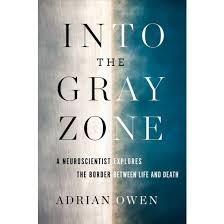
A Review of Adrian Owen’s “Into the Gray Zone: A Neuroscientist Explores the Border Between Life and Death”
Imagine that you could communicate with someone in a coma. What kinds of questions would you ask? Maybe you would ask if they had memory of their life before the tragedy, or if they were in pain. Maybe you would ask if you should keep playing that Celine Dion record they liked in high-school everyday (in the case of one young woman who awoke years later, the answer was a resounding no). The ability to get answers to such questions has long been considered science fiction, however, recent technological developments have made such communication possible.
In his book “Into the Gray Zone: A Neuroscientist Explores the Border Between Life and Death” Adrian Owen uses breakthroughs in technology and science to investigate what it’s like to be caught up in that twilight zone of conscious awareness often referred to as a vegetative-state. Using fMRI, PET, and other scanning techniques, Dr. Owen studies the neurological responses of patients from outside stimulation. The task isn’t as easy as it sounds. The brain is hard wired to automatically respond to some forms of stimulation (hearing someone cry out your name for example). To demonstrate that someone is consciously aware, not just having a knee-jerk reaction, Dr. Owen and his team had to develop tests that show the patient is actively responding in the study.
For example, the brain activity displayed while watching a movie tends to be uniform across all healthy, fully conscious brains. Exploiting this phenomenon, Dr. Owen’s patients are shown an Alfred Hitchcock film (the 1961 classic “Bang! You’re Dead) while their brain activity is monitored. The results are then compared with those of healthy individuals. A close match indicates that the patient was following the movie and was therefore aware or conscious. The results from these experiments show that such people are often far more aware than previously realized.
Although we don’t have precise numbers, it is estimated that there are somewhere between fifteen thousand and forty thousand individuals in the United States who are in a vegetative-state. Of these, Dr. Owen believes that “… 15 to 20 percent of people in the vegetative state who are assumed to have no more awareness than a head of broccoli are fully conscious, although they never respond to any form of external stimulation.” This is astounding, and should make us all feel a little uneasy.
Dr. Owen goes a step further than just establishing conscious awareness. In some patients, he was even able to produce yes/no answers. This result has implications going beyond just asking if they want the Celine Dion album turned off. For example, Jean-Dominique Bauby, an editor, was paralyzed with only the use of his left eye. Using a series of two hundred thousand blinks, he was able to write an entire book, “The Driving Bell and the Butterfly”. While such an endeavor is not currently feasible for individuals in a vegetative state, it’s not impossible that new tech would make such communication possible.
Dr. Owen also addresses the issue of quality of life. He mentions a study conducted by Steven Laurey, wherein patients with locked-in syndrome “…(conscious people who were only able to communicate by blinking or vertically moving their eyes.” were asked questions to evaluate their quality of life based on a scale from -5 to 5. The results were interesting:
“Contrary to what most of us might expect, a significant proportion of the patients (72 percent of those who responded) reported that they were happy. What’s more, a longer time in a locked-in syndrome was correlated with how happy this group said they were! … Only 7 percent of the entire group surveyed by Laureys and his team expressed a wish for euthanasia.”
Dr. Owen is a scientific skeptic, and the book is not a defense of the Catholic position on euthanasia and end of life issues. The underlying philosophy of the book is materialistic. This is perhaps best exemplified by a quotation, used in the book, from Francis Crick the physicist/molecular biologist:
“You, your joys and your sorrows, your memories and your ambitions, your sense of personal identity and free will, are in fact no more than the behavior of a vast assembly of nerve cells and their associated molecules.”
Despite his skepticism, Owen isn’t hostile towards religion in the book, and for Catholics seeking equip themselves for debates on end-of-life issues “Into the Gray Zone” provides an excellent update on the scientific and technological aspects of the topic. Despite the technical nature of the material, the book is readable, thought provoking, and even at times humorous. The reader is struck by how suddenly a person can be thrown into the vegetative state, with many of the case studies being young people in their teens and early twenties who had little or no warning of the accidents that put them there. Inform yourself on the ethics, philosophy, and science of the “gray zone” because as the saying goes, “The life you save may be your own.”
Into the Gray Zone: A Neuroscientist Explores the Border Between Life and Death
Adrian Owen
Scribner | 320 pages | ISBN 9781501135200 | June 2017
$34.99 (Canadian dollars)

Remembering Father Alphonse de Valk
(Today marks the sixth anniversary of the death of Father Alphonse de Valk, C.S.B., a faithful, courageous and indefatigable Basilian priest, pro-life-and-family apostle, and the founder of Catholic Insight magazine. Here is what we wrote those on his entering into eternity five years ago, as we continue to remember him in our prayers and thoughts)[…]Continue reading→

Divine Mercy Sunday – An Echo of Every Mass
Reach out your hand and put it in my side. Do not doubt but believe’… ‘My Lord and my God!’ (Jn. 20:18)). Today is Divine Mercy Sunday, and as we celebrate the end of the Easter Octave, we contemplate the wounded side of our Saviour, the Church’s source of life. On Good Friday in the[…]Continue reading→

Saint Stanislaus of Szczepanów
We celebrate Saint Stanislaus today (+ April 11, 1079), in light of this Easter Octave, a bishop and martyr who accepted the episcopacy only at the direct order of Pope Alexander II. He proved a wise and courageous leader of his flock, put to death by his own king, Boleslaus, for rebuking the monarch’s ‘immoral[…]Continue reading→
First Holy Communion: Sermon from May 16, 1943
Here is a sermon from the good old days by +Rev. Msgr. Vincent Nicholas Foy (August 14, 1915 – March 13, 2017), from 1943. Readers may recall that Pope Saint Pius X, by the decree Quam Singulari in 1910, lowered the customary age of reception of Holy Communion – after the rigours of the plague[…]Continue reading→
In the Glorious Light of Easter, Alleluia!
Set your minds on things that are above, not on things that are on earth, for you have died, and your life is hidden with Christ in God. When Christ who is your life is revealed, then you also will be revealed with him in glory (Col. 3:3-4). The Resurrection of Our Lord and Saviour[…]Continue reading→
An Ancient Homily for Holy Saturday
The time between Good Friday and Easter Sunday is one of waiting, in silence, as the world wonders – anticipates – what will happen, after the death of Christ. We re-live this time each year in the anamnesis of our liturgy, and in turn look forward to the glorious re-creation of all things at the[…]Continue reading→
Europe’s Long Descent
(As we meditate on this day on Christ’s burial, and His descent into hell, it is fitting to ponder here with contributor Peter Marcus how the world seems to be heading there as well. The difference is that, although God cannot ‘redeem’ hell, nor those therein, He can and did redeem the world. There is[…]Continue reading→
Pope Saint John Paul II’s First Good Friday Homily
ADDRESS OF HIS HOLINESS JOHN PAUL II AT THE CONCLUSION OF THE STATIONS OF THE CROSS AT THE COLOSSEUM Good Friday, 13 April 1979 When we make the Way of the Cross from one station to the next, in spirit we are always at the spot wherethis journey had its “historical” place: where it[…]Continue reading→
A Meditation for Good Friday: How To Undo the Effects of Sin?
Cardinal Newman, now Saint John Henry Newman, was a towering figure of nineteenth-century Catholicism who is almost universally admired. I say “almost” because not everyone likes him. I knew a priest once, Arthur Caulkins, who has become disenchanted with Newman. As an undergraduate Arthur had been enamoured of Newman, and this interest continued when he[…]Continue reading→
Pope Benedict’s Last Holy Thursday Homily
MASS OF THE LORD’S SUPPER HOMILY OF HIS HOLINESS BENEDICT XVI Basilica of St John Lateran Holy Thursday, 5 April 2012 Photo Gallery (Video) Dear Brothers and Sisters! Holy Thursday is not only the day of the institution of the Most Holy Eucharist, whose splendour bathes all else and in some ways draws it to[…]Continue reading→