
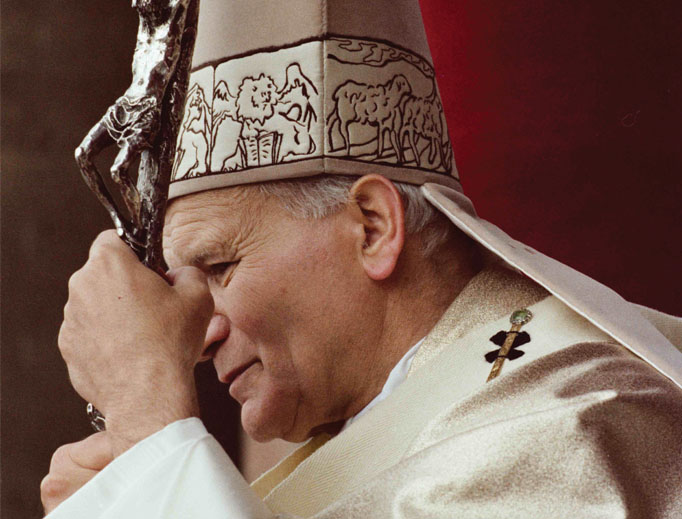
Message of John Paul II to the Bishop of Albano for the Centenary of the Death of St. Maria Goretti
To my Venerable Brother Bishop Agostino Vallini of Albano
1. A hundred years ago, on 6 July 1902, Maria Goretti died in the hospital at Nettuno, brutally stabbed the day before in the little village of Le Ferriere, in the Pontine Marshes. Her spiritual life, the strength of her faith, her ability to forgive her murderer have placed her among the best-loved saints of the 20th century. Appropriately, therefore, the Congregation of the Passion (C.P.), entrusted with the care of the shrine where the saint’s remains repose, wanted to celebrate the anniversary with special solemnity.
St Maria Goretti was a girl whom God’s Spirit endowed with the courage to stay faithful to her Christian vocation even to the point of making the supreme sacrifice of her life. Her tender age, her lack of education and the poverty of the environment in which she lived did not prevent grace from working its miracles in her. Indeed, it was precisely in these conditions that God’s special love for the lowly appeared. We are reminded of the words with which Jesus blesses the heavenly Father for revealing himself to children and the simple, rather than to the wise and learned of the world (cf. Mt 11,25).
It was rightly observed that St Maria Goretti’s martyrdom heralded what was to be known as the century of martyrs. It was in this perspective that at the end of the Great Jubilee of the Year 2000, I stressed that “this lively sense of repentance … has not prevented us from giving glory to the Lord for what he has done in every century, and in particular during the century which we have just left behind, by granting his Church a great host of saints and martyrs” (Novo Millennio ineunte, n. 7).
2. Maria Goretti, born in Corinaldo in The Marches on 16 October 1890, was soon obliged to emigrate with her family, and after sometime they arrived at Le Ferriere di Conca in the Pontine Marshes. Despite the hardships of poverty which even prevented her from going to school, little Maria lived in a serene and united family atmosphere, enlivened by Christian faith, in which the children felt welcomed as a gift and were taught by their parents self-respect and respect for others, as well as a sense of duty based on love of God. This enabled the little girl to grow up peacefully, nourishing her simple but deep faith. The Church has always recognized the role of the family as the first and fundamental place for the sanctification of its members, starting with the children.
In this family environment Maria assimilated steadfast trust in God’s provident love, which she showed in particular at the death of her father, who died of malaria. “Mother, be brave, God will help us”, the little girl was in the habit of saying in those difficult times, bravely reacting to her deep feeling of loss at her father’s death.
3. In the homily for her canonization, Pope Pius XII of venerable memory pointed to Maria Goretti as “the sweet little martyr of purity” (cf. Discorsi e Radiomessaggi, XII [1950-1951], 121), because she did not break God’s commandment in spite of being threatened by death.
What a shining example for young people! The non-commital mindset of much of our society and culture today sometimes has a struggle to understand the beauty and value of chastity. A high and noble perception of dignity, her own and that of others emerges from the behaviour of this young saint, was mirrored in her daily choices, giving them the fullness of human meaning. Is not there a very timely lesson in this? In a culture that idolizes the physical aspect of the relations between a man and a woman, the Church continues to defend and to champion the value of sexuality as a factor that involves every aspect of the person and must therefore be lived with an interior attitude of freedom and reciprocal respect, in the light of God’s original plan. With this outlook, a person discovers he or she is being given a gift and is called, in turn, to be a gift to the other.
To continue reading, please see here.

Saint Kateri , Canada’s Protectress
This was the title given to Saint Kateri Tekakwitha, by Pope Benedict XVI, when he canonized her on October 28th, 2012, along with six others, in Saint Peter’ Square (she had been beatified by Pope John Paul II back in 1980). With Saint Joseph as our protector, along with the Canadian martyrs, we seem to[…]Continue reading→

Remembering Father Alphonse de Valk
(Today marks the sixth anniversary of the death of Father Alphonse de Valk, C.S.B., a faithful, courageous and indefatigable Basilian priest, pro-life-and-family apostle, and the founder of Catholic Insight magazine. Here is what we wrote those on his entering into eternity five years ago, as we continue to remember him in our prayers and thoughts)[…]Continue reading→

My Name is Bernadette
April 16th is a propitious day, for besides the anniversary of Father de Valk’s death, who founded Catholic Insight in its print form decades ago, and the commemoration of the ‘two Benedicts’, mentioned in accompanying posts, today we also recall Saint Bernadette Soubirous, the young visionary to whom the Virgin Mary appeared numerous times at[…]Continue reading→
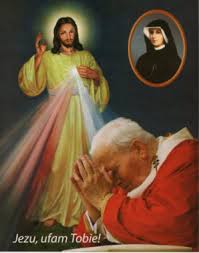
Canonizing Sister Faustina and Divine Mercy
HOMILY OF THE HOLY FATHER MASS IN ST PETER’S SQUARE FOR THE CANONIZATION OF SR MARY FAUSTINA KOWALSKA Sunday, 30 April 2000 1. “Confitemini Domino quoniam bonus, quoniam in saeculum misericordia eius”; “Give thanks to the Lord for he is good; his steadfast love endures for ever” (Ps 118: 1). So the Church sings on the Octave of[…]Continue reading→

Divine Mercy Sunday – An Echo of Every Mass
Reach out your hand and put it in my side. Do not doubt but believe’… ‘My Lord and my God!’ (Jn. 20:18)). Today is Divine Mercy Sunday, and as we celebrate the end of the Easter Octave, we contemplate the wounded side of our Saviour, the Church’s source of life. On Good Friday in the[…]Continue reading→

Saint Stanislaus of Szczepanów
We celebrate Saint Stanislaus today (+ April 11, 1079), in light of this Easter Octave, a bishop and martyr who accepted the episcopacy only at the direct order of Pope Alexander II. He proved a wise and courageous leader of his flock, put to death by his own king, Boleslaus, for rebuking the monarch’s ‘immoral[…]Continue reading→
First Holy Communion: Sermon from May 16, 1943
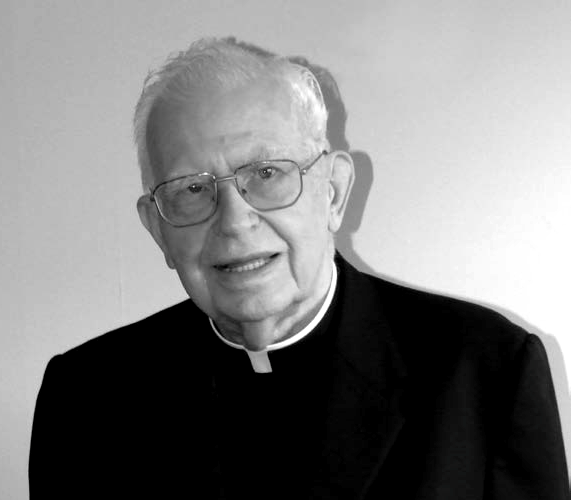
Here is a sermon from the good old days by +Rev. Msgr. Vincent Nicholas Foy (August 14, 1915 – March 13, 2017), from 1943. Readers may recall that Pope Saint Pius X, by the decree Quam Singulari in 1910, lowered the customary age of reception of Holy Communion – after the rigours of the plague[…]Continue reading→
In the Glorious Light of Easter, Alleluia!
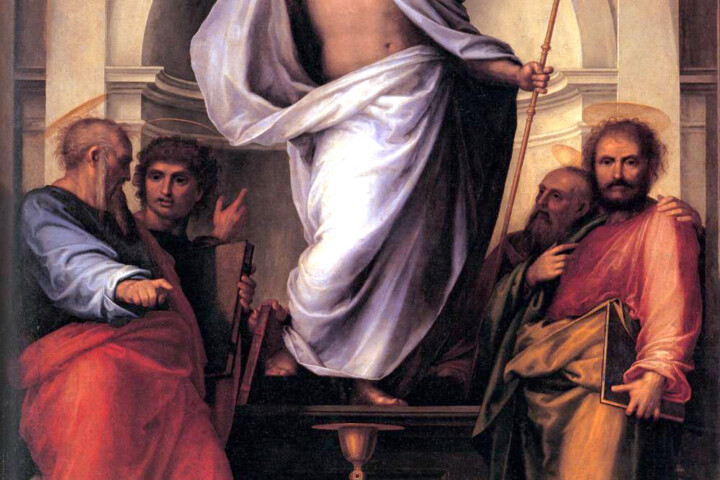
Set your minds on things that are above, not on things that are on earth, for you have died, and your life is hidden with Christ in God. When Christ who is your life is revealed, then you also will be revealed with him in glory (Col. 3:3-4). The Resurrection of Our Lord and Saviour[…]Continue reading→

An Ancient Homily for Holy Saturday
The time between Good Friday and Easter Sunday is one of waiting, in silence, as the world wonders – anticipates – what will happen, after the death of Christ. We re-live this time each year in the anamnesis of our liturgy, and in turn look forward to the glorious re-creation of all things at the[…]Continue reading→
Europe’s Long Descent
(As we meditate on this day on Christ’s burial, and His descent into hell, it is fitting to ponder here with contributor Peter Marcus how the world seems to be heading there as well. The difference is that, although God cannot ‘redeem’ hell, nor those therein, He can and did redeem the world. There is[…]Continue reading→