
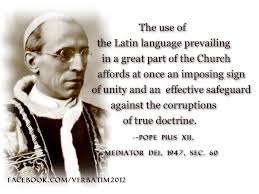
Why Children (and Adults!) Should Learn Latin
Whenever the census in Canada rolls round, I suspect that I am one of the few people who, in the box where one reports languages spoken in the home, must honestly write Latin. Since the birth of my first of four sons seven years ago, I have spoken almost entirely in Latin to them. Why? Not because I am passing on a family tradition. I grew up speaking English.
I began learning Latin when I was seventeen. That year I entered a seminary, but Latin was not spoken there. Thinking I was going to a seminary where Latin would be taught excited me until I was told that reading and speaking it were two different things.
Having heard another call, I married the love of my life. When we were expecting our first child, I began to think seriously about my paternal duties—it is not enough to bring a child into this great world and then, like Alfred P. Doolittle, “leave ’er alone to enjoy it.” As we all know, a child must be given a loving education. One thing I learned in the seminary was an understanding of the historical life of the Church; that the Church has experienced periods of flourishing and years of decline. There have been recurrent dark periods, where Church morals and discipline sank to hellish levels—ours is not the first age of scandal. Frequently, the causes of these declines were the demise of Catholic education.
For example, after the Black Plague (1346–1353), which killed half of Christendom’s clergy, bishops were eager to get men back into the sanctuary. Priests were ordained—often without priestly training, or a solid grounding in Latin and Theology. Many of these priests had a lax attitude to a liturgy they could not understand, coupled with moral indifference.
The period preceding Vatican Council II shows some similarities in the decline of Latin and Theology. John Senior, in his The Restoration of Christian Culture, notes:
“To compensate for our [educational] failures, seminaries in the decades preceding Vatican II tabulated maxims based upon the Summa as texts for easily testable courses … In the great Catholic universities at Rome and elsewhere, the grand old Dominican and Jesuit masters went on lecturing in Latin to students, many from America, who had to get laugh-signals from the graduate assistants when the master cracked a joke because no one knew Latin well enough to tell a joke from a scholastic formula.”1
In light of history, it becomes obvious that poor Latin equals poor theology, since the very words and texts of theology and even of prayer were Latin. But what about now, when seminary education is offered in vernacular languages? Current Canon Law stipulates (§249) that seminarians must know their Latin: “sed etiam linguam latinam bene calleant” (but they must understand Latin well). What does “well” mean? The Vatican II decree Optatam Totius explains:
13. Moreover [seminarians] are to acquire a knowledge of Latin which will enable them to understand and make use of the sources of so many sciences and of the documents of the Church. The study of the liturgical language proper to each rite should be considered necessary.
So why do I teach my children Latin? First, I want to equip them for a divine vocation, should God come a’knocking. Second, I want them to have the freedom, even as laymen, to approach 2000 years of Latin scholarship in Catholic thought, history, philosophy, theology, prayer, and mysticism with ease and delight. Ultimately I wish to arm them to follow Christ and thus lead the necessary restoration of Catholic Culture. John XXIII, in his Apostolic Constitution Veterum Sapientia, said:
10. … It is a matter of regret that so many people, unaccountably dazzled by the marvelous progress of science, are taking it upon themselves to oust or restrict the study of Latin and other kindred subjects…. Yet, in spite of the urgent need for science, our own view is that the very contrary policy should be followed. The greatest impression is made on the mind by those things which correspond more closely to man’s nature and dignity. And therefore the greatest zeal should be shown in the acquisition of whatever educates and ennobles the mind. Otherwise poor mortal creatures may well become like the machines they build—cold, hard, and devoid of love.
According to the thought of John XXIII, in teaching my children Latin I am teaching them a language of love.
1. Senior, John. The Restoration of Christian Culture. Norfolk, VA: IHS Press, 2008, p. 74.
Photo source.

Saint Kateri , Canada’s Protectress
This was the title given to Saint Kateri Tekakwitha, by Pope Benedict XVI, when he canonized her on October 28th, 2012, along with six others, in Saint Peter’ Square (she had been beatified by Pope John Paul II back in 1980). With Saint Joseph as our protector, along with the Canadian martyrs, we seem to[…]Continue reading→

Remembering Father Alphonse de Valk
(Today marks the sixth anniversary of the death of Father Alphonse de Valk, C.S.B., a faithful, courageous and indefatigable Basilian priest, pro-life-and-family apostle, and the founder of Catholic Insight magazine. Here is what we wrote those on his entering into eternity five years ago, as we continue to remember him in our prayers and thoughts)[…]Continue reading→

My Name is Bernadette
April 16th is a propitious day, for besides the anniversary of Father de Valk’s death, who founded Catholic Insight in its print form decades ago, and the commemoration of the ‘two Benedicts’, mentioned in accompanying posts, today we also recall Saint Bernadette Soubirous, the young visionary to whom the Virgin Mary appeared numerous times at[…]Continue reading→

Canonizing Sister Faustina and Divine Mercy
HOMILY OF THE HOLY FATHER MASS IN ST PETER’S SQUARE FOR THE CANONIZATION OF SR MARY FAUSTINA KOWALSKA Sunday, 30 April 2000 1. “Confitemini Domino quoniam bonus, quoniam in saeculum misericordia eius”; “Give thanks to the Lord for he is good; his steadfast love endures for ever” (Ps 118: 1). So the Church sings on the Octave of[…]Continue reading→

Divine Mercy Sunday – An Echo of Every Mass
Reach out your hand and put it in my side. Do not doubt but believe’… ‘My Lord and my God!’ (Jn. 20:18)). Today is Divine Mercy Sunday, and as we celebrate the end of the Easter Octave, we contemplate the wounded side of our Saviour, the Church’s source of life. On Good Friday in the[…]Continue reading→

Saint Stanislaus of Szczepanów
We celebrate Saint Stanislaus today (+ April 11, 1079), in light of this Easter Octave, a bishop and martyr who accepted the episcopacy only at the direct order of Pope Alexander II. He proved a wise and courageous leader of his flock, put to death by his own king, Boleslaus, for rebuking the monarch’s ‘immoral[…]Continue reading→

First Holy Communion: Sermon from May 16, 1943
Here is a sermon from the good old days by +Rev. Msgr. Vincent Nicholas Foy (August 14, 1915 – March 13, 2017), from 1943. Readers may recall that Pope Saint Pius X, by the decree Quam Singulari in 1910, lowered the customary age of reception of Holy Communion – after the rigours of the plague[…]Continue reading→

In the Glorious Light of Easter, Alleluia!
Set your minds on things that are above, not on things that are on earth, for you have died, and your life is hidden with Christ in God. When Christ who is your life is revealed, then you also will be revealed with him in glory (Col. 3:3-4). The Resurrection of Our Lord and Saviour[…]Continue reading→

An Ancient Homily for Holy Saturday
The time between Good Friday and Easter Sunday is one of waiting, in silence, as the world wonders – anticipates – what will happen, after the death of Christ. We re-live this time each year in the anamnesis of our liturgy, and in turn look forward to the glorious re-creation of all things at the[…]Continue reading→

Europe’s Long Descent
(As we meditate on this day on Christ’s burial, and His descent into hell, it is fitting to ponder here with contributor Peter Marcus how the world seems to be heading there as well. The difference is that, although God cannot ‘redeem’ hell, nor those therein, He can and did redeem the world. There is[…]Continue reading→