
Are the Poor Blessed? L’Arche, Part II
Jesus lifted up his eyes on his disciples and said,
“Blessed are you poor, for yours is the kingdom of God.
Blessed are you that hunger now, for you shall be satisfied.
Blessed are you that weep now, for you shall laugh.
Blessed are you when men hate you, when they exclude you and revile you, and cast out your name as evil, on account of the Son of Man,
Rejoice in that day and leap for joy, for behold, your reward is great in heaven.”
Luke 6
I am not a year passes without Christians reading or hearing these words of Jesus. You will remember that Matthew records them slightly differently—for instance, he writes, “Blessed are the poor in spirit”—but in both cases the blessedness seems to reside in the fact that God’s Kingdom is not the possession of the poor. Many books have been written and many sermons have been preached on the meaning of those words of Jesus. I find Luke’s version the more uncomfortable, and so I—and perhaps you too—prefer Matthew because it seems much easier to be poor in spirit than to be poor in fact.
What is blessed about actually being poor? All of us have seen people in Ethiopia, in the Sudan, and in other countries who are literally dying of hunger as we watch them on television. We would feel as though we were blaspheming if, as we saw those children dying say, “Those people are blessed.” Nevertheless, if you know where your next meal is coming from it is fairly easy to talk about poverty, quite easy to philosophize about it as I am doing, wondering if you are poor, or poor enough, or whatever. But if you don’t know where your next meal is coming from you don’t speculate about poverty. You expend all your time and energy searching for food for yourself and for those you love. People like that don’t write books or give talks about poverty.
Somewhere I read the words written by a poor woman in Central America, in which she recorded the daily happenings in her village in the mountain. She wrote something like this: “The priest came on Sunday to celebrate Mass. He told us that God loves the poor, that he loves us with a very special love, that he is with us in a way that he is not present with those who are not poor. Right after Mass, the priest left. I wonder why he spent so little time with us if God is so close to us.” I think that is a very good question, and all of us, I suspect, could give many reasons why we prefer not to spend time with the poor. Let us look a little more closely at this poverty we are talking about. All the misery which material poverty brings—hunger, cold, disease, insecurity, anger, violence, fear—all these things are related to not having what a human being needs in order to live with dignity. Then there are all the other forms of poverty such as sickness, physical disability, mental illness, mental handicap, and old age. What is blessed about being unable to hear, to see, to understand what is going on, to be unable to walk, to be dependent? If, in asking these questions, we look again at the Gospel we find two clues that help us to interpret what this is about.
Both Luke and Matthew record that Jesus said these radical words immediately after a time when people had been crowding around him, seeking him out, following him, asking him to heal them; and both Luke and Matthew record that he did heal them. The search for healing by these poor people was in some way intrinsic to their blessedness because they recognized, however tentatively, that they were in need of healing. Maybe it was partly in that that their blessedness lay.
The other clue, it seems, is the way Luke records the circumstances. As a prelude to the first words, “Blessed are you poor,” Luke writes, “And all the crowd sought to touch him, for power came forth from him and healed them all.” Then in the next verse we read, “And he lifted up his eyes on his disciples, and said, ‘Blessed are you poor. . . .’” Perhaps Jesus addressed these radical things only to his close disciples and not to the whole crowd. Maybe he was looking his disciples in the eye, saying, “You are following me. You are my disciples, and blessed are you indeed because you are poor, you are hungry, you weep, men will hate you and will exclude you just because you are my disciples.” I’m not sure, but these could be two clues about the blessedness of poverty. Maybe it lies in knowing your need and asking for help; maybe it lies in trying to follow Jesus. It is as though Jesus was saying, “Get your expectations right. You seem to want to follow me. Well, this is what it involves.”
Having mentioned healing, I need to be clear in my own mind what I mean by it, for it is a word that bears many meanings. What I mean by healing has something to do with knowing that I need to change. I meet many disabled and very sick people. What sort of healing do I see in them? I see a healing of the heart that has nothing to do with the healing of a diseased body or a malfunctioning brain. Healing of the heart has a lot to do both with accepting what does not and cannot change as well as with changing what can. It has a lot to do with peace and rest and trust and hope. This is the prayer familiar to us from Alcoholics Anonymous: Lord, help me to change those things I can, to accept those things I can’t change, and to know the difference.
People who suffer from alcoholism are poor. When they recognize their disability and seek help and healing, they become blessed. They come together to share their poverty, to sustain each other, and to pray for help. But, like the priest the poor woman wrote about, we are reluctant to spend time with people who are poor—poor because they don’t know where their next meal is coming from or because they can’t control their craving for alcohol or drugs or because they can’t see or because they are mentally ill or mentally handicapped or because they have some severe physical disability. We say that they distress us, and often they do, of course; we feel helpless because we can’t do anything.
In Saint Christopher’s Hospice we often have visitors who come to observe how we work with severely ill and dying patients and with their families. Once a social worker was with us over an extended period. She spent time with one family in particular and afterwards she described her feeling of utter helplessness in her desire to say something to this bereaved family who had just lost a husband and a father. She felt she had to say or do something. I remember a psychiatrist saying to her: “Thank you for sharing your helplessness with us, because what you are saying is really very important. You see, that family wanted only one thing when you were with them. They wanted the person who died not to have died, and there was absolutely nothing that you could do about that. Any gestures, particularly any words that you would have said, would have been meaningless. You could not do the one thing that family wanted, so what you did was to actually share your helplessness with them by staying with them.”
Now if that is true—and I believe profoundly that it is—blessedness is not merely various forms of poverty. It is a matter of sharing our helplessness, of recognizing our own poverty. Once we become vulnerable we are in some way disabled too. We become closer to our companions and, like the social worker, our poverty meets the poverty of the others, and then a healing process begins because it is a meeting of equals. Those who are poor in any way really challenge us to use the whole of ourselves.
There is another challenge in being close to people who are poor, the challenge of accepting their capacity to heal us rather than think we are whole. People who are disabled in one way have a great power to heal in another. They can give us the assurance—such has been my experience, at least—that we can be human, we can be ourselves, we can be unique, we can be a child of God, a bringer of gifts even if our minds, bodies, and emotions aren’t working too well. And this is what we are often most frightened of because we ask ourselves, “Can I still be human, be loved, be myself if I recognize all the weaknesses, all the handicaps that are in me?”
But maybe the greatest blessing of all, the way in which the poor are really blessed, is merely by being part of God’s Kingdom. Jesus seems to have said very clearly, “Blessed are you poor, for yours is the Kingdom of God.” He said “yours.” That is a mystery. What it seems to mean is that as you live your poverty, whether as material poverty or sickness or vulnerability, you are in God’s Kingdom, you are where he is. You are part of the horror and also, at the same time, part of the blessedness of the cross, of God’s Kingdom come to earth. No wonder God loves the poor. They are part of that huge mystery of love and suffering which God met when he became man.
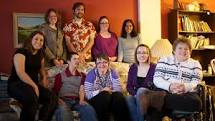
Doctor Thérèse Vanier, who died in 2014 at the age of ninety-one, was a member of one of Canada’s most distinguished families. Her father, Georges Vanier, served with distinction in the Foreign Service around the world. In 1959 he was appointed Governor General of Canada. Doctor Vanier, the eldest of five children, was educated mainly in England. She qualified in medicine at Cambridge University specializing in pediatrics and haematology. In 1972 she left the more conventional forms of medical practice in order to work with L’Arche, a project started by her brother Jean in 1964 to provide homes and workshops for mentally handicapped people. She founded the first L’Arche community in the United Kingdom near Canterbury. Later she founded another in London. She had also worked at Saint Christopher’s Hospice, which provides care and treatment for terminally ill persons. Toronto has had a L’Arche home—“Daybreak”—since 1969, located in Richmond Hill. It was there that Henri Nouwen lived in retirement until his death in 1996. –

Saint Kateri , Canada’s Protectress
This was the title given to Saint Kateri Tekakwitha, by Pope Benedict XVI, when he canonized her on October 28th, 2012, along with six others, in Saint Peter’ Square (she had been beatified by Pope John Paul II back in 1980). With Saint Joseph as our protector, along with the Canadian martyrs, we seem to[…]Continue reading→

Remembering Father Alphonse de Valk
(Today marks the sixth anniversary of the death of Father Alphonse de Valk, C.S.B., a faithful, courageous and indefatigable Basilian priest, pro-life-and-family apostle, and the founder of Catholic Insight magazine. Here is what we wrote those on his entering into eternity five years ago, as we continue to remember him in our prayers and thoughts)[…]Continue reading→

My Name is Bernadette
April 16th is a propitious day, for besides the anniversary of Father de Valk’s death, who founded Catholic Insight in its print form decades ago, and the commemoration of the ‘two Benedicts’, mentioned in accompanying posts, today we also recall Saint Bernadette Soubirous, the young visionary to whom the Virgin Mary appeared numerous times at[…]Continue reading→

Canonizing Sister Faustina and Divine Mercy
HOMILY OF THE HOLY FATHER MASS IN ST PETER’S SQUARE FOR THE CANONIZATION OF SR MARY FAUSTINA KOWALSKA Sunday, 30 April 2000 1. “Confitemini Domino quoniam bonus, quoniam in saeculum misericordia eius”; “Give thanks to the Lord for he is good; his steadfast love endures for ever” (Ps 118: 1). So the Church sings on the Octave of[…]Continue reading→

Divine Mercy Sunday – An Echo of Every Mass
Reach out your hand and put it in my side. Do not doubt but believe’… ‘My Lord and my God!’ (Jn. 20:18)). Today is Divine Mercy Sunday, and as we celebrate the end of the Easter Octave, we contemplate the wounded side of our Saviour, the Church’s source of life. On Good Friday in the[…]Continue reading→

Saint Stanislaus of Szczepanów
We celebrate Saint Stanislaus today (+ April 11, 1079), in light of this Easter Octave, a bishop and martyr who accepted the episcopacy only at the direct order of Pope Alexander II. He proved a wise and courageous leader of his flock, put to death by his own king, Boleslaus, for rebuking the monarch’s ‘immoral[…]Continue reading→

First Holy Communion: Sermon from May 16, 1943
Here is a sermon from the good old days by +Rev. Msgr. Vincent Nicholas Foy (August 14, 1915 – March 13, 2017), from 1943. Readers may recall that Pope Saint Pius X, by the decree Quam Singulari in 1910, lowered the customary age of reception of Holy Communion – after the rigours of the plague[…]Continue reading→

In the Glorious Light of Easter, Alleluia!
Set your minds on things that are above, not on things that are on earth, for you have died, and your life is hidden with Christ in God. When Christ who is your life is revealed, then you also will be revealed with him in glory (Col. 3:3-4). The Resurrection of Our Lord and Saviour[…]Continue reading→

An Ancient Homily for Holy Saturday
The time between Good Friday and Easter Sunday is one of waiting, in silence, as the world wonders – anticipates – what will happen, after the death of Christ. We re-live this time each year in the anamnesis of our liturgy, and in turn look forward to the glorious re-creation of all things at the[…]Continue reading→

Europe’s Long Descent
(As we meditate on this day on Christ’s burial, and His descent into hell, it is fitting to ponder here with contributor Peter Marcus how the world seems to be heading there as well. The difference is that, although God cannot ‘redeem’ hell, nor those therein, He can and did redeem the world. There is[…]Continue reading→