
4th. Sunday of Easter: Vicariousness
I am the Good Shepherd. The Good Shepherd lays down His life for the sheep (Jn. 10:11).
Today is Good Shepherd Sunday and as we continue to celebrate the Feast of Easter, we contemplate the figure of Jesus, the Good Shepherd “who has risen and who laid down his life for his sheep and willingly died for his flock” (Communion Antiphon Fourth Sunday of Easter, The Roman Missal). The Gospel reading of the Mass today emphasises the absolute freedom with which Our Lord brought about our redemption through His sacrificial death on the Cross. “For this reason the Father loves me, because I lay down my life in order to take it up again. No one takes it from me, but I lay it down of my own accord. I have power to lay it down, and I have power to take it up again.” (Jn. 10:18). Last Sunday in our meditation we noted that the sacrificial death of our Lord “is an event that bears within itself a ‘logos’, a logic” (Pope Benedict XVI); and, that this atoning sacrifice, because it was offered in complete freedom, is the source of reconciliation for all of humanity. As we endeavour to enter more fully into the power and significance of this mystery, today we will consider this truth in light of the reality of vicariousness; the reality upon which the entire mystery of Christ is founded. As the word itself indicates, vicariousness refers to an action performed or suffered by one person as a substitute for another or to the benefit of advantage of another.
The author of the Epistle to the Hebrews explains: “We do indeed see Jesus, who for a little while was made lower than the Angels, now crowned with glory and honour because of the suffering and death, so that by the grace of God he might taste death for everyone” (Heb. 2:9). St. Paul further explains how this mystery is at work in us: “For the love of Christ controls us, because we are convinced that one has died for all; therefore all have died. And he died for all, that those who live might live no longer for themselves but for him who for their sake died and was raised”. (2 Cor. 5:14-15). While this reality of vicariousness is at the heart of the Christian Mystery, it is no less evident in life itself. We share one another’s lives and in many ways, we share in and enjoy one another’s victories and achievements. In a most intimate manner this is true of authentic family life and friendship. The nature of these relationships is such that whatever we do is done also for the sake of others. Life is authentically human when it is relational. This is no less true of the supernatural life of grace; of the communion of grace that we share with the saints and especially with our Lady. When our lives are lived in a manner that is authentically Christian this reality manifests itself in a sacrificial life, a life sanctified by sacrifice.
The image of our Lord as the Good Shepherd is the most common of the symbolic representations found in early Christian art. This is significant for it witnesses to the fundamental teaching of the Christian faith; that is, the divinity of Christ. He is God Incarnate. In speaking of Himself as the Good Shepherd, our Lord is identifying Himself with the Divine Shepherd spoken of in the twenty-third Psalm, a psalm that is often chanted at funeral Masses and many pray each day. “The Lord is my Shepherd; there is nothing that I want….” In salvation history the Divine Shepherd exercised his rule through earthly shepherds like Joshua and David but in the last days, the Prophet Ezekiel prophesied that the Lord Himself would shepherd His people. “For thus says the Lord GOD: Behold, I, I myself will search for my sheep and I will seek them out… I will seek the lost, and I will bring back the strayed, and I will bind up the crippled, and I will strengthen the weak” (Ez. 34: 11-16).
On this Good Shepherd Sunday the sacred liturgy invites us to enter into this particular mystery of revelation. We are invited to proceed from the visible to the invisible; from the sign to the thing signified, from the sacraments to the mysteries (Catechism of the Catholic Church, 1075). This is mystagogy; and its aim is to lead us ever more deeply into the Mystery of Christ. Thus, Christ our Lord, the Bread of Life, the Lamb of Sacrifice, the Shepherd who lays down His life for us leads us into the Mystery of the Compassionate God whose Trinitarian life we are created to share. This form of liturgical catechesis rightly presupposes a commitment to prayer, personal prayer that is reflective, silent and meaningful. Because the ultimate Mystery is God Himself, we can easily understand why in the contemplation of this Mystery we are always beginners, always in need of initiation; and because we grow and change and our lives change, the reality of this Mystery must be brought to bear on the different stages of our lives.
Often, for all of us, much of what happens in life is not always immediately evident or clear. What matters then is that we learn to recognize God’s presence in our lives and to recognise the voice of the Good Shepherd. He is good because He cares for us and leads us. He is not only our Shepherd but also our way and our food for the journey for He has laid down His life for our salvation and His Body and Blood sustain us. It is important, indeed essential for us to learn to recognise the voice of the Good Shepherd not only in the prayer of the Mass but also in our personal prayer. This is how we come to know God and to know ourselves even if only in part.
In the heavenly liturgy as described in the Book of Revelation, a vision is given to us of “a great multitude which no man could number, from every nation, form all tribes and people and tongues, standing before the Throne and before the Lamb” (Rev. 7:9). Our sacred assembly before the Lamb of God on the altar here is a sign of this mystery of universal salvation. What we do in this sacred building; the praise of God, our prayers of intercession, the offering of the Atoning Sacrifice, our worship of the Lamb slain for our salvation – all prefigure in some way the heavenly liturgy where Christ our Lord makes intercession for the world’s salvation. So we imitate the Good Shepherd, our Saviour and endeavour to pattern our lives on the Mystery that we venerate and celebrate. Easter is the proclamation of the Kingdom of the Lamb that was sacrificed; whose death was freely suffered “that those who live might live no longer for themselves but for him who for their sake died and was raised”. (2 Cor. 5: 15). May the Eucharist that we receive with reverence and gratitude be for us a foretaste of the joys of heaven, “so that [this] humble flock may reach where the brave Shepherd has gone before” (Collect, Fourth Sunday of Easter, The Roman Missal).

Saint Kateri , Canada’s Protectress
This was the title given to Saint Kateri Tekakwitha, by Pope Benedict XVI, when he canonized her on October 28th, 2012, along with six others, in Saint Peter’ Square (she had been beatified by Pope John Paul II back in 1980). With Saint Joseph as our protector, along with the Canadian martyrs, we seem to[…]Continue reading→

Remembering Father Alphonse de Valk
(Today marks the sixth anniversary of the death of Father Alphonse de Valk, C.S.B., a faithful, courageous and indefatigable Basilian priest, pro-life-and-family apostle, and the founder of Catholic Insight magazine. Here is what we wrote those on his entering into eternity five years ago, as we continue to remember him in our prayers and thoughts)[…]Continue reading→

My Name is Bernadette
April 16th is a propitious day, for besides the anniversary of Father de Valk’s death, who founded Catholic Insight in its print form decades ago, and the commemoration of the ‘two Benedicts’, mentioned in accompanying posts, today we also recall Saint Bernadette Soubirous, the young visionary to whom the Virgin Mary appeared numerous times at[…]Continue reading→

Canonizing Sister Faustina and Divine Mercy
HOMILY OF THE HOLY FATHER MASS IN ST PETER’S SQUARE FOR THE CANONIZATION OF SR MARY FAUSTINA KOWALSKA Sunday, 30 April 2000 1. “Confitemini Domino quoniam bonus, quoniam in saeculum misericordia eius”; “Give thanks to the Lord for he is good; his steadfast love endures for ever” (Ps 118: 1). So the Church sings on the Octave of[…]Continue reading→

Divine Mercy Sunday – An Echo of Every Mass
Reach out your hand and put it in my side. Do not doubt but believe’… ‘My Lord and my God!’ (Jn. 20:18)). Today is Divine Mercy Sunday, and as we celebrate the end of the Easter Octave, we contemplate the wounded side of our Saviour, the Church’s source of life. On Good Friday in the[…]Continue reading→

First Holy Communion: Sermon from May 16, 1943
Here is a sermon from the good old days by +Rev. Msgr. Vincent Nicholas Foy (August 14, 1915 – March 13, 2017), from 1943. Readers may recall that Pope Saint Pius X, by the decree Quam Singulari in 1910, lowered the customary age of reception of Holy Communion – after the rigours of the plague[…]Continue reading→

In the Glorious Light of Easter, Alleluia!
Set your minds on things that are above, not on things that are on earth, for you have died, and your life is hidden with Christ in God. When Christ who is your life is revealed, then you also will be revealed with him in glory (Col. 3:3-4). The Resurrection of Our Lord and Saviour[…]Continue reading→

An Ancient Homily for Holy Saturday
The time between Good Friday and Easter Sunday is one of waiting, in silence, as the world wonders – anticipates – what will happen, after the death of Christ. We re-live this time each year in the anamnesis of our liturgy, and in turn look forward to the glorious re-creation of all things at the[…]Continue reading→

Europe’s Long Descent
(As we meditate on this day on Christ’s burial, and His descent into hell, it is fitting to ponder here with contributor Peter Marcus how the world seems to be heading there as well. The difference is that, although God cannot ‘redeem’ hell, nor those therein, He can and did redeem the world. There is[…]Continue reading→
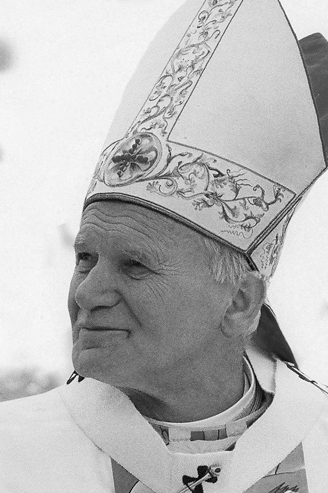
Pope Saint John Paul II’s First Good Friday Homily
ADDRESS OF HIS HOLINESS JOHN PAUL II AT THE CONCLUSION OF THE STATIONS OF THE CROSS AT THE COLOSSEUM Good Friday, 13 April 1979 When we make the Way of the Cross from one station to the next, in spirit we are always at the spot wherethis journey had its “historical” place: where it[…]Continue reading→